Showing posts with label hypergiant star. Show all posts

Friday, March 05, 2021

Hubble Solves Mystery of Monster Star's Dimming

This zoom into VY Canis Majoris is a combination of Hubble imaging and an artist's impression. The left panel is a multicolor Hubble image of the huge nebula of material cast off by the hypergiant star. This nebula is approximately a trillion miles across. The middle panel is a close-up Hubble view of the region around the star. This image reveals close-in knots, arcs, and filaments of material ejected from the star as it goes through its violent process of casting off material into space. VY Canis Majoris is not seen in this view, but the tiny red square marks the location of the hypergiant, and represents the diameter of the solar system out to the orbit of Neptune, which is 5.5 billion miles across. The final panel is an artist's impression of the hypergiant star with vast convection cells and undergoing violent ejections. VY Canis Majoris is so large that if it replaced the Sun, the star would extend for hundreds of millions of miles, to between the orbits of Jupiter and Saturn. Credit: NASA, ESA, and R. Humphreys (University of Minnesota), and J. Olmsted (STScI).  Releaaed Images

Last year, astronomers were puzzled when Betelguese, the bright red supergiant star in the constellation Orion, dramatically faded, but then recovered. The dimming lasted for weeks. Now, astronomers have turned their sights toward a monster star in the adjoining constellation Canis Major, the Great Dog.

The red hypergiant VY Canis Majoris—which is far larger, more massive, and more violent than Betelgeuse—experiences much longer, dimmer periods that last for years. New findings from NASA's Hubble Space Telescope suggest the same processes that occurred on Betelgeuse are happening in this hypergiant, but on a much grander scale.

"VY Canis Majoris is behaving a lot like Betelgeuse on steroids," explained the study's leader, astrophysicist Roberta Humphreys of the University of Minnesota, Minneapolis.

As with Betelgeuse, Hubble data suggest the answer for why this bigger star is dimming. For Betelgeuse, the dimming corresponded to a gaseous outflow that may have formed dust, which briefly obstructed some of Betelgeuse's light from our view, creating the dimming effect.

"In VY Canis Majoris we see something similar, but on a much larger scale. Massive ejections of material which correspond to its very deep fading, which is probably due to dust that temporarily blocks light from the star," said Humphreys.

The enormous red hypergiant is 300,000 times brighter than our Sun. If it replaced the Sun in our own solar system, the bloated monster would extend out for hundreds of millions of miles, between the orbits of Jupiter and Saturn.

"This star is absolutely amazing. It's one of the largest stars that we know of—a very evolved, red supergiant. It has had multiple, giant eruptions," explained Humphreys.

Giant arcs of plasma surround the star at distances from it that are thousands of times farther away than the Earth is from the Sun. These arcs look like the solar prominences from our own Sun, only on a much grander scale. Also, they're not physically connected to the star, but rather, appear to have been thrown out and are moving away. Some of the other structures close to the star are still relatively compact, looking like little knots and nebulous features.

In previous Hubble work, Humphreys and her team were able to determine when these large structures were ejected from the star. They found dates ranging over the past several hundred years, some as recently as the past 100 to 200 years.

Now, in new work with Hubble, researchers resolved features much closer to the star that may be less than a century old. By using Hubble to determine the velocities and motions of the close-in knots of hot gas and other features, Humphreys and her team were able to date these eruptions more accurately. What they found was remarkable: many of these knots link to multiple episodes in the 19th and 20th centuries when VY Canis Majoris faded to one-sixth its usual brightness.

Unlike Betelgeuse, VY Canis Majoris is now too faint to be seen by the naked eye. The star was once visible but has dimmed so much that it can now only be seen with telescopes.

The hypergiant sheds 100 times as much mass as Betelgeuse. The mass in some of the knots is more than twice the mass of Jupiter. "It's amazing the star can do it," Humphreys said. "The origin of these high mass-loss episodes in both VY Canis Majoris and Betelgeuse is probably caused by large-scale surface activity, large convective cells like on the Sun. But on VY Canis Majoris, the cells may be as large as the whole Sun or larger."

"This is probably more common in red supergiants than scientists thought and VY Canis Majoris is an extreme example," Humphreys continued. "It may even be the main mechanism that's driving the mass loss, which has always been a bit of a mystery for red supergiants."

Though other red supergiants are comparably bright and eject a lot of dust, none of them is as complex as VY Canis Majoris. "So what's special about it? VY Canis Majoris may be in a unique evolutionary state that separates it from the other stars. It's probably this active over a very short period, maybe only a few thousand years. We're not going to see many of those around," said Humphreys.

The star began life as a super-hot, brilliant, blue supergiant star perhaps as much as 35 to 40 times our Sun's mass. After a few million years, as the hydrogen fusion burning rate in its core changed, the star swelled up to a red supergiant. Humphreys suspects that the star may have briefly returned to a hotter state and then swelled back up to a red supergiant stage.

"Maybe what makes VY Canis Majoris so special, so extreme, with this very complex ejecta, might be that it's a second-stage red supergiant," explained Humphreys. VY Canis Majoris may have already shed half of its mass. Rather than exploding as a supernova, it might simply collapse directly to a black hole.

The team's findings appear in the February 4, 2021 edition of The Astronomical Journal.

The Hubble Space Telescope is a project of international cooperation between NASA and ESA (European Space Agency). NASA's Goddard Space Flight Center in Greenbelt, Maryland, manages the telescope. The Space Telescope Science Institute (STScI) in Baltimore, Maryland, conducts Hubble science operations. STScI is operated for NASA by the Association of Universities for Research in Astronomy, in Washington, D.C.

Contact

Media Contacts:
Ann Jenkins / Ray Villard
Space Telescope Science Institute, Baltimore, Maryland
410-338-4488 / 410-338-4514

jenkins@stsci.edu / villard@stsci.edu 

Science Contact:

Roberta Humphreys
University of Minnesota, Minneapolis, Minnesota

roberta@umn.edu

Related Links  


Source: HubbleSite/News


Wednesday, October 09, 2019

Astronomers show how supergiant stars repeatedly cool and heat up

The star HR 5271A is one of the four hyper-giants investigated. 
(c) A. Lobel/NASA/Spitzer Space Telescope/IRAC

An international team of professional and amateur astronomers, which includes Alex Lobel, astronomer at the Royal Observatory of Belgium, has determined in detail how the temperature of four yellow hypergiants increases from 4000 degrees to 8000 degrees and back again in a few decades. They publish their findings in the professional journal Astronomy & Astrophysics.

The researchers analysed the light of four yellow hypergiants that has been observed on Earth over the past fifty to one hundred years. Yellow hypergiants are huge, luminous stars. They are fifteen to twenty times heavier than the Sun and shine 500,000 times brighter. The atmospheres of these stars can be so huge that, if they replaced our Sun, they would stretch beyond the orbit of Jupiter.

Because the researchers had such a long series of measurements, they could see in detail how the stars get warmer over decades and cool down in a few years.

The cycle begins with a cool star. In a few decades, the average atmospheric temperature increases to about 8000 degrees. At 8000 degrees, however, the atmosphere becomes unstable due to amplified pulsations. At a certain moment the entire atmosphere erupts. As a result, it cools down quickly and a self-accelerating process occurs in which electrons attach themselves to hydrogen ions and a lot of ionisation energy is released. This cools the atmosphere even further. The cooling from 8000 degrees to 4000 degrees takes only two years.

Then the cycle starts again from the beginning, only with a slightly less massive star. Eventually, astronomers think, the hypergiant transforms into a hotter star and ends its life as a supernova.

During the research, astronomers also found out that one of the four studied hypergiants was not as large as previously assumed. The star, HR5171A, turns out to be much closer than expected.


Contact:
 

Alex Lobel
E-mail: alex.lobel@oma.be
Phone number : +32(0)23730348
See also:
http://alobel.freeshell.org/hr5171.html

Article:

A.M. van Genderen  et al. (2019), Pulsations, eruptions and evolution of four yellow hypergiants. Accepted for public ation in Astronomy & Astrophysics:https://doi.org/10.1051/0004-6361/201834358. Free preprint: http://arxiv.org/abs/1910.02460


Wednesday, December 26, 2012

A Hypergiant Star (Partially) Traversing the Yellow Evolutionary Void

After thirty years of investigation, a team of scientists from six European countries reports that the hypergiant star HR 8752 is partially traversing the Yellow Evolutionary Void, an area in the Hertzsprung-Russell diagram empty of hypergiant stars with surface temperatures between 5000 and 12000 degrees kelvin. 

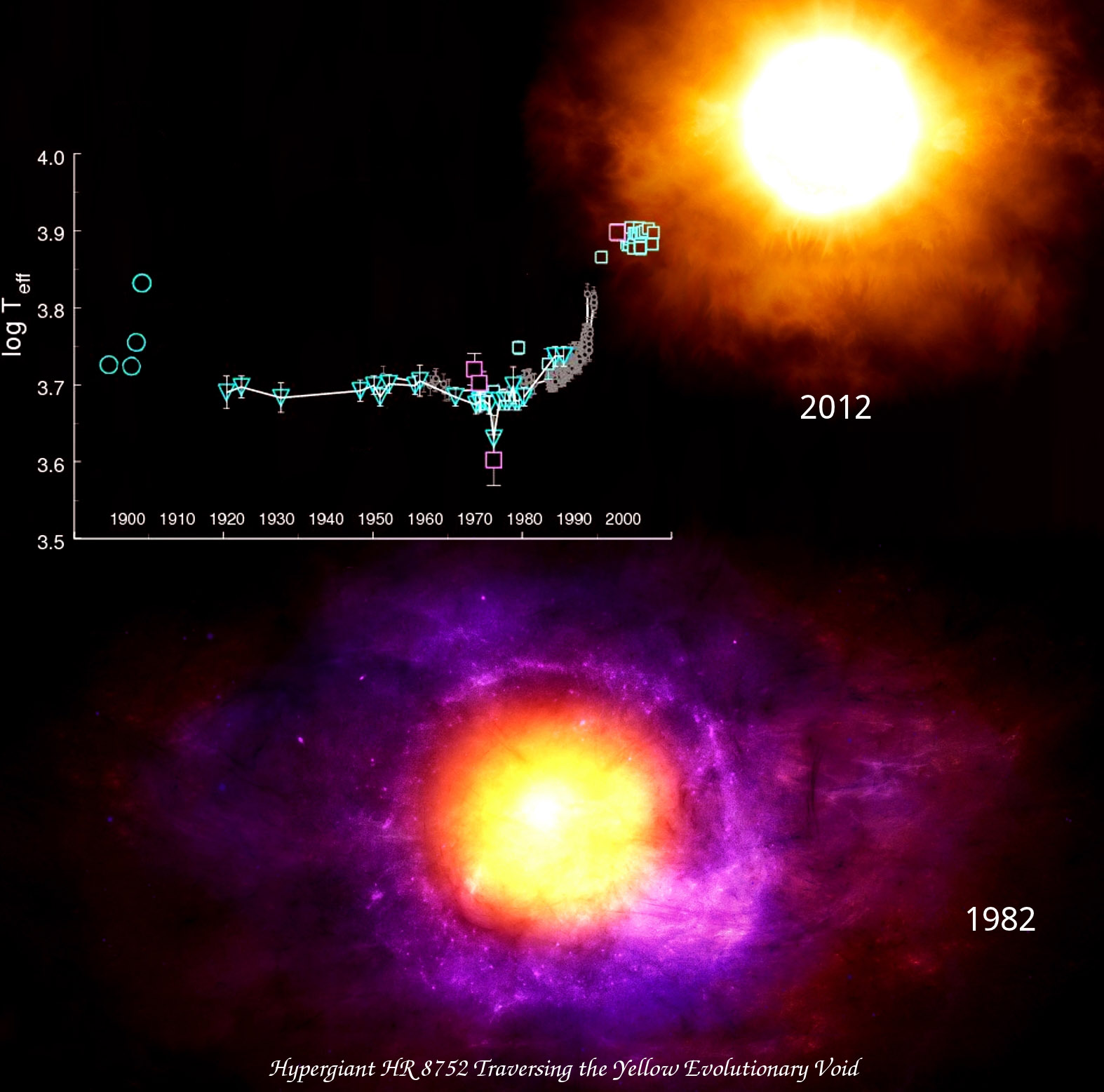
Some of the observations were carried out using the Utrecht Echelle Spectrograph (UES, now retired) on the William Herschel Telescope. They show that in the twenty years from 1985 to 2005, the star's surface temperature rose from 5000 to 8000 degrees, while undergoing a series of strong mass-loss events. During this time, the radius of HR 8752 shrank from 750 to 400 times that of the Sun. These observations indicate that HR 8752 is traversing (part of) the Yellow Evolutionary Void. 

The astronomers found that the atmospheres of hypergiants are unstable inside the Void because the outward forces in their atmospheres can match or even overcome the inward gravitational pull. The resulting instability of the atmospheres causes these enormous stars to lose huge amounts of mass, and consequently to traverse the Void on a relatively-short timescale. 

The team also discovered that the Void actually consists of two areas where the atmosphere of hypergiants becomes unstable, associated with the ionization of hydrogen and helium gas respectively. Between them, at around 8000 degrees, is a narrow stability strip where the atmospheres are more stable.

Artist's impression of the hypergiant HR 8752 traversing the Yellow Evolutionary Void. The graph shows the star's surface temperature (log Teff) as observed over the last 100 years. It increased from ~5000 to ~8000 degrees between 1985 and 2005, while the hypergiant's radius decreased from 750 to 400 times that of the Sun. Image credit: A. Lobel (ROB).  [ JPEG ]

While an analysis of earlier photometric observations of HR 8752 showed that, at least from ~1900 to ~1980, HR 8752 stayed at a nearly constant surface temperature of 5000 degrees, the team had some indications that around 1985 this remarkable star was fairly close to or even beyond the low-temperature boundary of the Void. Wondering what would happen, the scientists embarked on a long and systematic program of spectroscopic observations that lasted for three decades.

Hypergiants are currently the most luminous stars known in the Universe. The study reported here was of a particular hypergiant called HR 8752, which is about 250000 times as luminous as our Sun. It lies in the constellation of Cassiopeia, and can be seen through binoculars.

The science team mentioned in this news release consists of Dr. H. Nieuwenhuijzen (SRON Laboratory for Space Research, Netherlands), Dr. C. de Jager (NIOZ Royal Netherlands Institute for Sea Research, Netherlands), Dr. I. Kolka (Tartu Observatory, Estonia), Dr. G. Israelian (Instituto de Astrofisica de Canarias, Spain), Dr. A. Lobel (Royal Observatory of Belgium), Dr. E. Zsoldos (Konkoly Observatory, Hungary), Dr. A. Maeder (Observatoire de Geneve, Switzerland), and Dr. G. Meynet (Observatoire de Geneve, Switzerland).

More information:
 
H. Nieuwenhuijzen, C. De Jager, I. Kolka, G. Israelian, A. Lobel, E. Zsoldos, A. Maeder and G. Meynet, 2012, "The hypergiant HR 8752 evolving through the yellow evolutionary void", A&A, 546, A105, which is an Open Access paper (also available at http://www.cdejager.com/hypergiant-publications/).

YouTube video: http://www.youtube.com/watch?v=BOqsPJZoifo, by Orso Byanco.

Contact: Javier Méndez (Public Relations Officer)
Source: Isaac Newton Group of Telescopes