Showing posts with label flare star. Show all posts

Saturday, August 16, 2025

NuSTAR Observes A Flaring Star

An image of a coronal mass ejection from the Sun, taken by the Solar Dynamics Observatory in 2015. The star that NuSTAR observed, BD-08 6022, is a G-type star, making it very similar to our own Sun. Image credit: NASA/Goddard/SDO
. Download Image

During the past week, NuSTAR responded to a Director’s Discretionary Time request for a rapid follow-up of a bright stellar flare reported by the Einstein Probe Wide-field X-ray Telescope (EP-WXT) on August 2, 2025. Stellar flares are explosive releases of magnetic energy on active stars that heat plasma and accelerate particles, producing bright, rapidly evolving X-ray emission. A growing number of studies have found that some flares are accompanied by brief episodes of strong X-ray absorption, when cool, dense ejecta lifted from the low corona crosses the line of sight and temporarily boosts photoelectric opacity. Such ejecta can naturally arise if a coronal mass ejection (CME) is launched: clumpy prominences and filament material in the CME front and wake may partially cover the X-ray source, suppressing low-energy photons while higher-energy X-rays continue to escape, and producing sharp spectral hardening and energy-dependent dips. NuSTAR is ideal for probing transient X-ray absorption and searching for hard-X-ray signatures of CME-driven obscuration. By tracking spectral hardness and effective column density through the flare decay, the observations will constrain the geometry and dynamics of the absorber and evaluate the CME interpretation. Combined with EP discovery data and ongoing monitoring, this NuSTAR dataset is expected to place stringent hard-X-ray constraints on this event and provide a template for rapid characterization of similar nearby stellar flares.

Authors: Yifan Hu (Imperial College London, UK)


Friday, November 01, 2013

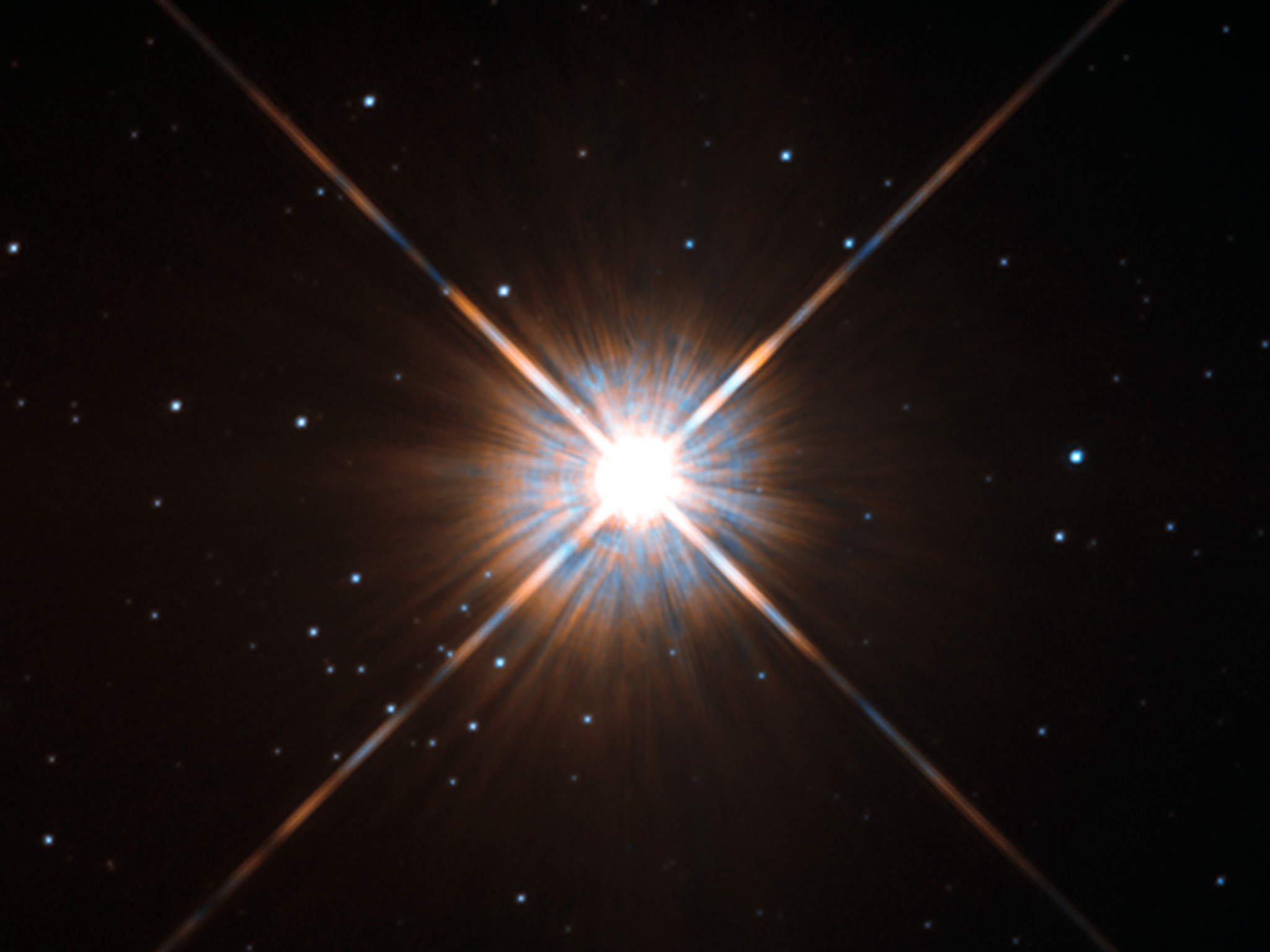
New shot of Proxima Centauri, our nearest neighbour

Credit: ESA/Hubble & NASA

Shining brightly in this Hubble image is our closest stellar neighbour: Proxima Centauri.

Proxima Centauri lies in the constellation of Centaurus (The Centaur), just over four light-years from Earth. Although it looks bright through the eye of Hubble, as you might expect from the nearest star to the Solar System, Proxima Centauri is not visible to the naked eye. Its average luminosity is very low, and it is quite small compared to other stars, at only about an eighth of the mass of the Sun. 

However, on occasion, its brightness increases. Proxima is what is known as a “flare star”, meaning that convection processes within the star’s body make it prone to random and dramatic changes in brightness. The convection processes not only trigger brilliant bursts of starlight but, combined with other factors, mean that Proxima Centauri is in for a very long life. Astronomers predict that this star will remain middle-aged — or a “main sequence” star in astronomical terms — for another four trillion years, some 300 times the age of the current Universe. 

These observations were taken using Hubble’s Wide Field and Planetary Camera 2 (WFPC2). Proxima Centauri is actually part of a triple star system — its two companions, Alpha Centauri A and B, lie out of frame. 

Although by cosmic standards it is a close neighbour, Proxima Centauri remains a point-like object even using Hubble’s eagle-eyed vision, hinting at the vast scale of the Universe around us.