


Videos

Astronomers have peered through the
atmosphere of a planet beyond the Solar System, mapping its 3D structure
for the first time. By combining all four telescope units of the
European Southern Observatory’s Very Large Telescope (ESO’s VLT), they
found powerful winds carrying chemical elements like iron and titanium,
creating intricate weather patterns across the planet’s atmosphere. The
discovery opens the door for detailed studies of the chemical makeup and
weather of other alien worlds.
“This planet’s atmosphere behaves in ways that challenge our understanding of how weather works — not just on Earth, but on all planets. It feels like something out of science fiction,” says Julia Victoria Seidel, a researcher at the European Southern Observatory (ESO) in Chile and lead author of the study, published today in Nature.
The planet, WASP-121b (also known as Tylos), is some 900 light-years away in the constellation Puppis. It’s an ultra-hot Jupiter, a gas giant orbiting its host star so closely that a year there lasts only about 30 Earth hours. Moreover, one side of the planet is scorching, as it is always facing the star, while the other side is much cooler.
The team has now probed deep inside Tylos’s atmosphere and revealed distinct winds in separate layers, forming a map of the atmosphere’s 3D structure. It’s the first time astronomers have been able to study the atmosphere of a planet outside our Solar System in such depth and detail.
“What we found was surprising: a jet stream rotates material around the planet’s equator, while a separate flow at lower levels of the atmosphere moves gas from the hot side to the cooler side. This kind of climate has never been seen before on any planet,” says Seidel, who is also a researcher at the Lagrange Laboratory, part of the Observatoire de la Côte d'Azur, in France. The observed jet stream spans half of the planet, gaining speed and violently churning the atmosphere high up in the sky as it crosses the hot side of Tylos. “Even the strongest hurricanes in the Solar System seem calm in comparison,” she adds.
To uncover the 3D structure of the exoplanet's atmosphere, the team used the ESPRESSO instrument on ESO’s VLT to combine the light of its four large telescope units into a single signal. This combined mode of the VLT collects four times as much light as an individual telescope unit, revealing fainter details. By observing the planet for one full transit in front of its host star, ESPRESSO was able to detect signatures of multiple chemical elements, probing different layers of the atmosphere as a result.
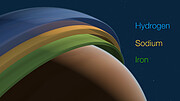
“The VLT enabled us to probe three different layers of the exoplanet’s atmosphere in one fell swoop,” says study co-author Leonardo A. dos Santos, an assistant astronomer at the Space Telescope Science Institute in Baltimore, United States. The team tracked the movements of iron, sodium and hydrogen, which allowed them to trace winds in the deep, mid and shallow layers of the planet’s atmosphere, respectively. “It’s the kind of observation that is very challenging to do with space telescopes, highlighting the importance of ground-based observations of exoplanets,” he adds.
Interestingly, the observations also revealed the presence of titanium just below the jet stream, as highlighted in a companion study published in Astronomy and Astrophysics. This was another surprise since previous observations of the planet had shown this element to be absent, possibly because it’s hidden deep in the atmosphere.
“It’s truly mind-blowing that we’re able to study details like the chemical makeup and weather patterns of a planet at such a vast distance,” says Bibiana Prinoth, a PhD student at Lund University, Sweden, and ESO, who led the companion study and is a co-author of the Nature paper.
To uncover the atmosphere of smaller, Earth-like planets, though, larger telescopes will be needed. They will include ESO’s Extremely Large Telescope (ELT), which is currently under construction in Chile’s Atacama Desert, and its ANDES instrument. “The ELT will be a game-changer for studying exoplanet atmospheres,” says Prinoth. “This experience makes me feel like we’re on the verge of uncovering incredible things we can only dream about now.”
“This planet’s atmosphere behaves in ways that challenge our understanding of how weather works — not just on Earth, but on all planets. It feels like something out of science fiction,” says Julia Victoria Seidel, a researcher at the European Southern Observatory (ESO) in Chile and lead author of the study, published today in Nature.
The planet, WASP-121b (also known as Tylos), is some 900 light-years away in the constellation Puppis. It’s an ultra-hot Jupiter, a gas giant orbiting its host star so closely that a year there lasts only about 30 Earth hours. Moreover, one side of the planet is scorching, as it is always facing the star, while the other side is much cooler.
The team has now probed deep inside Tylos’s atmosphere and revealed distinct winds in separate layers, forming a map of the atmosphere’s 3D structure. It’s the first time astronomers have been able to study the atmosphere of a planet outside our Solar System in such depth and detail.
“What we found was surprising: a jet stream rotates material around the planet’s equator, while a separate flow at lower levels of the atmosphere moves gas from the hot side to the cooler side. This kind of climate has never been seen before on any planet,” says Seidel, who is also a researcher at the Lagrange Laboratory, part of the Observatoire de la Côte d'Azur, in France. The observed jet stream spans half of the planet, gaining speed and violently churning the atmosphere high up in the sky as it crosses the hot side of Tylos. “Even the strongest hurricanes in the Solar System seem calm in comparison,” she adds.
To uncover the 3D structure of the exoplanet's atmosphere, the team used the ESPRESSO instrument on ESO’s VLT to combine the light of its four large telescope units into a single signal. This combined mode of the VLT collects four times as much light as an individual telescope unit, revealing fainter details. By observing the planet for one full transit in front of its host star, ESPRESSO was able to detect signatures of multiple chemical elements, probing different layers of the atmosphere as a result.
“The VLT enabled us to probe three different layers of the exoplanet’s atmosphere in one fell swoop,” says study co-author Leonardo A. dos Santos, an assistant astronomer at the Space Telescope Science Institute in Baltimore, United States. The team tracked the movements of iron, sodium and hydrogen, which allowed them to trace winds in the deep, mid and shallow layers of the planet’s atmosphere, respectively. “It’s the kind of observation that is very challenging to do with space telescopes, highlighting the importance of ground-based observations of exoplanets,” he adds.
Interestingly, the observations also revealed the presence of titanium just below the jet stream, as highlighted in a companion study published in Astronomy and Astrophysics. This was another surprise since previous observations of the planet had shown this element to be absent, possibly because it’s hidden deep in the atmosphere.
“It’s truly mind-blowing that we’re able to study details like the chemical makeup and weather patterns of a planet at such a vast distance,” says Bibiana Prinoth, a PhD student at Lund University, Sweden, and ESO, who led the companion study and is a co-author of the Nature paper.
To uncover the atmosphere of smaller, Earth-like planets, though, larger telescopes will be needed. They will include ESO’s Extremely Large Telescope (ELT), which is currently under construction in Chile’s Atacama Desert, and its ANDES instrument. “The ELT will be a game-changer for studying exoplanet atmospheres,” says Prinoth. “This experience makes me feel like we’re on the verge of uncovering incredible things we can only dream about now.”
Source: ESO/News
More information
This research was presented in a paper published in the journal Nature titled “Vertical structure of an exoplanet’s atmospheric jet stream” (doi:10.1038/s41586-025-08664-1).
The team is composed of: Julia V. Seidel (European Southern Observatory, Santiago, Chile [ESO Chile]; Laboratoire Lagrange, Observatoire de la Côte d’Azur, CNRS, Université Côte d’Azur, Nice, France [Lagrange]), Bibiana Prinoth (ESO Chile and Lund Observatory, Division of Astrophysics, Department of Physics, Lund University, Lund, Sweden [ULund]), Lorenzo Pino (INAF-Osservatorio Astrofisico di Arcetri, Florence, Italy), Leonardo A. dos Santos (Space Telescope Science Institute, Baltimore, USA, Johns Hopkins University, Baltimore, USA), Hritam Chakraborty (Observatoire de Genève, Département d’Astronomie, Université de Genève, Versoix, Switzerland [UNIGE]), Vivien Parmentier (Lagrange), Elyar Sedaghati (ESO Chile), Joost P. Wardenier (Département de Physique, Trottier Institute for Research on Exoplanets [IREx], Université de Montréal, Canada), Casper Farret Jentink (UNIGE), Maria Rosa Zapatero Osorio (Centro de Astrobiología, CSIC-INTA, Madrid, Spain), Romain Allart (IREx), David Ehrenreich (UNIGE), Monika Lendl (UNIGE), Giulia Roccetti (European Southern Observatory, Garching bei München, Germany; Meteorologisches Institut, Ludwig-Maximilians-Universität München, Munich, Germany), Yuri Damasceno (Instituto de Astrofísica e Ciências do Espaço, Universidade do Porto, Porto, Portugal [IA-CAUP], Departamento de Fisica e Astronomia, Faculdade de Ciências, Universidade do Porto, Porto, Portugal [FCUP]; ESO Chile), Vincent Bourrier (UNIGE), Jorge Lillo-Box (Centro de Astrobiología (CAB); CSIC-INTA, Madrid, Spain), H. Jens Hoeijmakers (ULund), Enric Pallé (Instituto de Astrofísica de Canarias, La Laguna, Tenerife, Spain [IAC]; Departamento de Astrofísica, Universidad de La Laguna, La Laguna, Tenerife, Spain [IAC-ULL]), Nuno Santos (IA-CAUP and FCUP), Alejandro Suàrez Mascareño (IAC and IAC-ULL), Sergio G. Sousa (IA-CAUP), Hugo M. Tabernero (Departamento de Física de la Tierra y Astrofísica & IPARCOS-UCM (Instituto de Física de Partículas y del Cosmos de la UCM), Universidad Complutense de Madrid, Spain), and Francesco A. Pepe (UNIGE).
The companion research, uncovering the presence of titanium, was published in the journal Astronomy & Astrophysics in a paper titled “Titanium chemistry of WASP-121 b with ESPRESSO in 4-UT mode” (doi: 10.1051/0004-6361/202452405)
The team behind this paper is composed of: Bibiana Prinoth (European Southern Observatory, Santiago, Chile [ESO Chile] and Lund Observatory, Division of Astrophysics, Department of Physics, Lund University, Lund, Sweden [ULund]), Julia V. Seidel (ESO Chile; Laboratoire Lagrange, Observatoire de la Côte d’Azur, CNRS, Université Côte d’Azur, Nice, France [Lagrange]), H. Jens Hoeijmakers (ULund), Brett M. Morris (Space Telescope Science Institute, Baltimore, USA), Martina Baratella (ESO Chile), Nicholas W. Borsato (ULund, School of Mathematical and physical Sciences, Macquarie University, Sydney, Australia), Yuri Damasceno (Instituto de Astrofísica e Ciências do Espaço, Universidade do Porto, Porto, Portugal [IA-CAUP], Departamento de Fisica e Astronomia, Faculdade de Ciências, Universidade do Porto, Porto, Portugal [FCUP]; ESO Chile), Vivien Parmentier (Lagrange), Daniel Kitzmann (University of Bern, Physics Institute, Division of Space Research & Planetary Sciences, Bern, Switzerland), Elyar Sedaghati (ESO Chile), Lorenzo Pino (INAF-Osservatorio Astrofisico di Arcetri, Florence, Italy), Francesco Borsa (INAF-Osservatorio Astronomico di Brera, Merate, Italy), Romain Allart (Département de Physique, Trottier Institute for Research on Exoplanets [IREx], Université de Montréal, Canada), Nuno Santos (IA-CAUP and FCUP), Michal Steiner (Observatoire de l'Université de Genève, Versoix, Switzerland), Alejandro Suàrez Mascareño (Instituto de Astrofísica de Canarias, La Laguna, Tenerife, Spain; Departamento de Astrofísica, Universidad de La Laguna, La Laguna, Tenerife, Spain), Hugo M. Tabernero (Departamento de Física de la Tierra y Astrofísica & IPARCOS-UCM (Instituto de Física de Partículas y del Cosmos de la UCM), Universidad Complutense de Madrid, Spain) and Maria Rosa Zapatero Osorio (Centro de Astrobiologia, CSIC-INTA, Madrid, Spain).
The European Southern Observatory (ESO) enables scientists worldwide to discover the secrets of the Universe for the benefit of all. We design, build and operate world-class observatories on the ground — which astronomers use to tackle exciting questions and spread the fascination of astronomy — and promote international collaboration for astronomy. Established as an intergovernmental organisation in 1962, today ESO is supported by 16 Member States (Austria, Belgium, Czechia, Denmark, France, Finland, Germany, Ireland, Italy, the Netherlands, Poland, Portugal, Spain, Sweden, Switzerland and the United Kingdom), along with the host state of Chile and with Australia as a Strategic Partner. ESO’s headquarters and its visitor centre and planetarium, the ESO Supernova, are located close to Munich in Germany, while the Chilean Atacama Desert, a marvellous place with unique conditions to observe the sky, hosts our telescopes. ESO operates three observing sites: La Silla, Paranal and Chajnantor. At Paranal, ESO operates the Very Large Telescope and its Very Large Telescope Interferometer, as well as survey telescopes such as VISTA. Also at Paranal ESO will host and operate the Cherenkov Telescope Array South, the world’s largest and most sensitive gamma-ray observatory. Together with international partners, ESO operates ALMA on Chajnantor, a facility that observes the skies in the millimetre and submillimetre range. At Cerro Armazones, near Paranal, we are building “the world’s biggest eye on the sky” — ESO’s Extremely Large Telescope. From our offices in Santiago, Chile we support our operations in the country and engage with Chilean partners and society.
The team is composed of: Julia V. Seidel (European Southern Observatory, Santiago, Chile [ESO Chile]; Laboratoire Lagrange, Observatoire de la Côte d’Azur, CNRS, Université Côte d’Azur, Nice, France [Lagrange]), Bibiana Prinoth (ESO Chile and Lund Observatory, Division of Astrophysics, Department of Physics, Lund University, Lund, Sweden [ULund]), Lorenzo Pino (INAF-Osservatorio Astrofisico di Arcetri, Florence, Italy), Leonardo A. dos Santos (Space Telescope Science Institute, Baltimore, USA, Johns Hopkins University, Baltimore, USA), Hritam Chakraborty (Observatoire de Genève, Département d’Astronomie, Université de Genève, Versoix, Switzerland [UNIGE]), Vivien Parmentier (Lagrange), Elyar Sedaghati (ESO Chile), Joost P. Wardenier (Département de Physique, Trottier Institute for Research on Exoplanets [IREx], Université de Montréal, Canada), Casper Farret Jentink (UNIGE), Maria Rosa Zapatero Osorio (Centro de Astrobiología, CSIC-INTA, Madrid, Spain), Romain Allart (IREx), David Ehrenreich (UNIGE), Monika Lendl (UNIGE), Giulia Roccetti (European Southern Observatory, Garching bei München, Germany; Meteorologisches Institut, Ludwig-Maximilians-Universität München, Munich, Germany), Yuri Damasceno (Instituto de Astrofísica e Ciências do Espaço, Universidade do Porto, Porto, Portugal [IA-CAUP], Departamento de Fisica e Astronomia, Faculdade de Ciências, Universidade do Porto, Porto, Portugal [FCUP]; ESO Chile), Vincent Bourrier (UNIGE), Jorge Lillo-Box (Centro de Astrobiología (CAB); CSIC-INTA, Madrid, Spain), H. Jens Hoeijmakers (ULund), Enric Pallé (Instituto de Astrofísica de Canarias, La Laguna, Tenerife, Spain [IAC]; Departamento de Astrofísica, Universidad de La Laguna, La Laguna, Tenerife, Spain [IAC-ULL]), Nuno Santos (IA-CAUP and FCUP), Alejandro Suàrez Mascareño (IAC and IAC-ULL), Sergio G. Sousa (IA-CAUP), Hugo M. Tabernero (Departamento de Física de la Tierra y Astrofísica & IPARCOS-UCM (Instituto de Física de Partículas y del Cosmos de la UCM), Universidad Complutense de Madrid, Spain), and Francesco A. Pepe (UNIGE).
The companion research, uncovering the presence of titanium, was published in the journal Astronomy & Astrophysics in a paper titled “Titanium chemistry of WASP-121 b with ESPRESSO in 4-UT mode” (doi: 10.1051/0004-6361/202452405)
The team behind this paper is composed of: Bibiana Prinoth (European Southern Observatory, Santiago, Chile [ESO Chile] and Lund Observatory, Division of Astrophysics, Department of Physics, Lund University, Lund, Sweden [ULund]), Julia V. Seidel (ESO Chile; Laboratoire Lagrange, Observatoire de la Côte d’Azur, CNRS, Université Côte d’Azur, Nice, France [Lagrange]), H. Jens Hoeijmakers (ULund), Brett M. Morris (Space Telescope Science Institute, Baltimore, USA), Martina Baratella (ESO Chile), Nicholas W. Borsato (ULund, School of Mathematical and physical Sciences, Macquarie University, Sydney, Australia), Yuri Damasceno (Instituto de Astrofísica e Ciências do Espaço, Universidade do Porto, Porto, Portugal [IA-CAUP], Departamento de Fisica e Astronomia, Faculdade de Ciências, Universidade do Porto, Porto, Portugal [FCUP]; ESO Chile), Vivien Parmentier (Lagrange), Daniel Kitzmann (University of Bern, Physics Institute, Division of Space Research & Planetary Sciences, Bern, Switzerland), Elyar Sedaghati (ESO Chile), Lorenzo Pino (INAF-Osservatorio Astrofisico di Arcetri, Florence, Italy), Francesco Borsa (INAF-Osservatorio Astronomico di Brera, Merate, Italy), Romain Allart (Département de Physique, Trottier Institute for Research on Exoplanets [IREx], Université de Montréal, Canada), Nuno Santos (IA-CAUP and FCUP), Michal Steiner (Observatoire de l'Université de Genève, Versoix, Switzerland), Alejandro Suàrez Mascareño (Instituto de Astrofísica de Canarias, La Laguna, Tenerife, Spain; Departamento de Astrofísica, Universidad de La Laguna, La Laguna, Tenerife, Spain), Hugo M. Tabernero (Departamento de Física de la Tierra y Astrofísica & IPARCOS-UCM (Instituto de Física de Partículas y del Cosmos de la UCM), Universidad Complutense de Madrid, Spain) and Maria Rosa Zapatero Osorio (Centro de Astrobiologia, CSIC-INTA, Madrid, Spain).
The European Southern Observatory (ESO) enables scientists worldwide to discover the secrets of the Universe for the benefit of all. We design, build and operate world-class observatories on the ground — which astronomers use to tackle exciting questions and spread the fascination of astronomy — and promote international collaboration for astronomy. Established as an intergovernmental organisation in 1962, today ESO is supported by 16 Member States (Austria, Belgium, Czechia, Denmark, France, Finland, Germany, Ireland, Italy, the Netherlands, Poland, Portugal, Spain, Sweden, Switzerland and the United Kingdom), along with the host state of Chile and with Australia as a Strategic Partner. ESO’s headquarters and its visitor centre and planetarium, the ESO Supernova, are located close to Munich in Germany, while the Chilean Atacama Desert, a marvellous place with unique conditions to observe the sky, hosts our telescopes. ESO operates three observing sites: La Silla, Paranal and Chajnantor. At Paranal, ESO operates the Very Large Telescope and its Very Large Telescope Interferometer, as well as survey telescopes such as VISTA. Also at Paranal ESO will host and operate the Cherenkov Telescope Array South, the world’s largest and most sensitive gamma-ray observatory. Together with international partners, ESO operates ALMA on Chajnantor, a facility that observes the skies in the millimetre and submillimetre range. At Cerro Armazones, near Paranal, we are building “the world’s biggest eye on the sky” — ESO’s Extremely Large Telescope. From our offices in Santiago, Chile we support our operations in the country and engage with Chilean partners and society.
Links
- Research paper (Nature)
- Research paper (A&A)
- Photos of the VLT
- Find out more about ESO's Extremely Large Telescope on our dedicated website and press kit
- For journalists: subscribe to receive our releases under embargo in your language and apply to take part in ESO's (partly funded) 2025 strategic media visit (NEW)
- For scientists: got a story? Pitch your research
- World's darkest and clearest skies at risk from industrial megaproject
Contacts:
Julia Victoria Seidel
European Southern Observatory (ESO) and Lagrange Laboratory, Observatoire de la Côte d'Azur
Santiago, Chile and Nice, France
Tel: +33 743 32 79 73
Email: jseidel@oca.eu
Bibiana Prinoth
Lund University
Lund, Sweden
Tel: +46 72 442 03 69
Email: bibiana.prinoth@fysik.lu.se
Leonardo A. dos Santos
Space Telescope Science Institute
Baltimore, USA
Tel: +1 (410) 338-4395
Email: ldsantos@stsci.edu
Bárbara Ferreira
ESO Media Manager
Garching bei München, Germany
Tel: +49 89 3200 6670
Cell: +49 151 241 664 00
Email: press@eso.org


