Showing posts with label Swift Telescope. Show all posts

Wednesday, August 24, 2011

Researchers Detail How A Distant Black Hole Devoured A Star


Black Hole Eats Star, Beams Signal to Earth

On March 28, 2011, NASA's Swift detected intense X-ray flares thought to be caused by a black hole devouring a star. In one model, illustrated here, a sun-like star on an eccentric orbit plunges too close to its galaxy's central black hole. About half of the star's mass feeds an accretion disk around the black hole, which in turn powers a particle jet that beams radiation toward Earth. Video credit: NASA/Goddard Space Flight Center. Download video

Positions from Swift's XRT constrained the source to a small patch of sky that contains a faint galaxy known to be 3.9 billion light-years away. But to link the Swift event to the galaxy required observations at radio wavelengths, which showed that the galaxy's center contained a brightening radio source. Analysis of that source using the Expanded Very Large Array and Very Long Baseline Interferometry (VLBI) shows that it is still expanding at more than half the speed of light. Credit: NRAO/CfA/Zauderer et al. Larger image - Unlabeled version

Swift's X-Ray Telescope continues to record high-energy flares from Swift J1644+57 (Swift J164449. 3+ 573451) more than three months after the source's first appearance. Astronomers believe that this behavior represents the slow depletion of gas in an accretion disk around a supermassive black hole. The first flares from the source likely coincided with the disk's creation, thought to have occurred when a star wandering too close to the black hole was torn apart. Credit: NASA/Swift/Penn State. Larger image - Unlabeled version

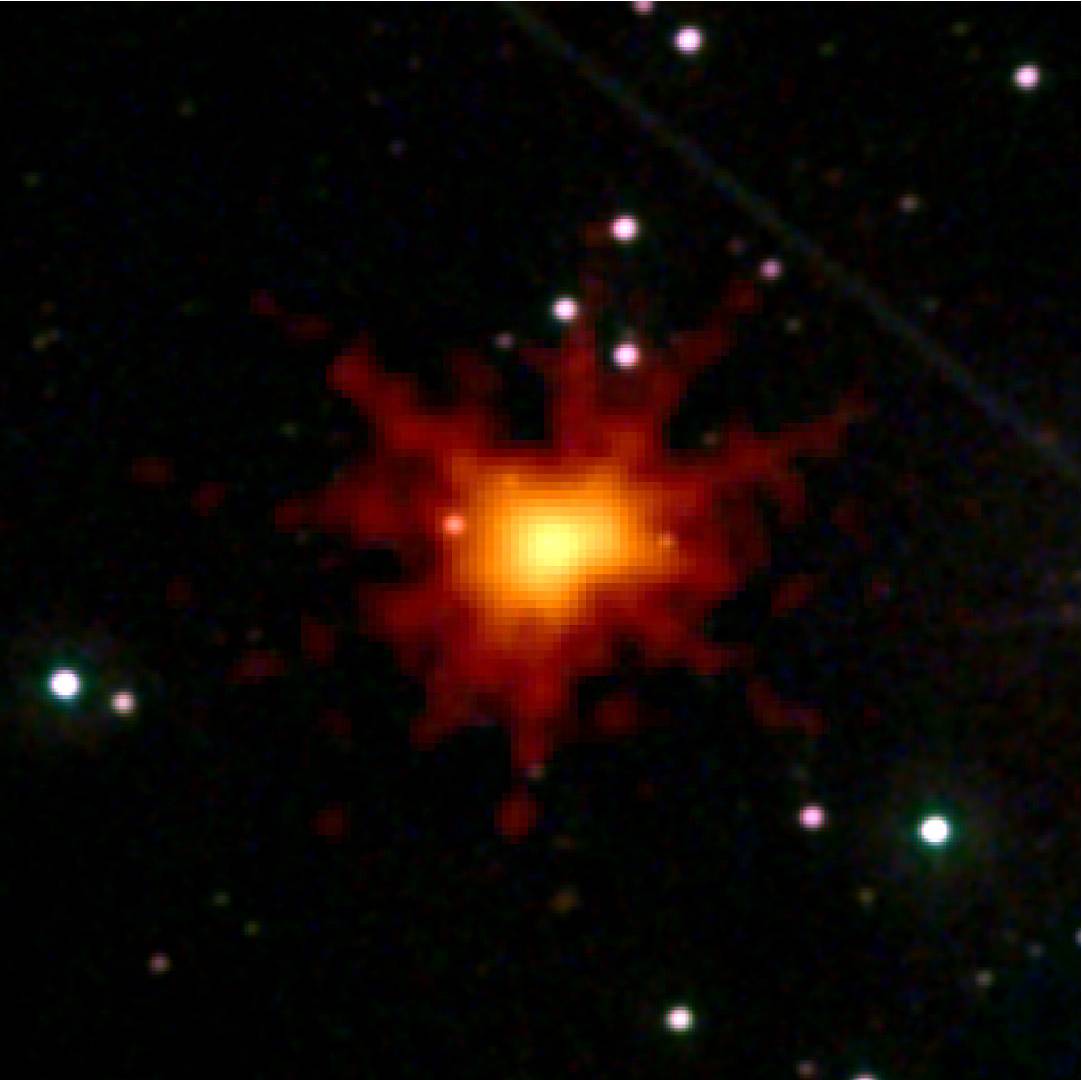
Images from Swift's Ultraviolet/Optical (white, purple) and X-Ray telescopes (yellow and red) were combined to make this view of Swift J1644+57. Evidence of the flares is seen only in the X-ray image, which is a 3.4-hour exposure taken on March 28, 2011. Credit: NASA/Swift/Stefan Immler. Larger image - Unlabeled version

WASHINGTON -- Two studies appearing in the Aug. 25 issue of the journal Nature provide new insights into a cosmic accident that has been streaming X-rays toward Earth since late March. NASA's Swift satellite first alerted astronomers to intense and unusual high-energy flares from the new source in the constellation Draco.

"Incredibly, this source is still producing X-rays and may remain bright enough for Swift to observe into next year," said David Burrows, professor of astronomy at Penn State University and lead scientist for the mission's X-Ray Telescope instrument. "It behaves unlike anything we've seen before."

Astronomers soon realized the source, known as Swift J1644+57, was the result of a truly extraordinary event -- the awakening of a distant galaxy's dormant black hole as it shredded and consumed a star. The galaxy is so far away, it took the light from the event approximately 3.9 billion years to reach Earth.

Burrows' study included NASA scientists. It highlights the X- and gamma-ray observations from Swift and other detectors, including the Japan-led Monitor of All-sky X-ray Image (MAXI) instrument aboard the International Space Station.

The second study was led by Ashley Zauderer, a post-doctoral fellow at the Harvard-Smithsonian Center for Astrophysics in Cambridge, Mass. It examines the unprecedented outburst through observations from numerous ground-based radio observatories, including the National Radio Astronomy Observatory's Expanded Very Large Array (EVLA) near Socorro, N.M.

Most galaxies, including our own, possess a central supersized black hole weighing millions of times the sun's mass. According to the new studies, the black hole in the galaxy hosting Swift J1644+57 may be twice the mass of the four-million-solar-mass black hole in the center of the Milky Way galaxy. As a star falls toward a black hole, it is ripped apart by intense tides. The gas is corralled into a disk that swirls around the black hole and becomes rapidly heated to temperatures of millions of degrees.

The innermost gas in the disk spirals toward the black hole, where rapid motion and magnetism create dual, oppositely directed "funnels" through which some particles may escape. Jets driving matter at velocities greater than 90 percent the speed of light form along the black hole's spin axis. In the case of Swift J1644+57, one of these jets happened to point straight at Earth.

"The radio emission occurs when the outgoing jet slams into the interstellar environment," Zauderer explained. "By contrast, the X-rays arise much closer to the black hole, likely near the base of the jet."

Theoretical studies of tidally disrupted stars suggested they would appear as flares at optical and ultraviolet energies. The brightness and energy of a black hole's jet is greatly enhanced when viewed head-on. The phenomenon, called relativistic beaming, explains why Swift J1644+57 was seen at X-ray energies and appeared so strikingly luminous.

When first detected March 28, the flares were initially assumed to signal a gamma-ray burst, one of the nearly daily short blasts of high-energy radiation often associated with the death of a massive star and the birth of a black hole in the distant universe. But as the emission continued to brighten and flare, astronomers realized that the most plausible explanation was the tidal disruption of a sun-like star seen as beamed emission.

By March 30, EVLA observations by Zauderer's team showed a brightening radio source centered on a faint galaxy near Swift's position for the X-ray flares. These data provided the first conclusive evidence that the galaxy, the radio source and the Swift event were linked.

"Our observations show that the radio-emitting region is still expanding at more than half the speed of light," said Edo Berger, an associate professor of astrophysics at Harvard and a coauthor of the radio paper. "By tracking this expansion backward in time, we can confirm that the outflow formed at the same time as the Swift X-ray source."

Swift, launched in November 2004, is managed by NASA's Goddard Space Flight Center in Greenbelt, Md. It is operated in collaboration with Penn State, the Los Alamos National Laboratory in N.M. and Orbital Sciences Corp., in Dulles, Va., with international collaborators in the U.K., Italy, Germany and Japan. MAXI is operated by the Japan Aerospace Exploration Agency as an external experiment attached to the Kibo module of the space station.

Related Links

University of Leicester release
Max Planck Institute for Radio Astronomy release
Seoul National University release
INAF Release

This illustration steps through the events that scientists think likely resulted in Swift J1644+57. Credit: NASA/Goddard Space Flight Center/Swift. Larger image - Unlabeled version

Contacts:

Trent J. Perrotto  
Headquarters, Washington 202-358-0321
trent.j.perrotto@nasa.gov

Lynn Chandler  
Goddard Space Flight Center, Greenbelt, Md. 301-286-2806
lynn.chandler-1@nasa.gov

Francis Reddy
NASA's Goddard Space Flight Center, Greenbelt, Md.

Wednesday, July 14, 2010

Record-Breaking X-ray Blast Briefly Blinds Space Observatory

The brightest gamma-ray burst ever seen in X-rays temporarily blinded Swift's X-ray Telescope on 21 June 2010. This image merges the X-rays (red to yellow) with the same view from Swift's Ultraviolet/Optical Telescope, which showed nothing extraordinary. (The image is 5 arcminutes across.) Credit: NASA/Swift/Stefan Immler

A blast of the brightest X-rays ever detected from beyond our Milky Way galaxy's neighborhood temporarily blinded the X-ray eye on NASA's Swift space observatory earlier this summer, astronomers now report. The X-rays traveled through space for 5-billion years before slamming into and overwhelming Swift's X-ray Telescope on 21 June. The blindingly bright blast came from a gamma-ray burst, a violent eruption of energy from the explosion of a massive star morphing into a new black hole. "This gamma-ray burst is by far the brightest light source ever seen in X-ray wavelengths at cosmological distances," said David Burrows, senior scientist and professor of astronomy and astrophysics at Penn State University and the lead scientist for Swift's X-ray Telescope (XRT).

Although the Swift satellite was designed specifically to study gamma-ray bursts, the instrument was not designed to handle an X-ray blast this bright. "The intensity of these X-rays was unexpected and unprecedented" said Neil Gehrels, Swift's principal investigator at NASA's Goddard Space Flight Center. He said the burst, named GRB 100621A, is the brightest X-ray source that Swift has detected since the observatory began X-ray observation in early 2005. "Just when we were beginning to think that we had seen everything that gamma-ray bursts could throw at us, this burst came along to challenge our assumptions about how powerful their X-ray emissions can be," Gehrels said.

"The burst was so bright when it first erupted that our data-analysis software shut down," said Phil Evans, a postdoctoral research assistant at the University of Leicester in the United Kingdom who wrote parts of Swift's X-ray-analysis software. "So many photons were bombarding the detector each second that it just couldn't count them quickly enough. It was like trying to use a rain gauge and a bucket to measure the flow rate of a tsunami."

The software soon resumed capturing the evolution of the burst over time, and Evans recovered the data that Swift had detected during the software's brief shutdown. The scientists then were able to measure the blast's X-ray brightness at 143,000 X-ray photons per second during its fleeting period of greatest brightness, which is more that 140 times brighter than the brightest continuous X-ray source in the sky -- a neutron star that is more than 500,000 times closer to Earth than the gamma-ray burst, and that sends a 'mere' 10,000 photons per second streaming toward Swift's telescopes.

Gamma-ray bursts typically begin with a bright flash of high-energy gamma-rays and X-rays, then fade away like a fireworks display, sometimes leaving behind a disappearing afterglow in less-energetic wavelengths, including optical and ultraviolet. Surprisingly, although the energy from this burst was the brightest ever in X-rays, it was merely ordinary in optical and ultraviolet wavelengths.

The Swift scientists were able to estimate the overall brightness of GRB 100621A by sampling the photons at some distance from its overexposed center -- a standard correction technique. Scientists who study the Sun use a similar approach to observe the Sun's corona by blocking out its much-brighter center. "With this burst, we had to sample the photons twice as far from the center as we ever had to go before," Burrows said. "The correction factor for the X-rays from GRB 100621A was 168 times larger than for a typical gamma-ray burst and 5 times larger than for the brightest burst we previously had seen. We never thought we'd see anything this bright."

Automated analysis of the Swift XRT data is performed at the University of Leicester in the United Kingdom, which has been studying X-rays from outer space for the past half century. Evans was the first to see the processed data from the burst's initial blast. "When I first saw the strange data from this burst, I knew that I had discovered something extraordinary," he said. "It was an indescribable feeling when I realized, at that moment, that I was the only person in the whole universe who knew that this extraordinary event had occurred. Now, after our analysis of the data, we know that this burst is one for the record books."

Other members of the research team include Tilan Ukwatta at NASA Goddard Space Flight Center and Valerio D'Elia and Giulia Stratta at the ASI Science Data Center in Italy.

[ Barbara K. Kennedy ]

SCIENCE CONTACTS:

David Burrows, lead scientist for Swift's X-ray Telescope and a senior scientist and professor of astronomy and astrophysics at Penn State: 814 865-7707, burrows@astro.psu.edu
Neil Gehrels, Swift principal investigator at NASA's Goddard Space Flight Center: 301-286-6546, gehrels@gsfc.nasa.gov

P.I.O. CONTACTS:

Barbara K. Kennedy (Penn State PIO): 814-863-4682, science@psu.edu
Lynn Cominsky (Swift PIO): 707-664-2655, lynnc@universe.sonoma.edu

MORE ABOUT GRB 100621A

NASA's "Geeked on Goddard" blog has a related story about the GRB 100621A burst at http://geeked.gsfc.nasa.gov/?p=1417

ABOUT THE SWIFT OBSERVATORY

The Swift observatory was launched in November 2004 and was fully operational by January 2005. Swift carries three main instruments: the Burst Alert Telescope, the X-ray Telescope, and the Ultraviolet/Optical Telescope. Its science and science and flight operations are controlled by Penn State from the Mission Operations Center in State College, Pennsylvania. Swift's gamma-ray detector, the Burst Alert Telescope, provides the rapid initial location and was built primarily by the NASA Goddard Space Flight Center in Greenbelt, Maryland, and Los Alamos National Laboratory in New Mexico and constructed at GSFC. Swift's X-Ray Telescope and UV/Optical Telescope were developed and built by international teams led by Penn State and drew heavily on each institution's experience with previous space missions. The X-ray Telescope resulted from Penn State's collaboration with the University of Leicester in the United Kingdom and the Brera Astronomical Observatory in Italy. The Ultraviolet/Optical Telescope resulted from Penn State's collaboration with the Mullard Space Science Laboratory of the University College-London. These three telescopes give Swift the ability to do almost immediate follow-up observations of most gamma-ray bursts because Swift can rotate so quickly to point toward the source of the gamma-ray signal. The spacecraft was built by General Dynamics.

Tuesday, November 10, 2009

Swift XMM-Newton Satellites Tune Into a Middleweight Black Hole


Swift X-ray observations of galaxy NGC 5408 indicate its ultraluminous X-ray source undergoes periodic changes every 115.5 days. This cycle, astronomers suspect, is linked to the orbit of a donor star around a middleweight black hole, as shown in this artist's view. Credit: NASA


This archival image taken by the Hubble Space Telescope shows the location of NGC 5408's unusually luminous X-ray source (circled). The irregular-type galaxy lies 15.8 million light-years away in the constellation Centaurus. Credit: NASA/ESA/C. Lang, P. Kaaret, A. Mercer (Univ. of Iowa), and S. Corbel (Univ. of Paris)

While astronomers have studied lightweight and heavyweight black holes for decades, the evidence for black holes with intermediate masses has been much harder to come by. Now, astronomers at NASA's Goddard Space Flight Center in Greenbelt, Md., find that an X-ray source in galaxy NGC 5408 represents one of the best cases for a middleweight black hole to date.

"Intermediate-mass black holes contain between 100 and 10,000 times the sun's mass," explained Tod Strohmayer, an astrophysicist at Goddard. "We observe the heavyweight black holes in the centers of galaxies and the lightweight ones orbiting stars in our own galaxy. But finding the 'tweeners' remains a challenge."

Several nearby galaxies contain brilliant objects known as ultraluminous X-ray sources (ULXs). They appear to emit more energy than any known process powered by stars but less energy than the centers of active galaxies, which are known to contain million-solar-mass black holes.

"ULXs are good candidates for intermediate-mass black holes, and the one in galaxy NGC 5408 is especially interesting," said Richard Mushotzky, an astrophysicist at the University of Maryland, College Park. The galaxy lies 15.8 million light-years away in the constellation Centaurus.

Using the European Space Agency's orbiting XMM-Newton observatory, Strohmayer and Mushotzky studied the source -- known as NGC 5408 X-1 -- in 2006 and 2008.

XMM-Newton detected what the astronomers call "quasi-periodic oscillations," a nearly regular "flickering" caused by the pile-up of hot gas deep within the accretion disk that forms around a massive object. The rate of this flickering was about 100 times slower than that seen from stellar-mass black holes. Yet, in X-rays, NGC 5408 X-1 outshines these systems by about the same factor.

Based on the timing of the oscillations and other characteristics of the emission, Strohmayer and Mushotzky conclude that NGC 5408 X-1 contains between 1,000 and 9,000 solar masses. This study appears in the October 1 issue of The Astrophysical Journal.

"For this mass range, a black hole's event horizon -- the part beyond which we cannot see -- is between 3,800 and 34,000 miles across, or less than half of Earth's diameter to about four times its size," said Strohmayer.

If NGC 5408 X-1 is indeed actively gobbling gas to fuel its prodigious X-ray emission, the material likely flows to the black hole from an orbiting star. This is typical for stellar-mass black holes in our galaxy.

Strohmayer next enlisted the help of NASA's Swift satellite to search for subtle variations of X-rays that would signal the orbit of NGC 5408 X-1's donor star. "Swift uniquely provides both the X-ray imaging sensitivity and the scheduling flexibility to enable a search like this," he added. Beginning in April 2008, Swift began turning its X-Ray Telescope toward NGC 5408 X-1 a couple of times a week as part of an on-going campaign.

Swift detects a slight rise and fall of X-rays every 115.5 days. "If this is indeed the orbital period of a stellar companion," Strohmayer said, "then it's likely a giant or supergiant star between three and five times the sun's mass." This study has been accepted for publication in a future issue of The Astrophysical Journal.

The Swift observations cover only about four orbital cycles, so continued observation is needed to confirm the orbital nature of the X-ray modulation.

"Astronomers have been studying NGC 5408 X-1 for a long time because it is one of the best candidates for an intermediate-mass black hole," adds Philip Kaaret at the University of Iowa, who has studied the object at radio wavelengths but is unaffiliated with either study. "These new results probe what is happening close to the black hole and add strong evidence that it is unusually massive."

Related Links: NASA's Swift mission

Francis Reddy
Goddard Space Flight Center

Wednesday, September 16, 2009

Swift Makes Best-ever Ultraviolet Portrait of Andromeda Galaxy

This mosaic of M31 merges 330 individual images taken by the Ultraviolet/Optical Telescope aboard NASA's Swift spacecraft. It is the highest-resolution image of the galaxy ever recorded in the ultraviolet. The image shows a region 200,000 light-years wide and 100,000 light-years high (100 arcminutes by 50 arcminutes). Credit: NASA/Swift/Stefan Immler (GSFC) and Erin Grand (UMCP)

This optical view from a ground-based telescope shows the Andromeda Galaxy in a more familiar light. This image encompasses the same area as the Swift mosaic. Credit: Bill Schoening, Vanessa Harvey/REU program/NOAO/AURA/NSF

M31 lies 2.5 million light-years away in the constellation Andromeda and is the nearest large spiral galaxy to our own. Under a clear, dark sky, it can be seen as a misty patch with the naked eye. Credit: Bill Schoening, Vanessa Harvey/REU program/NOAO/AURA/NSF

In a break from its usual task of searching for distant cosmic explosions, NASA's Swift satellite has acquired the highest-resolution view of a neighboring spiral galaxy ever attained in the ultraviolet. The galaxy, known as M31 in the constellation Andromeda, is the largest and closest spiral galaxy to our own.

"Swift reveals about 20,000 ultraviolet sources in M31, especially hot, young stars and dense star clusters," said Stefan Immler, a research scientist on the Swift team at NASA's Goddard Space Flight Center in Greenbelt, Md. "Of particular importance is that we have covered the galaxy in three ultraviolet filters. That will let us study M31's star-formation processes in much greater detail than previously possible."

M31, also known as the Andromeda Galaxy, is more than 220,000 light-years across and lies 2.5 million light-years away. On a clear, dark night, the galaxy is faintly visible as a misty patch to the naked eye.

Between May 25 and July 26, 2008, Swift's Ultraviolet/Optical Telescope (UVOT) acquired 330 images of M31 at wavelengths of 192.8, 224.6, and 260 nanometers. The images represent a total exposure time of 24 hours.

The task of assembling the resulting 85 gigabytes of images fell to Erin Grand, an undergraduate student at the University of Maryland at College Park who worked with Immler as an intern this summer. "After ten weeks of processing that immense amount of data, I'm extremely proud of this new view of M31," she said.

Several features are immediately apparent in the new mosaic. The first is the striking difference between the galaxy's central bulge and its spiral arms. "The bulge is smoother and redder because it's full of older and cooler stars," Immler explained. "Very few new stars form here because most of the materials needed to make them have been depleted."

Dense clusters of hot, young, blue stars sparkle beyond the central bulge. As in our own galaxy, M31's disk and spiral arms contain most of the gas and dust needed to produce new generations of stars. Star clusters are especially plentiful in an enormous ring about 150,000 light-years across.

What triggers the unusually intense star formation in Andromeda's "ring of fire"? Previous studies have shown that tides raised by the many small satellite galaxies in orbit around M31 help boost the interactions within gas clouds that result in new stars.

In 1885, an exploding star in M31's central bulge became bright enough to see with the naked eye. This was the first supernova ever recorded in any galaxy beyond our own Milky Way. "We expect an average of about one supernova per century in galaxies like M31," Immler said. "Perhaps we won't have to wait too long for another one."

"Swift is surveying nearby galaxies like M31 so astronomers can better understand star- formation conditions and relate them to conditions in the distant galaxies where we see gamma-ray bursts occurring," said Neil Gehrels, the mission's principal investigator at NASA Goddard. Since Swift's November 2005 launch, the satellite has detected more than 400 gamma-ray bursts -- massive, far-off explosions likely associated with the births of black holes.

Swift is managed by NASA Goddard. It was built and is being operated in collaboration with Pennsylvania State University, the Los Alamos National Laboratory in New Mexico, and General Dynamics of Gilbert, Ariz., in the United States. International collaborators include the University of Leicester and Mullard Space Sciences Laboratory in the United Kingdom, Brera Observatory and the Italian Space Agency in Italy, and additional partners in Germany and Japan.

Related Link: Blueshift podcast: Swift sees Andromeda in a New Light

Francis Reddy
NASA's Goddard Space Flight Center