Showing posts with label Super-Jupiter. Show all posts

Thursday, February 18, 2016

Hubble Directly Measures Rotation of Cloudy 'Super-Jupiter'

This is an illustration of a planet that is four times the mass of Jupiter and orbits 5 billion miles from a brown-dwarf companion (the bright red object seen in the background). The rotation rate of this "super-Jupiter" has been measured by studying subtle variations in the infrared light the hot planet radiates through a variegated, cloudy atmosphere. The planet completes one rotation every 10 hours — about the same rate as Jupiter. Because the planet is young, it is still contracting under gravity and radiating heat. The atmosphere is so hot that it rains molten glass and, at lower altitudes, molten iron.

2M1207, 2MASS J12073346-3932539
[Left] — This is a Hubble Space Telescope near-infrared-light image of a brown dwarf located 170 light-years away from Earth. The object is no more than 30 times the mass of Jupiter, making it too small to sustain nuclear fusion to shine as a star.

[Right] — When the glow of the brown dwarf is subtracted from the image, a smaller and fainter companion object becomes visible. No more that four times the mass of Jupiter, this companion is dubbed a "super-Jupiter." It has an estimated diameter as big as 40 percent greater than Jupiter's diameter. The world is 5 billion miles from the brown dwarf, nearly twice the distance between our sun and the planet Neptune.

Because the planet is only 10 million years old, it is so hot it may rain molten glass and iron in its atmosphere. Hubble has measured fluctuations in the planet's brightness that suggests the planet has patchy clouds as it completes one rotation every 10 hours.Credit: NASA, ESA, and Y. Zhou (University of Arizona)
 
This graph plots small changes in the infrared brightness of a super-Jupiter as measured by the Hubble Space Telescope. The S-shaped curve is extrapolated from the data points. Its sinusoidal shape suggests that brightness changes are a result of a 10-hour rotation period (horizontal axis). The vertical axis shows small changes in brightness. This would mean that the planet likely has patchy clouds that influence the amount of infrared radiation observed as the planet rotates. At a distance of 170 light-years from Earth, the planet is too far away for Hubble to actually resolve atmospheric structure. Credit: NASA, ESA, Y. Zhou (University of Arizona), and P. Jeffries (STScI)

 
Astronomers using NASA's Hubble Space Telescope have measured the rotation rate of an extreme exoplanet by observing the varied brightness in its atmosphere. This is the first measurement of the rotation of a massive exoplanet using direct imaging.

"The result is very exciting," said Daniel Apai of the University of Arizona in Tucson, leader of the Hubble investigation. "It gives us a unique technique to explore the atmospheres of exoplanets and to measure their rotation rates."

The planet, called 2M1207b, is about four times more massive than Jupiter and is dubbed a "super-Jupiter." It is a companion to a failed star known as a brown dwarf, orbiting the object at a distance of 5 billion miles. By contrast, Jupiter is approximately 500 million miles from the sun. The brown dwarf is known as 2M1207. The system resides 170 light-years away from Earth.

Hubble's image stability, high resolution, and high-contrast imaging capabilities allowed astronomers to precisely measure the planet's brightness changes as it spins. The researchers attribute the brightness variation to complex clouds patterns in the planet's atmosphere. The new Hubble measurements not only verify the presence of these clouds, but also show that the cloud layers are patchy and colorless.

Astronomers first observed the massive exoplanet 10 years ago with Hubble. The observations revealed that the exoplanet's atmosphere is hot enough to have "rain" clouds made of silicates: vaporized rock that cools down to form tiny particles with sizes similar to those in cigarette smoke. Deeper into the atmosphere, iron droplets are forming and falling like rain, eventually evaporating as they enter the lower levels of the atmosphere.

"So at higher altitudes it rains glass, and at lower altitudes it rains iron," said Yifan Zhou of the University of Arizona, lead author on the research paper. "The atmospheric temperatures are between about 2,200 to 2,600 degrees Fahrenheit."

The super-Jupiter is so hot that it appears brightest in infrared light. Astronomers used Hubble's Wide Field Camera 3 to analyze the exoplanet in infrared light to explore the object's cloud cover and measure its rotation rate. The planet is hot because it is only about 10 million years old and is still contracting and cooling. For comparison, Jupiter in our solar system is about 4.5 billion years old.

The planet, however, will not maintain these sizzling temperatures. Over the next few billion years, the object will cool and fade dramatically. As its temperature decreases, the iron and silicate clouds will also form lower and lower in the atmosphere and will eventually disappear from view.

Zhou and his team have also determined that the super-Jupiter completes one rotation approximately every 10 hours, spinning at about the same fast rate as Jupiter.

This super-Jupiter is only about five to seven times less massive than its brown-dwarf host. By contrast, our sun is about 1,000 times more massive than Jupiter. "So this is a very good clue that the 2M1207 system we studied formed differently than our own solar system," Zhou explained. The planets orbiting our sun formed inside a circumstellar disk through accretion. But the super-Jupiter and its companion may have formed throughout the gravitational collapse of a pair of separate disks.

"Our study demonstrates that Hubble and its successor, NASA's James Webb Space Telescope, will be able to derive cloud maps for exoplanets, based on the light we receive from them," Apai said. 

Indeed, this super-Jupiter is an ideal target for the Webb telescope, an infrared space observatory scheduled to launch in 2018. Webb will help astronomers better determine the exoplanet's atmospheric composition and derive detailed maps from brightness changes with the new technique demonstrated with the Hubble observations.

Results from this study will appear in the Feb. 18, 2016, edition of The Astrophysical Journal.


Contact:

Donna Weaver / Ray Villard
Space Telescope Science Institute, Baltimore, Maryland
410-338-4493 / 410-338-4514
dweaver@stsci.edu / villard@stsci.edu

Source: HubbleSite

Tuesday, May 26, 2015

A Curious Family of Giants

An artist's impression of the newly discovered super-Jupiter exoplanet around an evolved star, only the third known example of such a system.
Credit: NASA/JPL-Caltech


There are 565 exoplanets currently known that are as massive as Jupiter or bigger, about one third of the total known, confirmed exoplanet population. About one quarter of the massive population orbits very close to its star, with periods of less than ten days (the Earth takes about 365 days to orbit the Sun). Heated by the nearby star’s radiation, these giants are often called hot Jupiters. 

Despite the large and diverse population of known giant exoplanets, only two of them orbit older, evolved stars. How and why there are so many giant planets close to their host stars is still a mystery: perhaps over time they migrate in from more distant parts of their planetary system, or instead perhaps they are born there? Evolved stars that host close-in, giant exoplanets provide a valuable wrinkle to the picture, and some clues: these stars, as they age, cool off and swell in diameter, could disrupt or even swallow any nearby planets. Finding examples allows astronomers to refine their models of planet formation and evolution.

CfA astronomers Dave Latham, David Kipping, Matthew Payne, David Sliski, Lars Buchhave, Gilbert Esquerdo, Michel Calkins, and Perry Berlind and their colleagues have discovered two new giant exoplanets around an evolved star. Kepler-432b is about 5.4 Jupiter-masses in size and orbits every 52.5 days – it is the third known example of a close-in giant around an evolved star; Kepler-434c is 2.4 Jupiter-masses and orbits much farther away, in 406 days. The host star, Kepler-432 has a mass of about 1.35 solar-masses, an age of about 3.5 billion years, and it has just finished its stable lifetime burning hydrogen and begun to swell in size, with a current diameter of 4.16 solar-diameters.

The astronomers found that the massive inner planet is strange in at least three ways. First, it is not highly irradiated or hot, unlike typical hot Jupiters. Its orbit is highly eccentric (meaning that its distance from the star varies considerably over an orbit), suggesting that it may have migrated to this orbit. Finally, its spin axis happens to be closely aligned to the star's, another curious property, especially since it is usually not found in planets that have migrated. The results highlight the remarkable range of exoplanet properties and possible formation mechanisms, and imply either that Kepler-432b is an intrinsically rare case, or that it represents a common class of exoplanets that are usually destroyed as their host star ages, but which in this case has so far managed to survive - though its days are probably numbered (perhaps only another few hundred million years).

Reference(s):


"Kepler-432: A Red Giant Interacting with One of Its Two Long-Period Giant Planets," Samuel N. Quinn, Timothy. R. White, David W. Latham, William J. Chaplin, Rasmus Handberg, Daniel Huber, David M. Kipping, Matthew J. Payne, Chen Jiang, Victor Silva Aguirre, Dennis Stello, David H. Sliski, David R. Ciardi, Lars A. Buchhave, Timothy R. Bedding, Guy R. Davies, Saskia Hekker, Hans Kjeldsen, James S. Kuszlewicz, Mark E. Everett, Steve B. Howell, Sarbani Basu, Tiago L. Campante, Jørgen Christensen-Dalsgaard, Yvonne P. Elsworth, Christoffer Karoff, Steven D. Kawaler, Mikkel N. Lund, Mia Lundkvis, Gilbert A. Esquerdo, Michael L. Calkins, and Perry Berlind, ApJ 803, 49, 2015


Tuesday, November 20, 2012

Direct Imaging of a Super-Jupiter Around a Massive Star

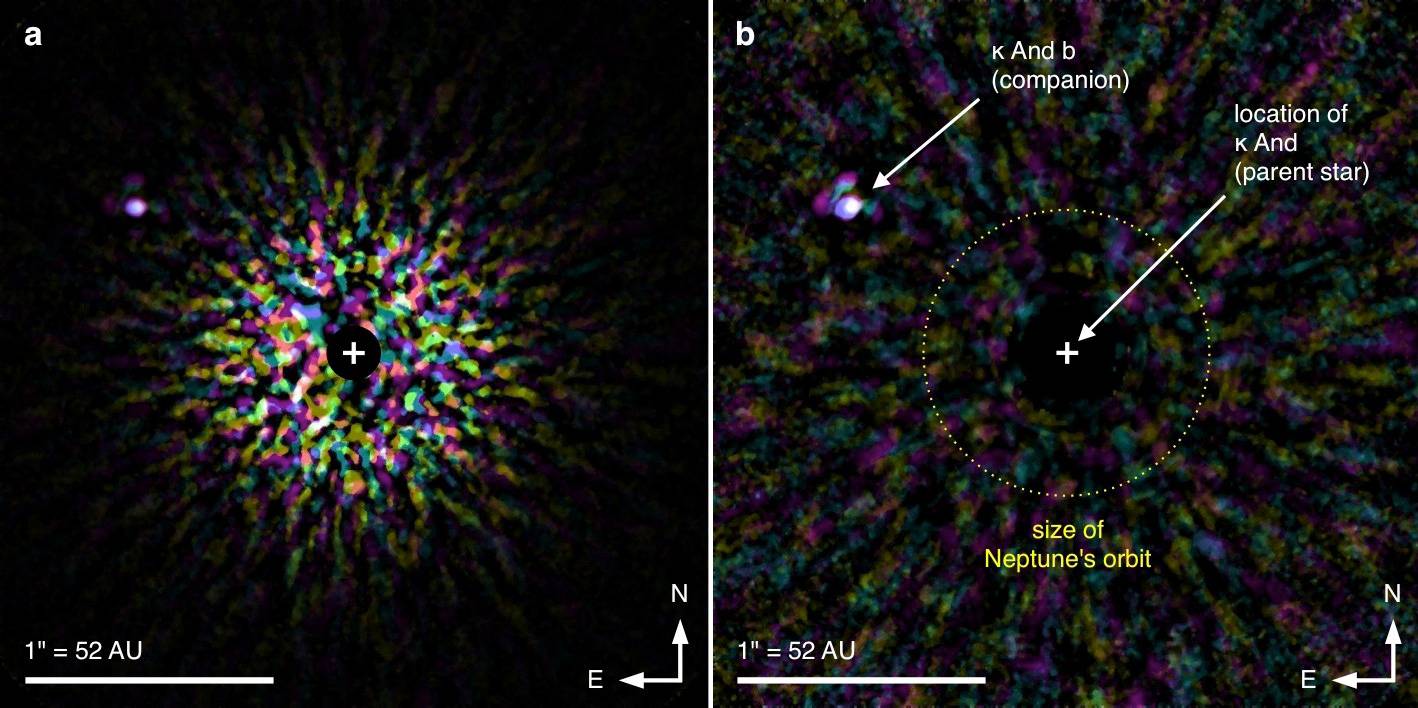
 An international team of astronomers, led by Joseph Carson (College of Charleston and Max Planck Institute for Astronomy), has discovered a "super-Jupiter" orbiting the massive star Kappa Andromedae. Using the High Contrast Instrument for the Subaru Next Generation Adaptive Optics (HiCIAO) and the Infrared Camera and Spectrograph (IRCS) mounted on the Subaru Telescope, the team was able to directly image the new exoplanet, a gas giant with a mass about 13 times that of Jupiter and an orbit somewhat larger than Neptune's. The host star has a mass 2.5 times that of the Sun, making it the highest mass star to ever host a directly imaged planet or very low-mass brown dwarf.
Successful direct imaging of an exoplanet is difficult at best, because the brightness of the central star obscures the fainter light emitted from a planet orbiting it. A major goal of the SEEDS Project (Note), of which the current team is a part, is to explore hundreds of nearby stars in an effort to directly image extrasolar planets and protoplanetary/debris disks. The team used Subaru Telescope's high-contrast imaging instrument, HiCIAO, with the AO 188 Adaptive Optics System to hunt for exoplanets. They targeted many young high-mass stars and then concentrated follow-up observations on the relatively young star Kappa Andromedae. Located 170 light years from our own Solar System, Kappa Andromedae is a member of the Columba stellar moving group, with a youthful estimated age of 30 million years (compared with the Sun's older age of about 5 billion years). Young star systems are attractive targets for directly imaging planets because young planets retain significant heat from their formation, thus enhancing their brightness at infrared wavelengths.

Kappa And b, a so-called "super-Jupiter" (a gas giant significantly more massive than Jupiter), was detected in independent observations in January and July 2012 at four different wavelengths. Comparison of its relative positions between the two time periods revealed that Kappa And b exhibits "common proper motion" with the host star, proving that the two objects are gravitationally bound. A comparison of Kappa And b's brightness between the four different wavelengths revealed infrared colors similar to those of a handful of other gas giant planets successfully imaged around stars.

Figure: Left (a): A false-color, near-infrared (1.2 - 2.4 microns) image of the Kappa And system. Image processing removed the light from the host star, which lies behind the mask (a software-generated, dark disk) at the center of the square. The colored speckles represent starlight left over after removal of light from the host star. Separated by about 55 Astronomical Units from its host star, the super-Jupiter, Kappa And b (upper left), resides at a distance about 1.8 times greater than Neptune's orbital separation from the Sun. (Credit: NAOJ)
 Right (b): A "signal-to-noise ratio map" generated from the image to the left. The colored speckles represent residual light that remains after subtraction of light from the host star. The white feature toward the upper left, representing a high signal-to-noise value, indicates detection of the super-Jupiter with high confidence. (Credit: NAOJ) 

Such direct imaging of an extrasolar planet is exceptionally rare, especially for objects with orbital separations akin to the planets in our own Solar System. In a single infrared snapshot, the glare of the host star completely overwhelms the tiny point of light that is Kappa And b. The SEEDS observing team distinguished its distinct light only after using a technique known as angular differential imaging, which combines a time-series of individual images in a manner that allows for removal of the otherwise overwhelming glare of the host star from the final, combined image.

The large masses of the host star and its gas giant planet sharply contrast to objects in our own Solar System. In recent years some observers and theoreticians have argued that large stars like Kappa Andromedae are likely to have large planets, perhaps conforming to a simple scaled-up model of our own Solar System. Other experts suggest that there are limits to extrapolating from our own Solar System; if a star is too massive, its powerful radiation may disrupt the "normal" planet formation process that would otherwise occur in the disk surrounding a star, its circumstellar disk. The discovery of the super-Jupiter around Kappa Andromedae demonstrates that stars as large as 2.5 solar masses are still fully capable of producing planets within their circumstellar disks.

The SEEDS research team is continuing to study the light emitted from Kappa And b across a broad wavelength range in order to better understand the atmospheric chemistry of the gas giant and define its the orbital characteristics. The team also continues to explore the system for possible secondary planets, which may have influenced the formation of Kappa And b and its orbital evolution. These follow-up studies will yield further clues not only about the formation of the Super-Jupiter but also about principles of planet formation around massive stars.

References:
The paper describing the research leading to this discovery, "Direct Imaging Discovery of a 'Super-Jupiter' Around the Late B-Type Star κ And", has been accepted for publication in the Astrophysical Journal Letters.

Core members of the research team are:
  • J. Carson, College of Charleston, USA and Max Planck Institute for Astronomy, Germany
  • C. Thalmann, University of Amsterdam, The Netherlands and Max Planck Institute for Astronomy, Germany
  • M. Janson, Princeton University, USA
  • T. Kozakis, College of Charleston, USA
  • M. Bonnefoy, Max Planck Institute for Astronomy, Germany
  • B. Biller, Max Planck Institute for Astronomy, Germany
  • J. Schlieder, Max Planck Institute for Astronomy, Germany
  • T. Currie, University of Toronto, Canada
  • M. McElwain, Goddard Space Flight Center, USA
  • M. Goto, Ludwig Maximilians University, Germany
  • T. Henning, Max Planck Institute for Astronomy, Germany
  • W. Brandner, Max Planck Institute for Astronomy, Germany
  • M. Feldt, Max Planck Institute for Astronomy, Germany
  • R. Kandori, National Astronomical Observatory of Japan, Japan
  • M. Kuzuhara, National Astronomical Observatory of Japan and University of Tokyo, Japan
  • H. Tamura, National Astronomical Observatory of Japan, Japan

Acknowledgements:


This research was made possible in part by support from the U.S. National Science Foundation.


Note:


The SEEDS Project began in 2009 for a five-year period using 120 observing nights at Subaru Telescope, located at the summit of Mauna Kea on the island of Hawaii. Principal investigator Motohide Tamura (National Astronomical Observatory of Japan) leads the SEEDS survey.