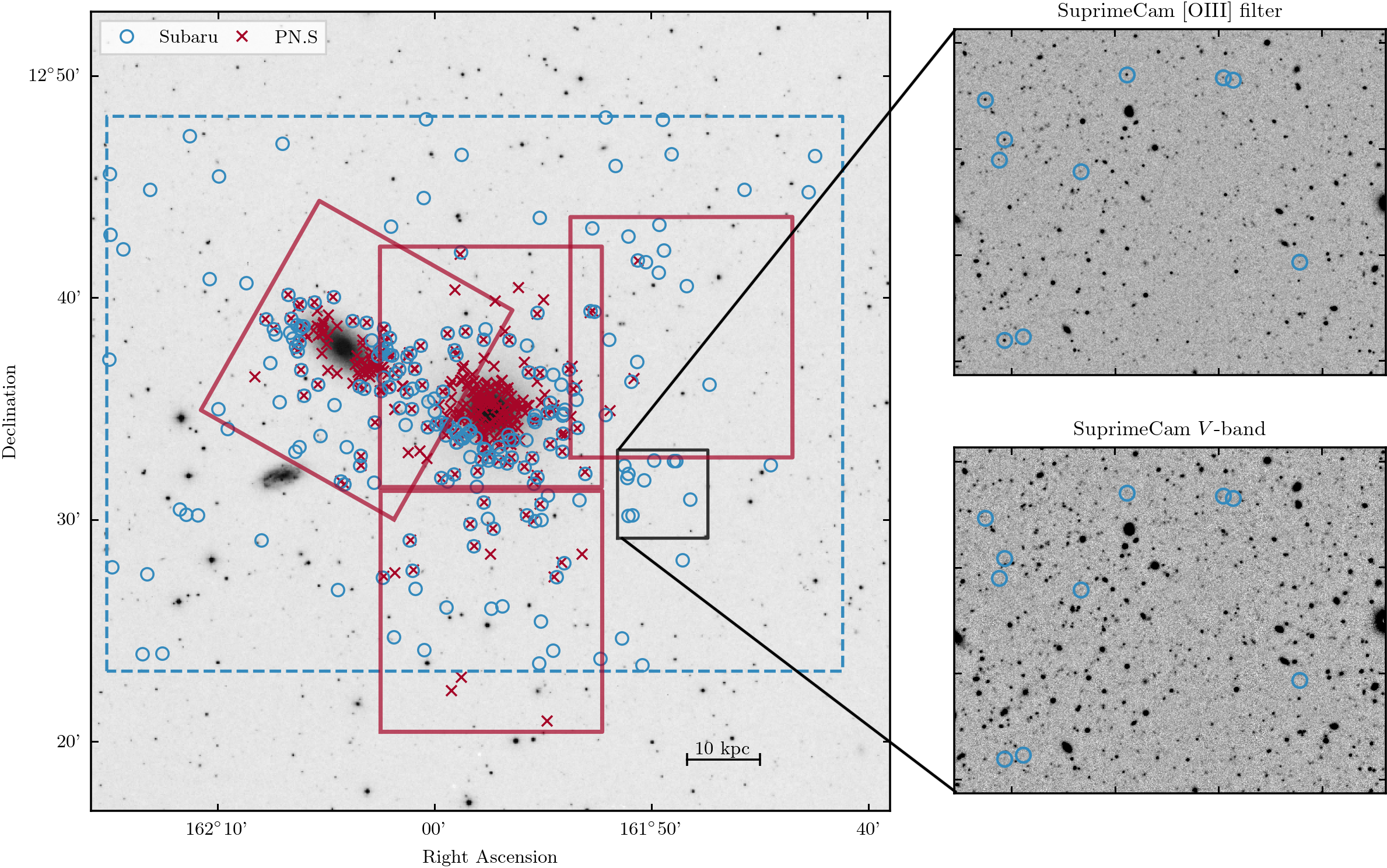
Figure 1: (left) On-sky distribution of planetary nebulae observed with the Subaru Telescope (blue circles) and the PN.S at the William Herschel Telescope (red crosses). The background image from the Digitized Sky Survey shows the galaxies NGC 3384 (left) and M105 (center); (right) Suprime-Cam [OIII] (top-right) and V-band (bottom-right) cutouts of a small region in the halo of M105, with the detected planetary nebulae highlighted with blue circles. (Credit: J. Hartke (ESO)). Hi-res image
A team of astronomers using the Subaru Telescope has revealed a
population of old and very metal-poor stars extensively surrounding the
elliptical galaxy M105. The finding is important to further test the
theory of formation of elliptical galaxies in galaxy groups, because
these "free floating stars" are considered to be fossils proving that
these groups form via extended processes through the continuous merging
of smaller structures.
Galaxies are seldom found in isolation.
Instead, most of them "live" in larger structures that are classified as
groups or clusters, depending on their size and number of galaxies. How
were these structures made? According to the standard cosmological
model (Lambda-CDM model), these structures form hierarchically (bottom
up), with smaller structures forming first and merging to form larger
structures. Consequently, there must be a population of single stars
unbound from the larger structures somewhere in the hierarchy. It then
becomes important to find stars in the empty regions between galaxies
that are in groups or clusters, and to determine through observations
when the "free floating stars" began to appear and populate the
surrounding space.
To identify a population of single stars
scattered in a galaxy group, a team of astronomers, including members
from the European Southern Observatory and the Max Plank Institute for
Extraterrestrial Physics, studied the Leo I group at a distance of about
10 Mpc (33 million light-years), which is the closest group that
contains all galaxy types (elliptical, spiral, and dwarf galaxies) with
the elliptical galaxy M105 (NGC 3379) at its center.
The team
used planetary nebulae (PNe) as tracers. PNe are the late stages of
stars like our own Sun. In these stages, the central core becomes naked
and the outer layers are expelled to form a nebula, that shines with a
particular color, of aquamarine hue due to the oxygen [OIII] emission at
5007 Angstrom. A similar greenish color is also visible in the Earth's
atmosphere as "northern lights." With the bright light from their
envelopes, the dying stars are like beacons that astronomers can use to
unveil the structure of the outermost regions of the galaxy M105.
The
team used Suprime-Cam on the Subaru Telescope together with the
Planetary Nebula Spectrograph (PN.S) mounted on the William Herschel
Telescope, to carry out a complete census in the outer regions of M105.
Figure 1 shows the distribution of PNe detected in the observed fields.
Blue circles highlight the detections made with Suprime-Cam.
Once the census was completed, the team found an
excess of PNe in the outer halo of M105, which significantly extends
out to 50 kpc (160 kilo light-years), 18 times the effective radius (a
"typical" size) of M105. In other words, there is an excess of old stars
distributed in the outer halo. As in a detective story, the team then
engaged in an investigation to look for the footprints of the parent
stars of the detected PNe. By comparison with previous studies of red
giant branch stars - the stellar ancestors of PNe - in the field, the
team concluded that an old and very metal-poor population ([M/H] <
-1.0) was "responsible" for generating the excess of PNe in the outer
envelope encircling M105.
This was the breakthrough: This is the first study that has
clearly established the link between the metal poor population and the
excess of PNe in the outer regions of an elliptical galaxy. This outer
component is faint – only 4% of the light in M105 reaches out to 18
effective radii, a region where it becomes possible to test the presence
and the structure of dark matter. This will be investigated by
measuring the velocities of the PNe and comparing the velocity
dispersion profile with the dynamical models, e.g. for a single halo, or
for a smaller halo within a larger halo of dark matter. Dr. Johanna
Hartke, the lead author of the paper, comments on the future prospects,
"This is especially interesting since M105 belongs to an elusive sample
of galaxies, whose motions, as measured to date, are consistent with
both very little dark matter as well as with massive dark matter halos.
Our new, more extended data, will be able to firmly distinguish between
these possibilities. "
This research was published in Astronomy and Astrophysics on October 7, 2020 (Johanna Hartke et al. "The
halo of M105 and its group environment as traced by planetary nebula
populations: I. Wide-field photometric survey of planetary nebulae in
the Leo I group".)
See the link below for the details of this research.
Source: Subaru Telescope