Showing posts with label Mars plumes. Show all posts

Monday, October 29, 2018

Mars Express keeps an eye on curious cloud

Credit: ESA/GCP/ UPV/EHU Bilbao, CC BY-SA 3.0 IGO

Cloud formation near Arsia Mons
Copyright: ESA/GCP/UPV/EHU Bilbao, CC BY-SA 3.0 IGO 


Credit: ESA/DLR/FU Berlin, CC BY-SA 3.0 IGO

Cloud on 17 September 2018
Credit: ESA/CNES/CNRS/IAS

Since 13 September, ESA's Mars Express has been observing the evolution of an elongated cloud formation hovering in the vicinity of the 20 km-high Arsia Mons volcano, close to the planet's equator.

In spite of its location, this atmospheric feature is not linked to volcanic activity but is rather a water ice cloud driven by the influence of the volcano's leeward slope on the air flow – something that scientists call an orographic or lee cloud – and a regular phenomenon in this region.

The cloud can be seen in this view taken on 10 October by the Visual Monitoring Camera (VMC) on Mars Express – which has imaged it hundreds of times over the past few weeks – as the white, elongated feature extending 1500 km westward of Arsia Mons. As a comparison, the cone-shaped volcano has a diameter of about 250 km; a view of the region with labels is provided here.

Mars just experienced its northern hemisphere winter solstice on 16 October. In the months leading up to the solstice, most cloud activity disappears over big volcanoes like Arsia Mons; its summit is covered with clouds throughout the rest of the martian year.

However, a seasonally recurrent water ice cloud, like the one shown in this image, is known to form along the southwest flank of this volcano – it was previously observed by Mars Express and other missions in 2009, 2012 and 2015.

The cloud's appearance varies throughout the martian day, growing in length during local morning downwind of the volcano, almost parallel to the equator, and reaching such an impressive size that could make it visible even to telescopes on Earth.

The formation of water ice clouds is sensitive to the amount of dust present in the atmosphere. These images, obtained after the major dust storm that engulfed the entire planet in June and July, will provide important information on the effect of dust on the cloud development and on its variability throughout the year.

The elongated cloud hovering near Arsia Mons this year was also observed with the visible and near-infrared mapping spectrometer, OMEGA, and the High Resolution Stereo Camera (HRSC) on Mars Express, providing scientists with a variety of different data to study this phenomenon.

Follow the development of this cloud via the daily images sent by the VMC: https://www.flickr.com/photos/esa_marswebcam/

 
For more information, please contact:

Agustin Sánchez-Lavega
University of the Basque Country, Bilbao, Spain
Email: agustin.sanchez@ehu.eus

Daniela Tirsch
DLR, Berlin, Germany
Email: daniela.tirsch@dlr.de

Brigitte Gondet
IAS, Orsay, France
Email: brigitte.gondet@ias.u-psud.fr

Dmitri Titov
ESA Mars Express project scientist
Email: dmitri.titov@esa.int

Markus Bauer
ESA Science and Robotic Exploration Communication Officer
Tel: +31 71 565 6799
Mob: +31 61 594 3 954
Email: markus.bauer@esa.int


Monday, May 23, 2016

Are mystery Mars plumes caused by space weather

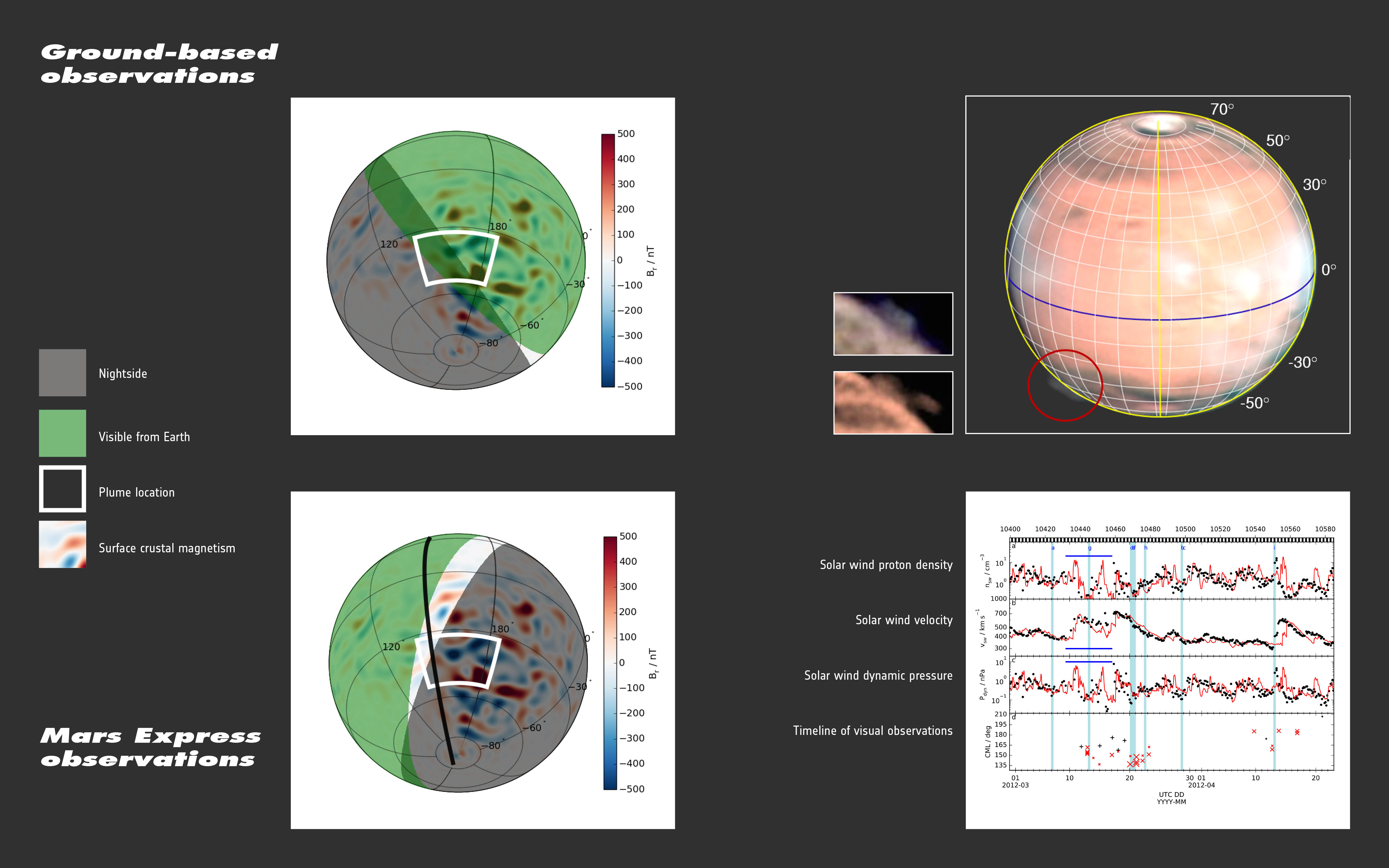
Copyright visual images: D. Parker (large Mars image and bottom inset) & W. Jaeschke (top inset)
All other graphics courtesy D. Andrews

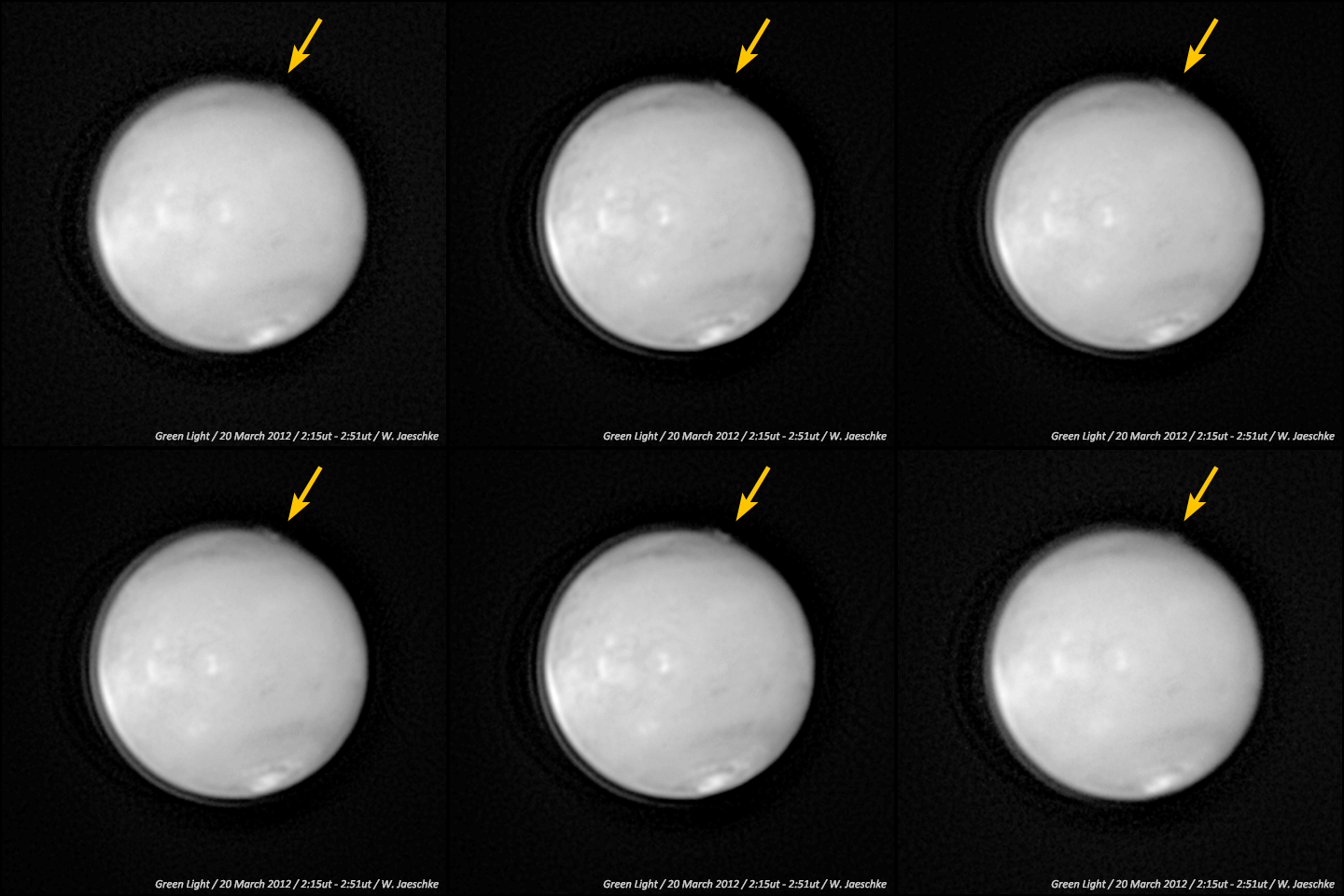
Observations of a mysterious plume-like feature (marked with yellow arrow) at the limb of the Red Planet on 20 March 2012. The observation was made by astronomer W. Jaeschke. The image is shown with the north pole towards the bottom and the south pole to the top.  Copyright: W. Jaeschke

Mysterious high-rise clouds seen appearing suddenly in the martian atmosphere on a handful of occasions may be linked to space weather, say Mars Express scientists.

Amateur astronomers using telescopes on Earth were the first to report an unusual cloud-like plume in 2012 that topped-out high above the surface of Mars at an altitude around 250 km. The feature developed in less than 10 hours, covered an area of up to 1000 x 500 km, and remained visible for around 10 days.

The extreme altitude poses something of a problem in explaining the features: it is far higher than where typical clouds of frozen carbon dioxide and water are thought to be able to form in the atmosphere.

Indeed, the high altitude corresponds to the ionosphere, where the atmosphere directly interacts with the incoming solar wind of electrically charged atomic particles.

Speculation as to their cause has included exceptional atmospheric circumstances, auroral emissions, associations with local crustal anomalies, or a meteor impact, but so far it has not been possible to identify the root cause.

Unfortunately, the spacecraft orbiting Mars were not in the right position to see the 2012 plume visually, but scientists have now looked into plasma and solar wind measurements collected by Mars Express at the time.
They have found evidence for a large ‘coronal mass ejection’, or CME, from the Sun striking the martian atmosphere in the right place and at around the right time.

“Our plasma observations tell us that there was a space weather event large enough to impact Mars and increase the escape of plasma from the planet’s atmosphere,” says David Andrews of the Swedish Institute of Space Physics, and lead author of the paper reporting the Mars Express results.

“But we were not able to see any signatures in the ionosphere that we can categorically say were due to the presence of this plume.

“One problem is that the plume was seen at the day–night boundary, over a region of known strong crustal magnetic fields where we know the ionosphere is generally very disturbed, so searching for ‘extra’ signatures is rather challenging.”

To go further, the scientists have looked at the chances of these two relatively rare events – a large and fast CME colliding with Mars, and the mysterious plume – occurring at the same time.

They have been searching back through the archives for similar events, but they are rare.

For example, the Hubble Space Telescope observed a similar high plume in May 1997, and a CME was registered hitting Earth at the same time.

Although that CME was widely studied, there is no information from Mars orbiters to judge the scale of its impact at the Red Planet. 

Similarly, CMEs have been detected at Mars without any associated plume being reported, although changes in distance and visibility of Mars from Earth makes it difficult to acquire good ground-based images at all times.

“The jury is still out as to what physics is at play here, but given the altitude of the plume, we think that plasma interactions must be important,” says David.

“One idea is that a fast-travelling CME causes a significant perturbation in the ionosphere resulting in dust and ice grains residing at high altitudes in the upper atmosphere being pushed around by the ionospheric plasma and magnetic fields, and then lofted to even higher altitudes by electrical charging.

“This could lead to a plume effect that is significant enough to be detected from Earth by astronomers.”

“A number of processes could be responsible, but if these plumes are indeed driven by space-weather disturbances, this adds an important angle to our understanding of how Mars may have lost much of its atmosphere in the past, changing from a warm, wet world and becoming the cold, dry, dusty place it is today,” says Dmitri Titov, Mars Express project scientist.

“The plume also emphasises the scientific potential for continuous monitoring of Mars by both orbiters and ground-based observatories. In particular, we are now going to use the webcam on Mars Express for more frequent coverage of the planet.”


Notes for Editors


Plasma observations during the Mars atmospheric “plume” event of March–April 2012, by D. Andrews et al has been accepted for publication in the Journal of Geophysical Research.

The measurements were conducted by the Mars Express Analyzer for 
Space Plasmas and Energetic Atoms (ASPERA-3) plasma instrument suite and the Mars Advanced Radar for Sub-Surface and Ionospheric Sounding (MARSIS).


For further information, please contact:

David Andrews
Swedish Institute of Space Physics
Tel: +46 (0) 184715922 
Email: david.andrews@irfu.se

Dmitri Titov
ESA Mars Express project scientist
Email: Dmitri.titov@esa.int

Markus Bauer


 ESA Science and Robotic Exploration Communication Officer


Tel: +31 71 565 6799


Mob: +31 61 594 3 954


Email: markus.bauer@esa.int

Source: ESA