Showing posts with label GeMS. Show all posts

Wednesday, September 04, 2013

First Published Science Result from GeMS: “Young Stars Leave the Nest”

This image of Haffner 16 illustrates that the GeMS AO system can successfully sharpen data even under relatively poor imaging conditions. With the correction, the point sources appeared spread by less than 0.16 arcseconds (full width at half-maximum, in the Ks band). This represents a significant improvement over the natural quality of the sky, which, on the night these data were obtained, was roughly 0.8 arcseconds – a value worse than average at Gemini South on Cerro Pachón. Credit: Gemini Observatory/AURA
 
The first refereed science paper based on data from the Gemini Multi-conjugate adaptive optics System (GeMS) demonstrates the effective use of young, lower mass stars to determine the age of a star cluster. The work, led by Canada’s Tim Davidge, also brings into focus how young cluster stars “leave the nest” and enter the general population of stars in our galaxy. 

Recent observations using the powerful new GeMS adaptive optics system at Gemini South catch stars before they settle into their “regular lives” and reveal clues into the past and future of a low-mass star cluster – in this case, Haffner 16 - in our Milky Way Galaxy. The combination of Gemini’s large 8-meter aperture, its infrared sensitivity, and the latest in adaptive optics (which corrects for the blurring effects of the Earth’s atmosphere), provide the key elements for the success of this work. The so-called “pre-main sequence” stars tend to be fainter, in part because they are less massive than their counterparts that advance onto the main sequence (where most stars spend the majority of their lives) more rapidly. Within a low-mass cluster like Haffner 16 very massive stars may not exist at all, preventing the use of standard age-dating techniques that rely on studying higher-mass stars. 

According to lead author Tim Davidge (Dominion Astrophysical Observatory, Canada), “Studies of low mass clusters like Haffner 16 provide insights into how typical stars transition from star-forming factories to the street.” We have caught this star cluster in the act of dissolving says Davidge. These direct observations are an important clue in understanding the local neighborhood of the Sun, where isolated pre-main sequence stars are observed, without any obvious sign of the typical clusters, where it is believed most stars are born. Such isolated pre-main sequence stars could have come from clusters like Haffner 16 but have since disintegrated. Davidge has already obtained additional observations using GeMS. Utilizing the same techniques, he is able to identify the pre-main-sequence stars in three other, more distant clusters, which he classifies as older. 

The GeMS system uses multiple laser guide stars (5) and several deformable mirrors to make exceptionally uniform corrections over an extremely large adaptive optics field-of-view which counteracts for distortions due to Earth’s turbulent atmosphere. The work engaged an international team, including several team-members involved in the development and operation of GeMS. The paper will appear soon in Publications of the Astronomical Society of the Pacific. 


Thursday, July 04, 2013

Revolutionary Instrument Delivers a Sharper Universe to Astronomers

Images from the Gemini Multi-conjugate adaptive optics System (GeMS) System Verification science observations. All images are available for download HERE. Image design by Eve Furchgott, Blue Heron Multimedia.Credit: Gemini Observatory/AURA 
 
A unique new instrument at Gemini South in Chile takes the removal of atmospheric distortions (using adaptive optics technology) to a new level. Today’s release of seven ultrasharp, large-field images from the instrument’s first science observations demonstrate its remarkable discovery potential.
 
Astronomers recently got their hands on Gemini Observatory’s revolutionary new adaptive optics system, called GeMS, “and the data are truly spectacular!” says Robert Blum, Deputy Director of the National Optical Astronomy Observatory with funding by the U.S. National Science Foundation. "What we have seen so far signals an incredible capability that leaps ahead of anything in space or on the ground – and it will for some time.” Blum is currently using GeMS to study the environments in and around star clusters, and his preliminary data, targeting the spectacular cluster identified as RMC 136, are among a set of seven images released today. The remaining six images –– spanning views of violent star-forming regions, to the graceful interaction of distant colliding galaxies –– only hint at the diversity of cutting-edge research that GeMS enables. 

After more than a decade in development, the system, now in regular use at the Gemini South telescope in Chile, is streaming ultrasharp data to scientists around the world – providing a new level of detail in their studies of the universe. The images made public today show the scientific discovery power of GeMS (derived from the Gemini Multi-conjugate adaptive optics System), which uses a potent combination of multiple lasers and deformable mirrors to remove atmospheric distortions (blurriness) from ground-based images. 

Unlike previous AO systems, GeMS uses a technique called “multi-conjugate adaptive optics,” which not only captures more of the sky in a single shot (between 10- to 20-times more area of sky imaged in each “picture”) but also forms razor-sharp images uniformly across the entire field, from top-to-bottom and edge-to-edge. This makes Gemini’s 8-meter mirror 10- to 20-times more efficient, giving astronomers the option to either expose deeper, or explore the universe more effectively with a wider range of filters, which will allow them to pick out subtle yet important structural details never seen before. 

“Each image tells a story about the scientific potential of GeMS,” says Benoit Neichel who led the GeMS commissioning effort in Chile. According to Neichel, the targets were selected to demonstrate the instrument’s diverse “discovery space” while producing striking images that would make astronomers say, ”I need that!” 

The first data coming from GeMS are already making waves among astronomers across the international Gemini partnership. Tim Davidge, an astronomer at Canada’s Dominion Astrophysical Observatory, with funding by the Canadian National Research Council, studies populations of stars within galaxies beyond our Milky Way. His work requires extreme resolution to see individual stars millions of light-years away. "GeMS sets the new cool in adaptive optics,” says Davidge. “It opens up all sorts of exciting science possibilities for Gemini, while also demonstrating technology that is essential for the next generation of ground-based mega-telescopes. With GeMS we are entering a radically new, and awesome, era for ground-based optical astronomy.” 

Stuart Ryder of the Australian Astronomical Observatory, with funding through the Australian Research Council, whose work requires crisp images of distant galaxies to reveal exploding stars (supernovae), also anticipates the potential of GeMS for his research. But mostly he says he’s blown away by the raw technology involved. “I was fortunate enough to witness GeMS/GSAOI in action, and I was awestruck by the sight of the yellow-orange laser beam piercing the clear, moonlit night,” says Ryder. “When one considers all the factors that have to work together, from clear skies, to a steady stream of meteors burning up in the upper atmosphere sprinkling enough sodium atoms to be excited by the laser –– it's wonderful to see it all come together.” 

The GeMS system uses a constellation of five laser guide stars and multiple deformable mirrors to remove atmospheric distortions to starlight in an innovative and revolutionary way. The laser, a solid-state sodium (yellow/orange) laser, was developed with significant supplemental funding through the U.S. National Science Foundation and from the entire Gemini partnership. See www.gemini.edu/node/11925 for the GeMS “first light” image release and a more detailed description of the technology used by GeMS. 

The new images, shown as a collage on the right, as well as images of the system in operation in Chile, are available as high-resolution downloads with captions at: www.gemini.edu/12020.
 

Media Contacts:

  • Peter Michaud
    Gemini Observatory, Hilo, HI 96720
    Office: +1 (808) 974-2510
    Cell: +1 (808) 936-6643

    pmichaud@gemini.edu

Science Contact:

  • Rodrigo Carrasco
    Gemini Observatory, La Serena, Chile
    Email:
    rcarrasco@gemini.edu
    Phone (Desk): 56-51-205607

  • Benoit Neichel (after July 5, 2013)
    Gemini Observatory, La Serena, Chile
    Email
    : bneichel@gemini.edu
    Phone (Desk): 56-51-205642

Thursday, January 10, 2013

Next-Generation Adaptive Optics Brings Remarkable Detaisl to Light in Stellar Nursery

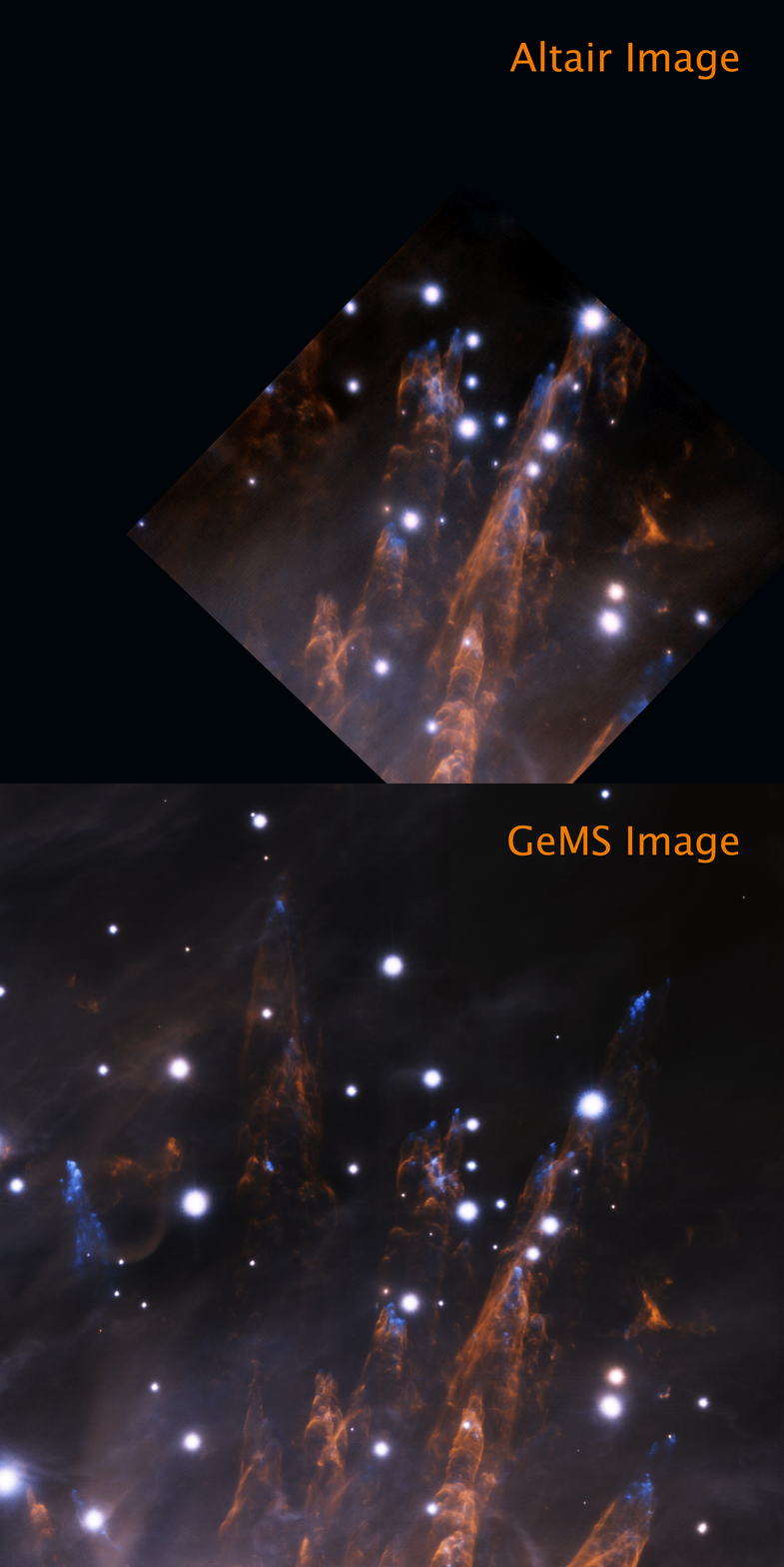
This animation compares the images obtained with Altair in 2007 with the new GeMS version obtained in December 2012. As the bullets (the blue dots at the end of the orange pillar) are moving at supersonic speeds, the comparison with the 2007 image illustrates this motion. In the new image, each single bullet has moved away from the star forming region located below the image's field-of-view and thanks to the high-resolution of AO correction these motions are easily detectable. Moreover, as the new GeMS/GSAOI instrument combination covers a larger field, more of these bullets can be monitored at once.  Image Credit: Gemini Observatory/AURA .  Download Animation: Medium Resolution | Full Resolution

Figure 2. Detailed views of the Orion Bullet region. In each image pair, left is the Altair 2007 image and right is the new 2012 GeMS image. This close-up view emphasizes the gain realized by MCAO and GeMS compared to normal AO (Altair). With the multiple lasers and deformable mirrors, MCAO allows for compensation of the elongations of star images seen in the Altair images. These elongations are due to atmospheric turbulence located at high altitudes that cannot be corrected using normal AO. MCAO is able to make these corrections and offers a unique and uniform correction across the entire field. The GeMS image also has a significantly larger field-of-view covering three times the area of sky compared to Altair. Moreover, the pixels are smaller by a factor of 2.5 in the MCAO image, realizing the potential to capture more details in the image. Combining the smaller pixels and bigger field-of-view, GeMS is dramatically more efficient than other existing AO systems. In effect, with Altair, one would need 5 to 20 times (depending on conditions) more telescope time to accomplish the same science compared to GeMS.  Image Credit: Gemini Observatory/AURA.  Full resolution JPEG | Full resolution TIF (12MB)

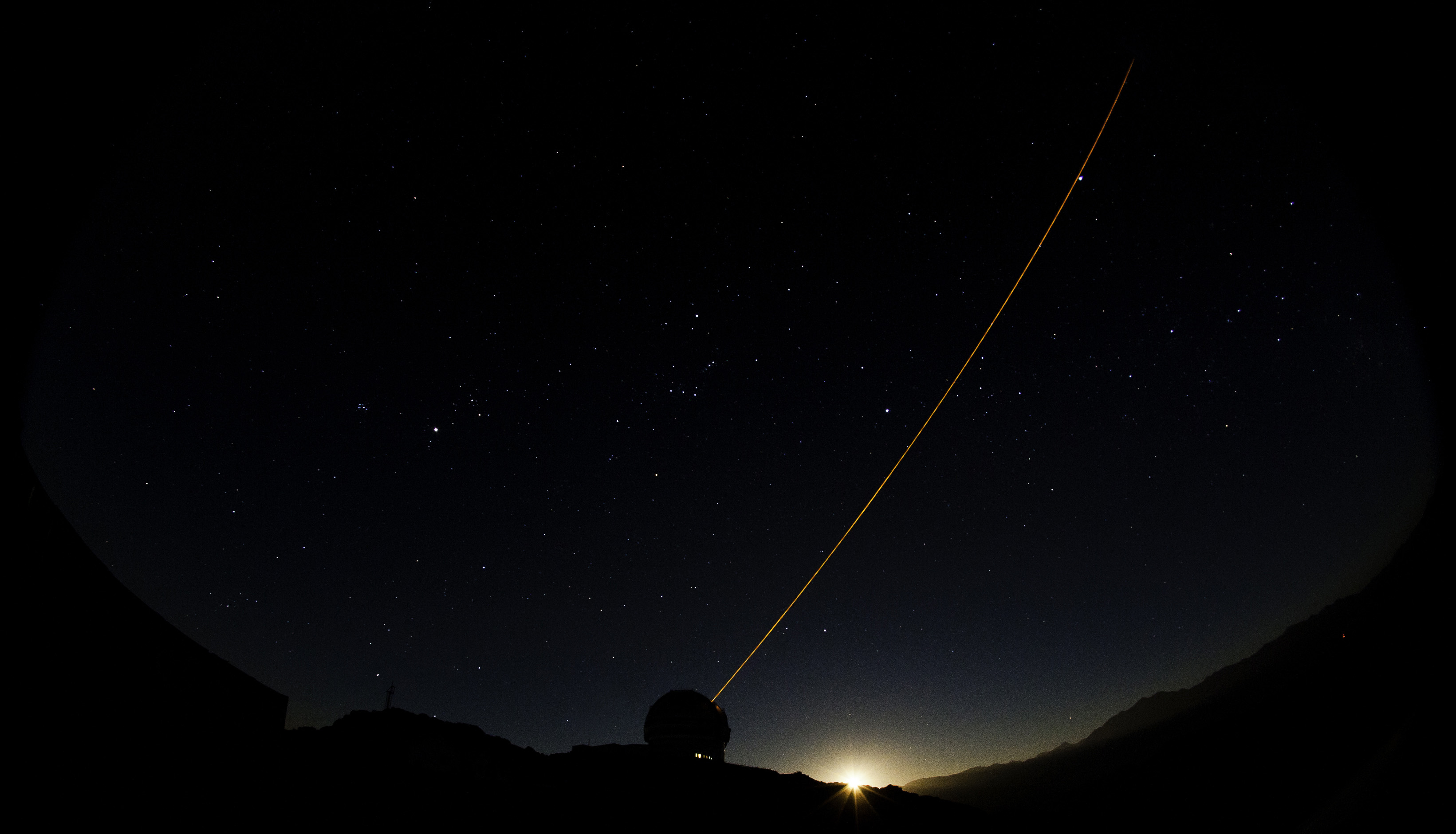
Figure 3. Propagation of the Gemini South Laser. 
Gemini Images by Manuel Paredes.
 Image Credit: Gemini Observatory/AURA

A new image released today reveals how Gemini Observatory's most advanced adaptive optics (AO) system will help astronomers study the universe with an unprecedented level of clarity and detail by removing distortions due to the Earth’s atmosphere. The photo, featuring an area on the outskirts of the famous Orion Nebula, illustrates the instrument's significant advancements over previous-generation AO systems.

"The combination of a constellation of five laser guide stars with multiple deformable mirrors allows us to expand significantly on what has previously been possible using adaptive optics in astronomy," said Benoit Neichel, who currently leads this adaptive optics program for Gemini. "For years our team has focused on developing this system, and to see this magnificent image, just hinting at its scientific potential, made our nights on the mountain - while most folks were celebrating the New Year’s holiday - the best celebration ever!"

The new system, called GeMS, is installed on the Gemini South telescope in Chile and is the first of its kind to use laser guide stars and a technology called Multi-Conjugate Adaptive Optics (MCAO) to image the sky. Motivated by MCAO's potential to produce a significantly larger field-of-view and more uniform corrections than previous AO systems, former Gemini scientist François Rigaut (now at the Australian National University), first suggested the system's development at Gemini over 10 years ago. According to Rigaut, "It's a great feeling to see this system on the sky and doing cutting-edge science. When it's all theoretical you dream of what it will someday do to improve our vision of the cosmos. An image like this makes it so real - it's worth all the mental sweat!"

"Adaptive optics allows ground-based telescopes to take full advantage of their large mirrors,” notes Dr. Gary Schmidt, Gemini program director for the U.S. National Science Foundation. “Gemini's development of MCAO leads the world, and its fidelity even surpasses that of current – and far more expensive – orbiting observatories for imaging the sky."

This milestone also bodes well for future generations of large ground-based telescopes. "As telescopes get larger they look through more and more of the Earth's atmosphere and this is a problem,” said Gary Sanders, Project Manager of the 30-Meter Telescope (TMT) Project. Sanders emphasizes that it is imperative that we find new and innovative ways to solve this problem by removing the distortions caused by the turbulent air overhead. “MCAO is a key technology that makes the next generation of large telescopes, like the TMT, justifiable. It allows us to use the light we collect more efficiently and see the universe more sharply than ever before in human history," said Sanders.

About five years ago, when GeMS was under development, and still just a vision for Rigaut and the team, Gemini Observatory released an image of a smaller section of this area of the Orion Nebula known as the "Orion Bullets." That image demonstrated the power of Gemini's AO system called Altair - which is still actively used at the Gemini North telescope. Gemini’s instrument scientist for Altair, Chad Trujillo, points out that in one shot GeMS covers a significantly larger field-of-view than Altair and, he adds, “The uniformity and performance across the image is amazing! In this new image, the pixels are 2.5 times finer and there are about 16 times more of them. Both the correction quality and the field-of-view are considerably better than the previous generation of AO systems.”

THE MCAO ADVANTAGE

The technology behind MCAO involves the use of multiple laser guide stars (five in the GeMS system) and several deformable mirrors (three in all) to sample atmospheric distortions and cancel them out in real-time as imaging data is collected. Using algorithms similar to those developed for medical tomographic imaging the GeMS MCAO system creates a three-dimensional snapshot of atmospheric turbulence about 500 to 1000 times per second. The result is about a 16-fold increase in the patch of sky observed, while providing uniform corrections over the entire field. "This is huge when it's time for astronomers to reduce their data," said Adam Ginsburg a graduate student working with John Bally at the University of Colorado who originally proposed that the GeMS system revisit the Orion bullets. "If the corrections are not uniform across the entire field it is difficult, and sometimes impossible, for researchers to compare one part of a dataset with another and errors proliferate,” said Ginsburg. Bally adds that MCAO should make this problem a non-issue.

GeMS, in conjunction with the Gemini South Adaptive Optics Imager (GSAOI), is undergoing commissioning and has obtained some early System Verification data. About 80 hours have been offered for the first semester of 2013, and more will be available in the second semester, for astronomers in the international partnership through the standard Gemini proposal process.

THE ORION BULLETS

Discovered in 1983, the Orion Bullets are clumps of gas ejected from deep within the Orion Nebula - located some 1500 light-years from our Solar System. The violence causing this is likely related to the recent formation of a cluster of massive stars with strong winds that can expel gas at supersonic speeds. The bullets (seen as distinctive blue features in the new Gemini image) are actually quite large, about 10 times the size of Pluto’s orbit around the Sun.

As the bullets speed outward, they leave behind distinctive tubular and cone-shaped wakes, which shine like tracers due to the bullets heating of the molecular hydrogen gas in the Orion Nebula. The wakes span much greater distances than the bullets, measuring as much as a fifth of a light-year in length. As Gemini first observed with Altair, the fingerlike wakes also resolve into filaments which are clearly resolved in the new Gemini GeMS image.


Media Contacts:
Peter Michaud (Attending AAS Long Beach)
Gemini Observatory, Hilo, HI
Cell: (808) 936-6643
Desk: (808) 974-2510

Antonieta Garcia (Spanish Language)
Gemini Observatory, La Serena, Chile
Desk: +56 (51) 205628

Science Contacts:
Peter Pessev (Attending AAS Long Beach)
Gemini Observatory, La Serena, Chile
Desk: +56 (51) 205668

Benoit Neichel
Gemini Observatory, La Serena, Chile
Desk: +56 (51) 205642

Friday, January 06, 2012

Revolutionary Instrument Propels Astronomical Imaging to New Extremes

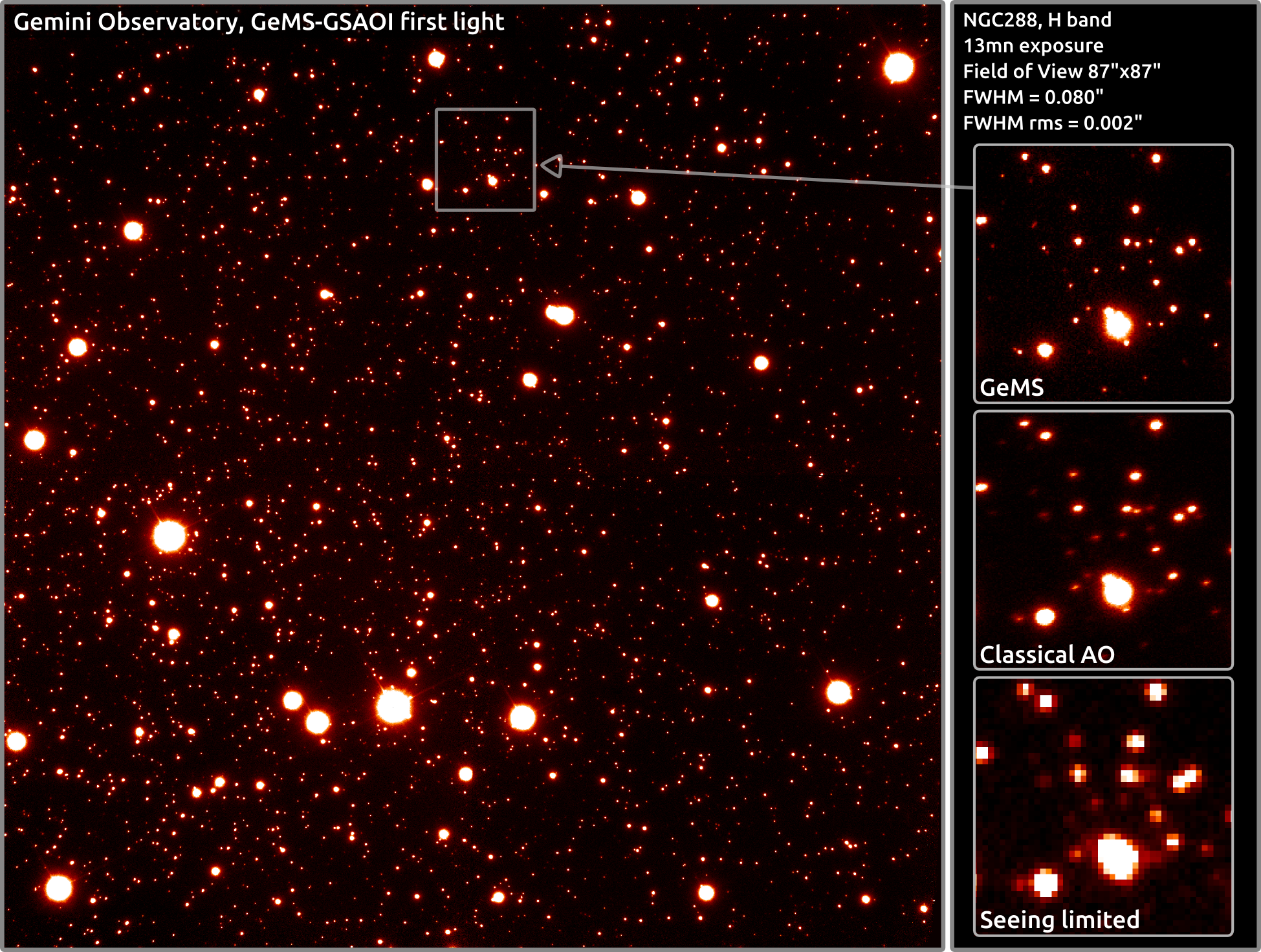
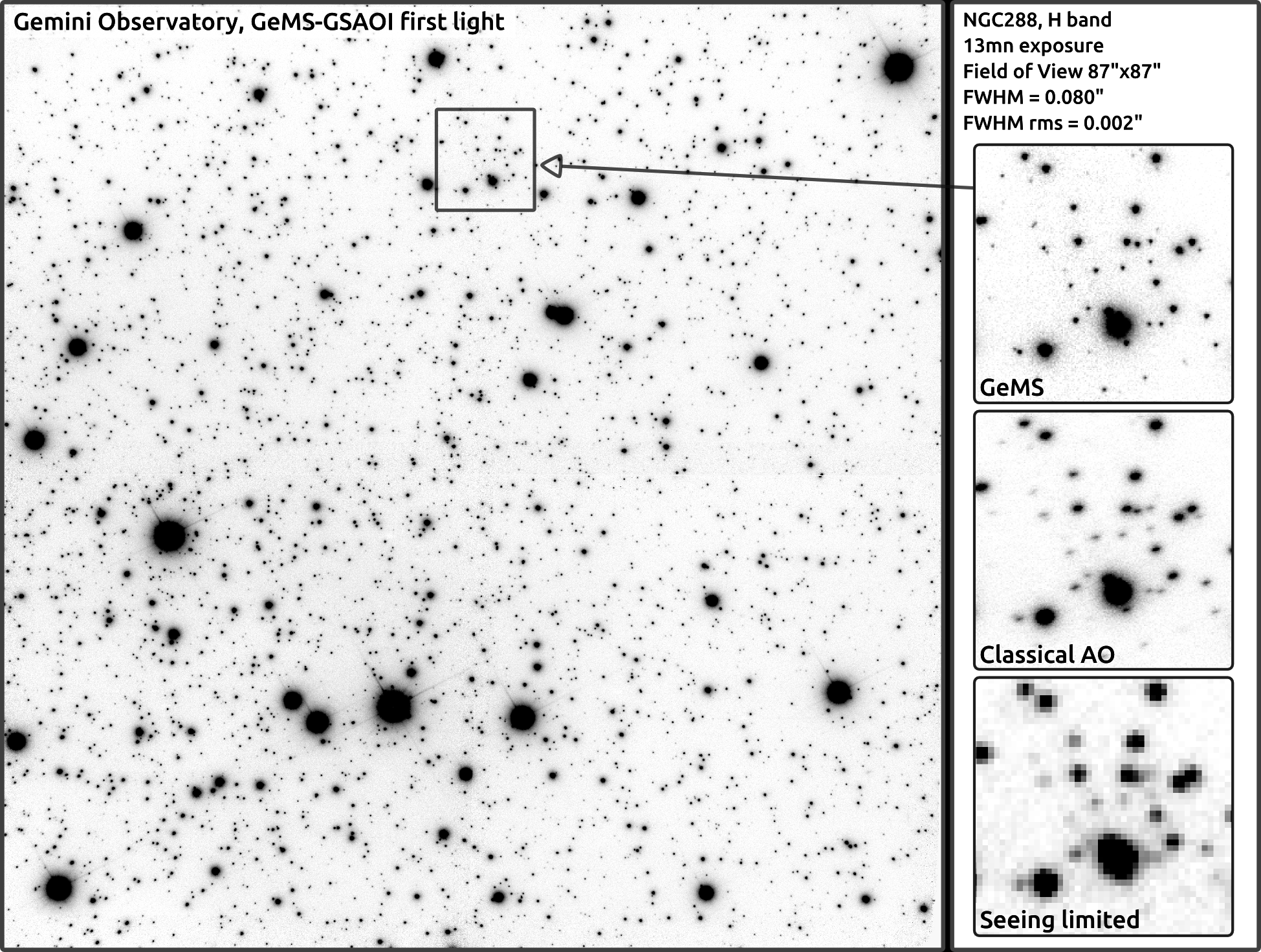
Figure 1: Gemini South’s first light image from GeMS/GSAOI shows extreme detail in the central part of the globular star cluster NGC 288. North is up, East is right. For more technical details on this image and others see the technical companion article here. High Resolution PNG | In Black & White

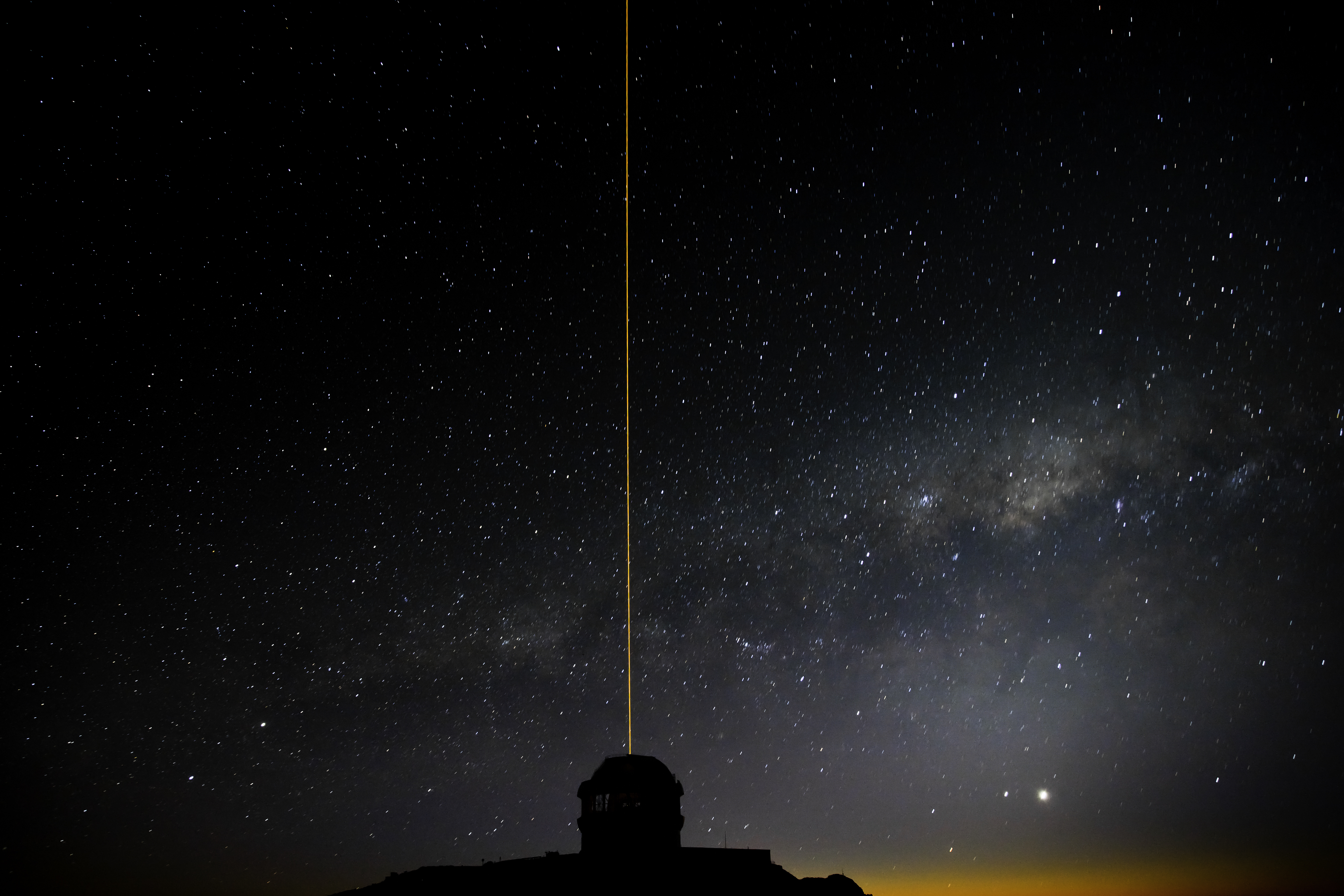
Figure 2: Gemini South laser guide star system propagating as the Milky Way rises. High Resolution JPG

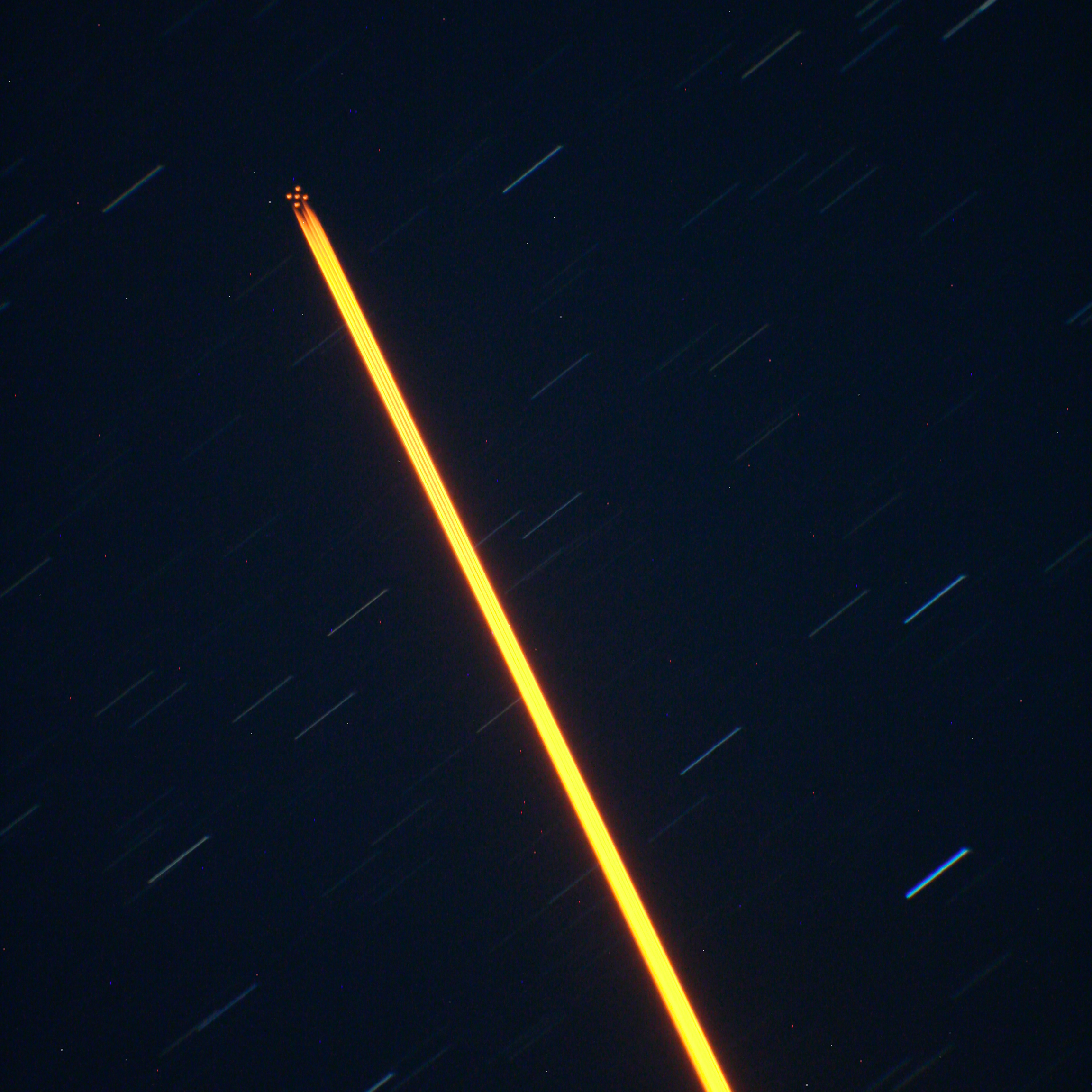
Figure 3: The Gemini South laser guide star “constellation” (upper left) is captured in this image by the lead of Gemini’s Optical Systems Group Maxime Boccas and Adaptive Optics Scientist Benoit Neichel. The image shows the 50-watt laser beam as it shines upward toward the atmospheric sodium layer about 90 kilometers above the earth’s surface to create a pattern of five artificial guide stars used to sample atmospheric turbulence for the Gemini Observatory’s GeMS adaptive optics system. The yellow-orange beam visible from lower right to upper left is caused by scattering of the laser's light by the Earth's lower atmosphere. The 30-second exposure was obtained on the night of January 21-22, 2011 and used a 500mm f/5.6 Celestron telescope with a Canon Rebel XT camera at an ISO setting of 1600. Image Credit: Gemini Observatory/AURA. High Resolution JPG

Gemini’s next-generation adaptive optics system produces highest-resolution with largest field-of-view ever captured from the ground using laser guide star technology.

For images and additional technical background information, see: www.gemini.edu/node/11718.

On December 16, 2011, a decade of hard work culminated at the Gemini South telescope in Chile, when a next-generation adaptive optics (AO) system produced its first ultra-sharp wide field image. The first target image showed a portion of a dense cluster of stars called NGC 288. This first light image reveals details at nearly the theoretical limit of Gemini’s large 8-meter mirror over an unprecedented large patch of the night sky.

The crispness of the first-light image clearly demonstrates the potential of the system, which is poised to provide astronomers with a powerful new tool for the study of a wide range of phenomena: from black holes at the centers of galaxies to the life histories of stars.

Called the Gemini Multi-conjugate adaptive optics System (GeMS for short), it uses five artificial guide stars made by a laser to provide extreme clarity over the largest area of night sky ever captured in a single AO observation — an area of the night sky which is 10 times larger than that covered by any other existing AO system in the world.

The reaction to this achievement has been swift and positive. When Space Telescope Science Institute director Matt Mountain saw the first light image, he praised the GeMS instrument team: “Incredible! You have truly revolutionized ground-based astronomy!”

Mountain was the director of the Gemini Observatory when the GeMS project began a decade ago. He also put together the original team, selecting François Rigaut as the lead scientist to develop the GeMS instrument.

Rigaut was in the Observatory’s control room high in the Chilean Andes when the new infrared image first appeared on the viewing monitor.

“We couldn’t believe our eyes!” Rigaut recalls. “The image of NGC 288 revealed thousands of pinpoint stars. Its resolution is Hubble-quality – and from the ground this is phenomenal.”

Rigaut explained that with the new gain in angular resolution the crowded city of stars captured in the first light image appears no more densely populated than a typical field in the Milky Way. “This is somewhat uncharted territory: no one has ever made images so large with such a high angular resolution.”

University of Toronto astronomer Roberto Abraham, one of a community of hundreds of astronomers worldwide who uses the 8-meter Gemini telescopes for cutting-edge research, was less reserved:

“This is fan-freaking-tastic!!!!!!!” he wrote.

The first light observing run culminated a decade-long effort in instrument planning and development. “We were lucky to have clear weather and stable atmospheric conditions that night,” said Gemini AO scientist Benoit Neichel. “Even despite interruptions of the laser propagation due to satellites and planes passing by, we obtained our first image with the system. It was surprisingly crisp and large, with an exquisitely uniform image quality.”

Gemini’s new system overcomes two limitations that have plagued the previous generation of AO systems: (1) a limited number of stars bright enough to guide on; and (2) a small field-of-view (the size of the patch of sky observed in a single observation).

While not a new solution, lasers have proved to be an effective solution to the first problem. When no "natural" guide star is available, an artificial one is created using a powerful laser emitting the well-known orange color used in some streetlights. This laser guide star technology is currently being used by observatories around the world, including both Gemini telescopes in Chile and Hawai‘i.

Gemini solved the field-of-view problem with a technique called Multi-Conjugate Adaptive Optics (MCAO). By using five laser guide stars (rather than a single one as in other systems), tomographic atmospheric modeling techniques borrowed from medical imaging, and several deformable mirrors, MCAO extends the field-of-view of AO systems by 10 times or more; it also produces images with exquisitely uniform image quality across the entire field-of-view. The Gemini Multi-Conjugate Adaptive Optics System (GeMS) is the first of its kind to combine laser guide stars with MCAO, which opens up more of the nighttime sky for detailed study.

“MCAO is game-changing,” Abraham said. "It’s going to propel Gemini to the next echelon of discovery space as well as lay a foundation for the next generation of extremely large telescopes. Gemini is going to be delivering amazing science while paving the way for the future.”

GeMS development started at Gemini in the early 2000s. The system was assembled in the Gemini instrumentation laboratories over the past four years and uses an infrared imager called the Gemini South AO Imager (GSAOI) built at the Australian National University. The GeMS team field-tested it on the telescope during several commissioning periods in 2011, and performed the final tests in mid-December.

GeMS work will continue through the first half of 2012. Testing will focus on stability, performance optimization, and integration into operations. It will gradually be opened to the Gemini astronomy community during 2012.

Background on Adaptive Optics: Taking the Twinkle Out of Starlight

Why adaptive optics? It’s the answer to some of the problems created by Earth’s atmosphere that have plagued astronomers for centuries. The atmosphere has two detrimental effects for astronomical observations. First, it filters out some incoming ultraviolet and part of the infrared spectrum. Second, warm and cold air mixing together create atmospheric turbulence, which causes starlight to twinkle and ground-based telescopic images to blur: a phenomenon called "seeing.” In good seeing, the atmosphere does not distort starlight as much as it does in bad seeing.

To surmount these two problems, some scientists have sent telescopes into orbit, an idea first suggested by German rocket scientist Hermann Oberth in the early 1920s. Although very successful, these endeavors are also very expensive.

In the 1950s, however, astronomer Horace Babcock (Mt. Wilson Observatory) derived an idea for solving the second problem. He imagined improving “seeing” by compensating for atmospheric distortions with special optics.

The first prototypes for astronomy of his novel idea were built in the 1980s and came to be known as adaptive optics (AO). The method uses a combination of light-wave sensors and deformable mirrors. AO un-poetically removes the twinkle from the star’s light and restores the ultimate angular resolution limit from a telescope’s optics. The end result is as if the atmospheric turbulence didn’t exist. By using AO on the current generation of large telescopes, this typically means being able to see a hundred times more detail in images of planets, stars, nebulae, or galaxies.

Science Contacts:

François Rigaut
Gemini Adaptive Optics Senior Scientist
Gemini Observatory, La Serena, Chile
Phone: +56-51-205 784
frigaut@gemini.edu

Benoit Neichel
Adaptive Optics Scientist
Gemini Observatory, La Serena, Chile
Phone: +56-51-205 642
bneichel@gemini.edu

Media Contacts:

Peter Michaud
Public Information and Outreach Manager
Gemini Observatory, Hilo, Hawai'i
Phone: (808) 974-2510
Cell: (808) 936-6643
pmichaud@gemini.edu

Antonieta Garcia
Media Specialist
Gemini Observatory, La Serena, Chile
Phone: +56-51-205 628
agarcia@gemini.edu

Monday, June 20, 2011

GeMS First Light: A New Generation of Adaptive Optics Begins

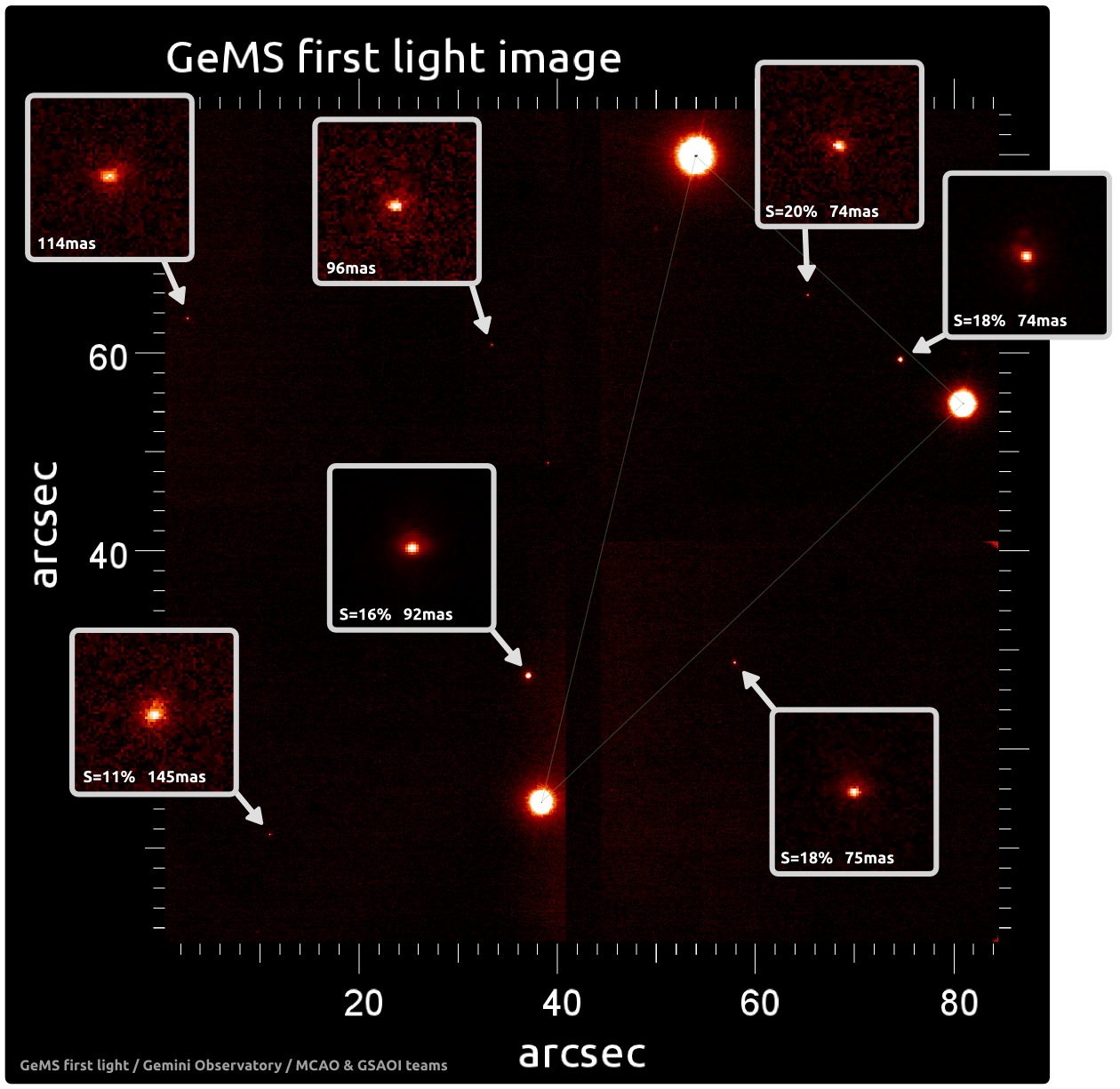
Figure 1. The engineering first light image obtained with GeMS and the Gemini South Adaptive Optics Imager GSAOI on April 19, 2011. The field of view is 85 x 85 arcseconds and the wavelength is 2.12 microns. Strehl ratio and full-width at half-maximum values for all stars are shown in the insets. This image was obtained after only 30 minutes of focusing and optimization – it is by no means representative of what is expected from the fully-commissioned system. However, it is very encouraging and already illustrates the main advantage of MCAO, which is a relatively uniform compensation across a large field of view. Note that the poorer image quality on the left edge is expected, as these stars are outside the constellation defined by the three bright stars in the right half used to control Tip-Tilt.Download full-resolution PNG 0.9 MB

In early April 2011, after more than a decade of effort, the Gemini Multi-Conjugate Adaptive Optics System (GeMS) saw starlight for the first time. With this milestone GeMS kicked off a new era in adaptive optics (AO) technologies both for Gemini and for future generations of even larger telescopes that will require advanced AO to make them scientifically viable. These first GeMS photons, captured on April 19, 2011 (see Figure 1), kept hopes high for equally successful progress when commissioning resumes in late 2011 and then for system verification in early 2012.

Adaptive Optics is a well-known technology that compensates for image distortions induced by atmospheric turbulence. The vast majority of large telescopes in the world are now equipped with AO systems of various kinds, and many use lasers to create artificial stars (laser guide stars, LGS) in order to probe and correct for atmospheric turbulence over a larger portion of the sky (e.g. Altair at Gemini North). Multi-Conjugate Adaptive Optics (MCAO) is a relatively novel concept, in which the distortions are compensated by using not one, but a series of deformable mirrors and multiple guide stars. In effect, this provides compensation in three dimensions versus the two dimensions for classical (existing) AO systems. The impact on data is that there is a ten-fold increase in the size of the corrected field of view and significantly more uniform corrections across the entire field than classical AO. GeMS is the first instrument to use MCAO with multiple laser guide stars – thus explaining the long development cycle which began in 2001.

In March 2010 Gemini received the 50-watt sodium laser built by Lockheed Martin Coherent Technology. Following this, Canopus, the GeMS optical bench, made its much-anticipated trek from the Gemini South Base Facility integration laboratory to the Cerro Pachón summit in November 2010. The installation on the telescope in January 2011 marked the beginning of a five-month commissioning marathon for the Gemini MCAO team. The first two commissioning periods – one week in January and one in February – were dedicated to the laser and associated subsystems, beam transfer optics, laser launch telescope and various laser safety systems. The laser generally performed well, delivering between 45 and 60 watts of yellow (sodium) light (see the June 2011 issue of GeminiFocus, pages 23-28). After initial concerns about the laser guide star spot size we regularly obtained spot sizes of 1.3 arcseconds as viewed by the telescope’s acquisition camera system.

The commissioning of Canopus started in March, with two subsequent runs in April and May, for a total of nine clear nights. To date, the commissioning has concentrated on functionality since this very complex instrument includes multiple subsystems linked together by closed loops and offloads that the MCAO team had to characterize, debug and optimize. Currently, almost all subsystems, loops and offloads are working, which include: the main LGS loop, the natural guide star (NGS) loops, all telescope offloads, the LGS and NGS acquisition sequences, and many others. The technical first light image shown in Figure 1 was obtained on April 19 with plans to continue commissioning through May. However, bad weather and various technical issues prevented making much more progress in areas such as performance optimization and characterization as well as plans to acquire additional astronomical images which would demonstrate the system’s capabilities more dramatically.

In early June 2011, GeMS entered a five-month rework period. Significant work on the laser to insure better beam quality, stability and reliability is planned. Stability issues in the Beam Transfer Optics will also be addressed. Finally, various Canopus subsystems will be upgraded, with a particular effort to improve the optical throughput of the natural guide star wavefront sensors. Commissioning should resume at the end of 2011, with a focus on performance and integration with the observatory high-level software. System Verification (SV) is expected to occur in the first half of 2012.