Showing posts with label Dark Energy Camera (DECam). Show all posts

Monday, September 19, 2022

Dark Energy Camera Captures Bright, Young Stars Blazing Inside Glowing Nebula

Dark Energy Camera Captures Bright, Young Stars Blazing Inside Glowing Nebula 


Videos


CosmoView Episodio 52: Dark Energy Camera Captures Bright, Young Stars Blazing Inside Glowing Nebula
CosmoView Episodio 52: Dark Energy Camera Captures Bright, Young Stars Blazing Inside Glowing Nebula 
 
Zoom-in to DECam Image of Lobster Nebula
Zoom-in to DECam Image of Lobster Nebula 
 
Pan of DECam image of the Lobster Nebula
Pan of DECam image of the Lobster Nebula 
 
CosmoView Episodio 52: Tololo celebra 10 años de la Cámara de Energía Oscura con impresionante imagen


To celebrate 10 years of discovery, the DOE-built DECam unveils thousands of stars shining in and around the Lobster Nebula

The 570-megapixel US Department of Energy-fabricated Dark Energy Camera at NOIRLab’s Cerro Tololo Inter-American Observatory in Chile is one of the most powerful tools in astronomy and astrophysics. To commemorate its first decade of discovery and exploration, NOIRLab has released a stunning image of the Lobster Nebula, a brilliant star-forming region located 8000 light-years from Earth in the direction of the constellation Scorpius. The image was unveiled at a conference highlighting DECam’s breakthrough science results.

The Dark Energy Camera (DECam) mounted on the Víctor M. Blanco 4-meter Telescope at Cerro Tololo Inter-American Observatory in Chile, a Program of NSF’s NOIRLab, is celebrating 10 years as one of the highest-performance, wide-field CCD imagers in the world. 

To help commemorate DECam’s first decade of operation, NOIRLab has released a breathtaking image of the star-forming Lobster Nebula (NGC 6357), which is located about 8000 light-years from Earth in the direction of the constellation Scorpius. This image reveals bright, young stars surrounded by billowing clouds of dust and gas. 

At the center of the nebula, which spans about 400 light-years, resides the open star cluster Pismis 24 — a collection of dazzlingly bright, massive stars. Surrounding this cluster is a region brimming with newborn stars, protostars still wrapped in their cocoons of star-forming material, and dense cores of gas and dust that will eventually become new stars. The twisting braids of dark clouds and complex structures inside the nebula are formed by the tumultuous pressure of interstellar winds, radiation, and powerful magnetic fields. 

One of the most striking things about this image is the beautifully detailed color palette selected to highlight different aspects of the nebula. This wide-field, high-resolution image showcases the power of DECam and its ability to produce stunning images while helping astronomers study the fundamental properties of the Universe.

This image was constructed using some of a new range of very special DECam narrowband filters, which isolate very specific wavelengths of light. They make it possible to infer the physics of distant objects, including important details about their inner motions, temperatures, and complex chemistry, which is especially important when examining star-forming regions like the Lobster Nebula.

In order to create a colorful image such as this one, the same celestial object is observed multiple times using different filters. Each observation provides a single-color image, which encompases a specific range of light waves. Imaging specialists then take these individual images and assign a corresponding color to each of them. The images can then be stacked on top of one another to create a composite that closely approximates what objects might look like if they were far brighter.

The image was unveiled at the DECam at 10 years: Looking Back, Looking Forward conference, which highlighted the outstanding DECam science results of the past 10 years and the exciting opportunities with DECam as astronomy looks to the future with Vera C. Rubin Observatory, currently under construction on Cerro Pachón in Chile. DECam has just passed the remarkable milestone of taking one million individual exposures, delivering on average 400 to 500 images per night.

DECam was operated by the DOE and NSF between 2013 and 2019. DECam was funded by the DOE and was built and tested at DOE's Fermilab. Currently, DECam is used for programs covering a huge range of science.

The image was obtained by NOIRLab’s Communication, Education & Engagement team as part of the NOIRLab Legacy Imaging Program.


More Information

NSF’s NOIRLab (National Optical-Infrared Astronomy Research Laboratory), the US center for ground-based optical-infrared astronomy, operates the international Gemini Observatory (a facility of NSF, NRC–Canada, ANID–Chile, MCTIC–Brazil, MINCyT–Argentina, and KASI–Republic of Korea), Kitt Peak National Observatory (KPNO), Cerro Tololo Inter-American Observatory (CTIO), the Community Science and Data Center (CSDC), and Vera C. Rubin Observatory (in cooperation with DOE’s SLAC National Accelerator Laboratory). It is managed by the Association of Universities for Research in Astronomy (AURA) under a cooperative agreement with NSF and is headquartered in Tucson, Arizona. The astronomical community is honored to have the opportunity to conduct astronomical research on Iolkam Du’ag (Kitt Peak) in Arizona, on Maunakea in Hawai‘i, and on Cerro Tololo and Cerro Pachón in Chile. We recognize and acknowledge the very significant cultural role and reverence that these sites have to the Tohono O'odham Nation, to the Native Hawaiian community, and to the local communities in Chile, respectively.

NCSA at the University of Illinois at Urbana-Champaign provides supercomputing and advanced digital resources for the nation’s science enterprise. At NCSA, University of Illinois faculty, staff, students, and collaborators from around the globe use advanced digital resources to address research grand challenges for the benefit of science and society. NCSA has been advancing one-third of the Fortune 50® for more than 30 years by bringing industry, researchers, and students together to solve grand challenges at rapid speed and scale. 

Fermilab is America’s premier national laboratory for particle physics and accelerator research. A US Department of Energy Office of Science laboratory, Fermilab is located near Chicago, Illinois, and operated under contract by the Fermi Research Alliance LLC, a joint partnership between the University of Chicago and the Universities Research Association, Inc. 

The DOE Office of Science is the single largest supporter of basic research in the physical sciences in the United States and is working to address some of the most pressing challenges of our time.


Links


Contacts:

Travis Rector
NSF's NOIRLab & University of Alaska
Tel: +1 907 786 1242
Email:
tarector@alaska.edu

Charles Blue
Public Information Officer
NSF’s NOIRLab
Tel: +1 202 236 6324
Email:
charles.blue@noirlab.edu

Source: NSF’s National Optical-Infrared Astronomy Research Laboratory (NOIRLab)/News


Monday, February 08, 2021

The Spiral of the Southern Pinwheel

Southern Pinwheel Galaxy, Messier 83 


Video

CosmoView Episode 21: The Spiral of the Southern Pinwheel
CosmoView Episode 21: The Spiral of the Southern Pinwheel 
 
Zooming on M83
Zooming on M83


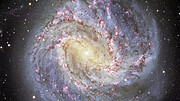
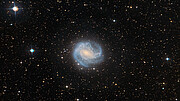
The Dark Energy Camera (DECam), which was originally designed for the Dark Energy Survey, has captured one of the deepest images ever taken of Messier 83, a spiral galaxy playfully known as the Southern Pinwheel. Built by the US Department of Energy, DECam is mounted on the Víctor M. Blanco 4-meter Telescope at the Cerro Tololo Inter-American Observatory (CTIO), a Program of NSF’s NOIRLab.

Astronomy enthusiasts might wonder why a camera called the Dark Energy Camera (DECam) would be used to image a single spiral galaxy. DECam has in fact already finished its main job, as the instrument was used to complete the Dark Energy Survey, which ran from 2013 to 2019. Like many people, rather than enjoying a quiet retirement, DECam is remaining occupied. Members of the astronomical community can apply for time to use it, and the data collected are processed and made publicly available [1], thanks to the Astro Data Archive at the Community Science and Data Center (CSDC) Program at NSF’s NOIRLab. DECam’s continued operation also makes sumptuously detailed images like this one possible.

Messier 83, or the Southern Pinwheel, is located in the southern constellation of Hydra and is an obvious target for a beautiful astronomical image. It is oriented so that it is almost entirely face-on as seen from Earth, meaning that we can observe its spiral structure in fantastic detail. The galaxy lies around 15 million light-years away, which makes it a neighbor in astronomical terms. It has a diameter of around 50,000 light-years, so it is a little diminutive in comparison to our own Milky Way, which has a diameter of 100,000–200,000 light-years. In other ways, however, the Southern Pinwheel probably gives a good approximation of how our Milky Way would look to a distant alien civilization.

Six different filters were used on DECam in order to create this spectacular new view of a classical beauty. Filters allow astronomers to select which wavelengths of light they wish to view the sky in. This is crucial for science observations, when astronomers require very specific information about an object, but it also allows colorful images like this one to be created. Observing celestial objects — such as the Southern Pinwheel — with several different filters means that different details can be picked out. For example, the dark tendrils curling through the galaxy are actually lanes of dust, blocking out light. In contrast, the clustered, bright red spots are caused by glowing, hot hydrogen gas (which identifies these as hubs of star formation). Dusty trails and dynamic ionized gas have different temperatures, and are therefore visible in different wavelengths. Filters allow both to be observed separately, and then combined into one intricate image. In all, 163 DECam exposures, with a total combined exposure time of over 11.3 hours, went into creating this portrait of Messier 83. 

Yet these observations were not just about creating a pretty picture. They are helping to prepare for upcoming observations by Vera C. Rubin Observatory, a future program of NOIRLab. In ten years of operation, starting in 2023, Rubin Observatory will carry out an unprecedented optical survey of the visible sky named the Legacy Survey of Space and Time (LSST). “The Messier 83 observations are part of an ongoing program to produce an atlas of time-varying phenomena in nearby southern galaxies in preparation for Rubin Observatory’s Legacy Survey of Space and Time,” said Monika Soraisam of the University of Illinois, who is the principal investigator for DECam’s observations of Messier 83. “We are generating multi-color light curves of stars in this galaxy, which will be used to tame the onslaught of alerts expected from LSST using state-of-the-art software infrastructure such as NOIRLab's own ANTARES alert-broker.” [2]

Built by the US Department of Energy (DOE), DECam is mounted on the Víctor M. Blanco 4-meter Telescope at CTIO in Chile. DECam is a powerful instrument that uses 74 highly sensitive charge-coupled devices (CCDs) to take images. CCDs are the same devices that are used to take photos in everyday cell phones. Of course, the CCDs in DECam are much larger, and they were specifically designed to collect very faint red light from distant galaxies. This capability was crucial for DECam’s original purpose, the Dark Energy Survey. This ambitious survey probed one of the most fundamental questions of the Universe — why is our Universe not only expanding, but expanding at an accelerating rate? For six years DECam surveyed the skies, imaging the most distant galaxies to collect more data to enable astronomers to further investigate our accelerating Universe. Taking beautiful images such as this one must seem a lot simpler for DECam.

“While DECam has fulfilled its original goal to complete the Dark Energy Survey, it continues to be a valuable resource for the astronomical community, capturing sweeping views of objects like Messier 83 that both delight the senses and advance our understanding of the Universe,” said Chris Davis, Program Director for NOIRLab at the National Science Foundation.


Source: NOIRLab/News


Notes

[1] Data from DECam typically have an 18-month proprietary period to allow the principal investigators who requested the observations time to perform their research before the data are released publicly for anyone to use. 

[2] ANTARES is a software tool built at NOIRLab to process information about changing objects in the night sky and to help distribute that information to the astronomical community.


More Information 

NSF’s NOIRLab (National Optical-Infrared Astronomy Research Laboratory), the US center for ground-based optical-infrared astronomy, operates the international Gemini Observatory (a facility of NSF, NRC–Canada, ANID–Chile, MCTIC–Brazil, MINCyT–Argentina, and KASI–Republic of Korea), Kitt Peak National Observatory (KPNO), Cerro Tololo Inter-American Observatory (CTIO), the Community Science and Data Center (CSDC), and Vera C. Rubin Observatory (in cooperation with DOE’s SLAC National Accelerator Laboratory). It is managed by the Association of Universities for Research in Astronomy (AURA) under a cooperative agreement with NSF and is headquartered in Tucson, Arizona. The astronomical community is honored to have the opportunity to conduct astronomical research on Iolkam Du’ag (Kitt Peak) in Arizona, on Maunakea in Hawai‘i, and on Cerro Tololo and Cerro Pachón in Chile. We recognize and acknowledge the very significant cultural role and reverence that these sites have to the Tohono O'odham Nation, to the Native Hawaiian community, and to the local communities in Chile, respectively.


Links


Contact:

Amanda Kocz
Press and Internal Communications Officer
NSF’s NOIRLab
Cell: +1 626 524 5884
Email:
amanda.kocz@noirlab.edu