Showing posts with label Cosmic radio bursts. Show all posts

Wednesday, October 06, 2021

Process leading to supernova explosions and cosmic radio bursts unearthed at PPPL

Physicist Kenan Qu with figures from his paper. 
(Photo of Qu by Elle Starkman/Office of Communications
Collage by Kiran Sudarsanan. Hi-res image

A promising method for producing and observing on Earth a process important to black holes, supernova explosions and other extreme cosmic events has been proposed by scientists at Princeton University’s Department of Astrophysical Sciences, SLAC National Acceleraor Laboratory, and the U.S. Department of Energy’s (DOE) Princeton Plasma Physics Laboratory (PPPL). The process, called quantum electrodynamic (QED) cascades, can lead to supernovas – exploding stars – and fast radio bursts that equal in milliseconds the energy the sun puts out in three days.

First demonstration

The researchers produced the first theoretical demonstration that colliding a laboratory laser with a dense electron beam can produce high-density QED cascades. “We show that what was thought to be impossible is in fact possible,” said Kenan Qu, lead author of a paper in Physical Review Letters (PRL) that describes the breakthrough demonstration. “That in turn suggests how previously unobserved collective effects can be probed with existing state-of-the-art laser and electron beam technologies.”

The process unfolds in a straightforward manner. Colliding a strong laser pulse with a high energy electron beam splits a vacuum into high-density electron-positron pairs that begin to interact with one another. This interaction creates what are called collective plasma effects that influence how the pairs respond collectively to electrical or magnetic fields.

Plasma, the hot, charged state of matter composed of free electrons and atomic nuclei, makes up 99 percent of the visible universe. Plasma fuels fusion reactions that power the sun and stars, a process that PPPL and scientists around the world are seeking to develop on Earth. Plasma processes throughout the universe are strongly influenced by electromagnetic fields.

The PRL paper focuses on the electromagnetic strength of the laser and the energy of the electron beam that the theory brings together to create QED cascades. “We seek to simulate the conditions that create electron-positron pairs with sufficient density that they produce measurable collective effects and see how to unambiguously verify these effects,” Qu said.

The tasks called for uncovering the signature of successful plasma creation through a QED process. Researchers found the signature in the shift of a moderately intense laser to a higher frequency caused by the proposal to send the laser against an electron beam. “That finding solves the joint problem of producing the QED plasma regime most easily and observing it most easily,” Qu said. “The amount of the shift varies depending on the density of the plasma and the energy of the pairs.”

Beyond current capabilities

Theory previously showed that sufficiently strong lasers or electric or magnetic fields could create QED pairs. But the required magnitudes are so high as to be beyond current laboratory capabilities.

However, “It turns out that current technology in lasers and relativistic beams [that travel near the speed of light], if co-located, is sufficient to access and observe this regime,” said physicist Nat Fisch, professor of astrophysical sciences and associate director for academic affairs at PPPL, and a co-author of the PRL paper and principal investigator of the project. “A key point is to use the laser to slow down the pairs so that their mass decreases, thereby boosting their contribution to the plasma frequency and making the collective plasma effects greater,” Fisch said. “Co-locating current technologies is vastly cheaper than building super-intense lasers,” he said. This work was funded by grants from the National Nuclear Security Administration and the Air Force Office of Scientific Research. Researchers now are gearing up to test the theoretical findings at SLAC at Stanford University, where a moderately strong laser is being developed and the source of electrons beams is already there. Physicist Sebastian Meuren, a co-author of the paper and a former post-doctoral visitor at PPPL who now is at SLAC, is centrally involved in this effort.

“Like most fundamental physics this research is to satisfy our curiosity about the universe,” Qu said. “For the general community, one big impact is that we can save billions of dollars of tax revenue if the theory can be validated.”

PPPL, on Princeton University's Forrestal Campus in Plainsboro, N.J., is devoted to creating new knowledge about the physics of plasmas — ultra-hot, charged gases — and to developing practical solutions for the creation of fusion energy. The Laboratory is managed by the University for the U.S. Department of Energy’s Office of Science, which is the single largest supporter of basic research in the physical sciences in the United States and is working to address some of the most pressing challenges of our time.

For more information, visit energy.gov/science

John Greenwald


Friday, December 04, 2015

Cosmic Radio Bursts yield first clues about their origins

An artist’s rendering of a Fast Radio Burst arriving at the Green Bank Telescope. Fast Radio Bursts are brief and highly energetic pulses of radio waves from the distant universe. Recent research suggests the bursts originate in deep space near what may be a supernova remnant or a stellar nursery.

Image: Jingchuan Yu, Beijing Planetarium


With the help of the world’s largest steerable radio telescope, a team of researchers that includes a University of Wisconsin-Madison physicist has produced the first detailed portrait of a Fast Radio Burst — a brief but highly energetic pulse of radio waves from unknown sources in the distant universe.

First detected about a decade ago, Fast Radio Bursts pack more energy than our sun emits over hundreds of thousands of years. So far, astrophysicists have conclusively detected only 15 such events. What causes the bursts is a mystery.

But now, with the help of hundreds of hours of archived data from the National Science Foundation’s Green Bank Telescope, researchers have pieced together the first detailed picture of a Fast Radio Burst, indicating it originated inside a highly magnetized region of space dense with matter, possibly as a supernova remnant or the energetic environment of a stellar nursery.

Photo: Peter Timbie
Peter Timbie

The new study is reported today (Dec. 2, 2015) in the journal Nature.

“Nobody really knows what these things are,” explains Peter Timbie, a University of Wisconsin-Madison professor of physics and a co-author of the new report.

According to Timbie, whose archived data from the Green Bank Telescope was used to help inform the study, astrophysicists now think that Fast Radio Bursts occur far more frequently than the scant evidence of their existence suggests, with detectable events possibly occurring thousands of times a day.

The reason they weren’t detected in the volumes of data captured each day by the world’s radio telescopes is that there was no specific algorithm for sorting the objects in the data from the many different types of phenomena radio astronomers are looking for. Using new software of their own design, Kiyoshi Masui of the University of British Columbia and his colleague Jonathan Sievers of the University of KwaZulu-Natal in Durban, South Africa, identified a new Fast Radio Burst, named FRB 110523, from data first obtained and archived by Timbie and his Wisconsin colleague Christopher J. Anderson, as well as other radio astronomers.

Timbie and Anderson work as part of a group attempting to sketch out the large-scale structure of the universe by three-dimensionally mapping the distribution of neutral hydrogen atoms in space. Some of their work depends on radio telescope observations such as those made at the Green Bank observatory.

Fast Radio Bursts pack more energy than our sun emits over hundreds of thousands of years.

Masui and Sievers mined nearly 700 hours or archived data, identified the new Fast Radio Burst, and provided the most detailed record to date of a Fast Radio Burst, this one originating an estimated 6 billion light years from Earth.

“It was in the data, but we didn’t notice it,” says Timbie, explaining that the Fast Radio Burst flashes only briefly in a large volume of data and that as radio signals travel cosmological distances they are “smeared out.” Thus, the short, sharp signal of a Fast Radio Burst can be hiding in plain sight.

The new data analysis software, notes Timbie, not only promises to make the discovery of Fast Radio Bursts a much more common occurrence, but is likely to continue to demystify objects astronomers have puzzled over for a decade.

“We now have more information about the source than previous measurements,” Timbie observes. 
“Because of the nature of the pulse, we can say that it is in an environment where there is a lot of matter.”

Such environments are consistent with things like supernova remnants or stellar nurseries, where dense concentrations of matter are continuously churned into new stars.


Monday, July 08, 2013

Cosmic radio bursts point to cataclysmic origins


Image and Video Credits:[Swinburne Astronomy Productions, vr.swin.edu.au]
 

Mysterious bursts of radio waves originating from billions of light years away have left the scientists who detected them speculating about their origins. 

The international research team, writing in the journal Science, rule out terrestrial sources for the four fast radio bursts and say their brightness and distance suggest they come from cosmological distances when the Universe was just half its current age. 

The burst energetics indicate that they originate from an extreme astrophysical event involving relativistic objects such as neutron stars or black holes. 

Study lead Dan Thornton, a PhD student at England’s University of Manchester and Australia’s Commonwealth Scientific and Industrial Research Organisation, said the findings pointed to some extreme events involving large amounts of mass or energy as the source of the radio bursts. 

He said: “A single burst of radio emission of unknown origin was detected outside our Galaxy about six years ago but no one was certain what it was or even if it was real, so we have spent the last four years searching for more of these explosive, short-duration radio bursts. This paper describes four more bursts, removing any doubt that they are real. The radio bursts last for just a few milliseconds and the furthest one that we detected was several billion light years away.” 

Astonishingly, the findings – taken from a tiny fraction of the sky – also suggest that there should be one of these signals going off every 10 seconds. Max-Planck Institute Director and Manchester’s Professor Michael Kramer explained: “The bursts last only a tenth of the blink of an eye. With current telescopes we need to be lucky to look at the right spot at the right time. But if we could view the sky with ‘radio eyes’ there would be flashes going off all over the sky every day.” 

The team, which included researchers from the UK, Germany, Italy, Australia and the US, used the CSIRO Parkes 64metre radio telescope in Australia to obtain their results. 

Co-author Professor Matthew Bailes, from the Swinburne University of Technology in Melbourne, thinks the origin of these explosive bursts may be from magnetic neutron stars, known as ‘magnetars’. He said: “Magnetars can give off more energy in a millisecond than our Sun does in 300,000 years and are a leading candidate for the burst.” 

The researchers say their results will also provide a way of finding out the properties of space between the Earth and where the bursts occurred. 

Author Dr Ben Stappers, from Manchester’s School of Physics and Astronomy, said: “We are still not sure about what makes up the space between galaxies, so we will be able to use these radio bursts like probes in order to understand more about some of the missing matter in the Universe. We are now starting to use Parkes and other telescopes, like the Lovell Telescope of the University of Manchester, to look for these bursts in real time.”


Notes for Editors

A copy of the paper, ‘A Population of Fast Radio Bursts at Cosmological Distances,’ published in Science on 5 July 2013, is available under embargo conditions on request.

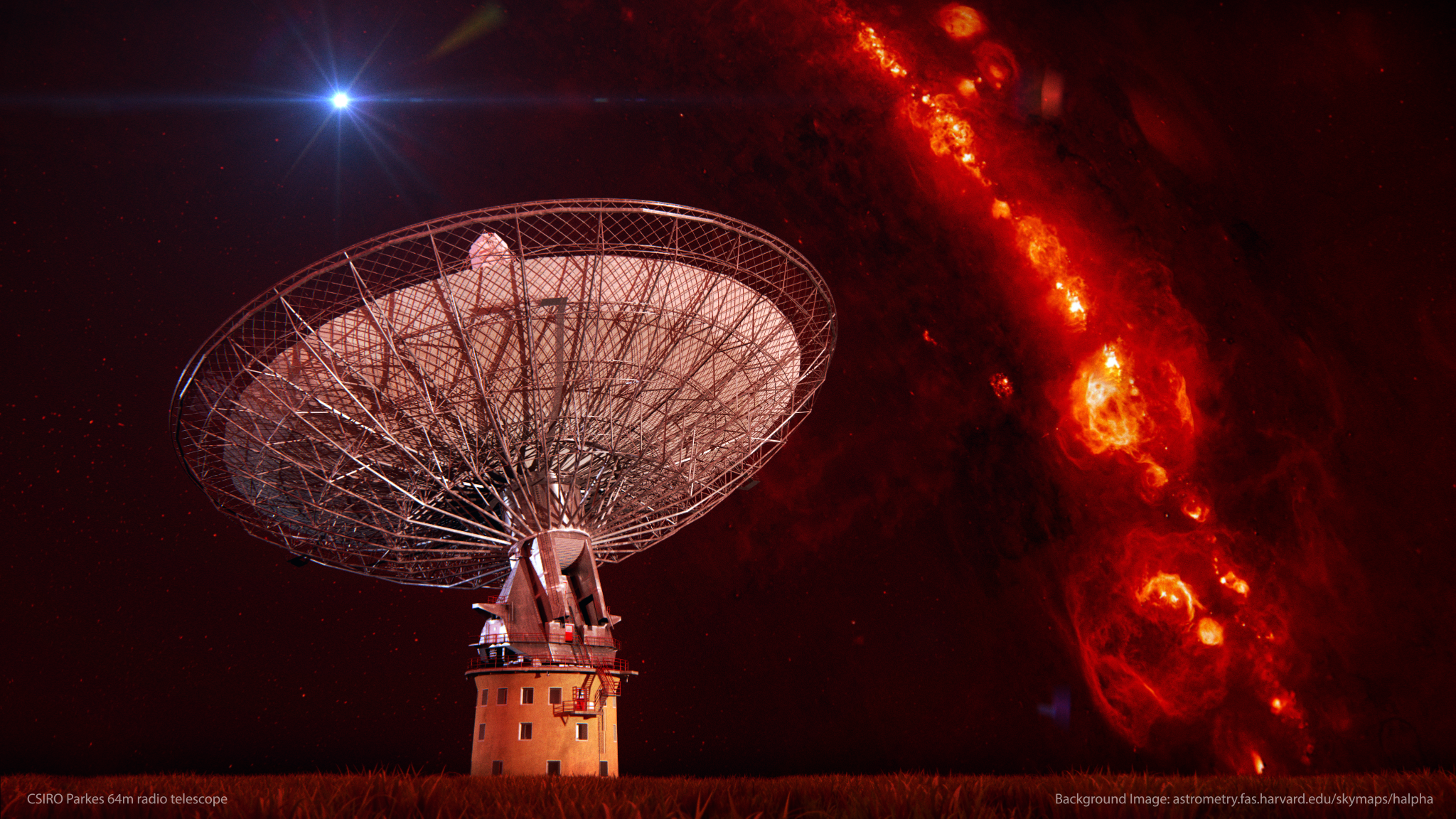
An artist’s impression of the radio wave bursts and the CSIRO Parkes radio telescope in Australia, as well as a short video of three bursts going off in the night sky, is available here: http://astronomy.swin.edu.au/production/parkes/ (Credit: Swinburne Astronomy Productions)

The institutions involved in the collaboration were the University of Manchester’s Jodrell Bank Observatory, the Max-Planck Institute for Radio Astronomy, Bonn, the INAF-Cagliari Astronomical Observatory and the Cagliari University, Sardinia, Swinburne University of Technology, Melbourne, the Commonwealth Scientific and Industrial Research Organisation (CSIRO), Sydney, the Australian Research Council Centre of Excellence for All-Sky Astrophysics (CAASTRO), Curtin University, Western Australia, West Virginia University, US, and the NASA Jet Propulsion Laboratory, California.

Contacts

Aeron Haworth
Media Relations
Faculty of Engineering and Physical Sciences
The University of Manchester
Tel: 0161 275 8387
Mob: 07717 881563
Email: aeron.haworth@manchester.ac.uk