
Videos

PR Video noirlab2519a
Pan on the Chamaeleon I Dark Cloud
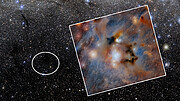
PR Video noirlab2519b
Zooming into the Chamaeleon I Dark Cloud

PR Video noirlab2519c
PR Video noirlab2519a
Pan on the Chamaeleon I Dark Cloud
PR Video noirlab2519b
Zooming into the Chamaeleon I Dark Cloud
PR Video noirlab2519c
Cosmoview Episode 99: Dark Energy Camera Captures Sparse Pockets of Light Amongst Dark Clouds of Chamaeleon I (horizontal)

Cosmoview Episode 99: Dark Energy Camera Captures Sparse Pockets of Light Amongst Dark Clouds of Chamaeleon I (vertical)

Episodio 99 de Cosmoview: Cerro Tololo descubre pequeñas fuentes de luz dispersas entre una densa nube molecular cercana a la Tierra (horizontal) in English only

Episodio 99 de Cosmoview: Cerro Tololo descubre pequeñas fuentes de luz dispersas entre una densa nube molecular cercana a la
Tierra (vertical)
From within the inky black plumes of the Chamaeleon I dark cloud, the light from three reflection nebulae breaks through
The ominous Chamaeleon I dark cloud, the nearest star-forming region to Earth, is captured in this image taken with the 570-megapixel Department of Energy-fabricated Dark Energy Camera mounted on the U.S. National Science Foundation Víctor M. Blanco 4-meter Telescope at Cerro Tololo Inter-American Observatory, a Program of NSF NOIRLab. Chamaeleon I is one portion of the larger Chamaeleon Complex and is home to three reflection nebulae that are brightly illuminated by nearby newly formed stars.
The origin of our Sun, and all the planets, comets and asteroids that orbit it, can be traced back to their birthplace inside a massive cloud of cold gas and dust, not unlike the billowing molecular cloud featured in this image. Found within these cool regions of highly condensed interstellar material are stellar nurseries where young stars are emerging from the swirling gaseous plumes. These regions are also home to nebulae that shine bright with the reflected light of newly formed stars.
This image was captured with the 570-megapixel Department of Energy-fabricated Dark Energy Camera (DECam) mounted on the U.S. National Science Foundation Víctor M. Blanco 4-meter Telescope at Cerro Tololo Inter-American Observatory, a Program of NSF NOIRLab. It showcases the atramentous molecular cloud known as the Chamaeleon I dark cloud. Located about 500 light-years away, Chamaeleon I is the nearest active star-forming region to Earth. This dark cloud is estimated to be around two billion years old and is home to about 200–300 stars.
Chamaeleon I is just a small component of the larger Chamaeleon Complex, an enormous active stellar birthplace that occupies almost the entirety of the southern constellation Chamaeleon, even overlapping into Apus, Musca, Carina and Octans. The Chamaeleon Complex also includes the Chamaeleon II and Chamaeleon III dark clouds, which show little and no active star formation, respectively.
Near the center of this image, brightly glowing from within the thick cosmic dust, is one of Chamaeleon I’s notable features, the stunning reflection nebula Cederblad 111. Reflection nebulae are clouds of gas and dust that do not create their own light, but instead shine by reflecting the light from nearby stars. This happens in the surroundings of newly formed stars that are not hot enough to excite the hydrogen atoms of the cloud, as is the case for emission nebulae. Instead, their light bounces off of the particles within the cloud.
Cederblad 110, a second reflection nebula within Chamaeleon I, can be seen just above Cederblad 111 with its recognizable C-shape. Like Cederblad 111, Cederblad 110 lies close to an active low-mass star forming region where the light of young stars is scattered by the nebula’s dust particles. This reflection creates a bright pocket of light amongst the otherwise opaque clouds.
Below the pair of reflection nebulae is the orange-tinted Chamaeleon Infrared Nebula. Resembling the wings of an ethereal cosmic aviator, this nebula is the product of streams of fast-moving gas that are being ejected from a newly formed low-mass star at the core of the nebula. These streams have carved a tunnel through the interstellar cloud where the young star was born. The infrared and visible light emitted by the nascent star escapes along this tunnel and scatters off its walls, giving rise to the wispy reflection nebula.
Embedded throughout Chamaeleon I, astronomers have also found numerous Herbig-Haro objects — bright patches of nebulosity that form when ionized jets of gas ejected from newly born stars collide with slow-moving gas in the surrounding cloud. One of these objects can be spotted as a tiny, faint red patch lying in the dusty realm between Cederblad 111 and Cederblad 110
More information
NSF NOIRLab, the U.S. National Science Foundation center for ground-based optical-infrared astronomy, operates the International Gemini Observatory(a facility of NSF,NRC–Canada,ANID–Chile, MCTIC–Brazil,;MINCyT–Argentina, andKASI–Republic of Korea), NSF Kitt Peak National Observatory (KPNO), NSF Cerro Tololo Inter-American Observatory (CTIO), the Community Science and Data Center (CSDC), and NSF–DOE Vera C. Rubin Observatory (in cooperation withDOE’SLACNational Accelerator Laboratory). It is managed by the Association of Universities for Research in Astronomy (AURA) under a cooperative agreement with NSF and is headquartered in Tucson, Arizona.
The scientific community is honored to have the opportunity to conduct astronomical research on I’oligam Du’ag (Kitt Peak) in Arizona, on Maunakea in Hawai‘i, and on Cerro Tololo and Cerro Pachón in Chile. We recognize and acknowledge the very significant cultural role and reverence of I’oligam Du’ag to the Tohono O’odham Nation, and Maunakea to the Kanaka Maoli (Native Hawaiians) community.
The Dark Energy Camera was designed specifically for DES. It was funded by the Department of Energy (DOE) and was built and tested at DOE's Fermilab.
Links
Contacts
Josie Fenske
Public Information Officer
NSF NOIRLab
Email: josie.fenske@noirlab.edu
The scientific community is honored to have the opportunity to conduct astronomical research on I’oligam Du’ag (Kitt Peak) in Arizona, on Maunakea in Hawai‘i, and on Cerro Tololo and Cerro Pachón in Chile. We recognize and acknowledge the very significant cultural role and reverence of I’oligam Du’ag to the Tohono O’odham Nation, and Maunakea to the Kanaka Maoli (Native Hawaiians) community.
The Dark Energy Camera was designed specifically for DES. It was funded by the Department of Energy (DOE) and was built and tested at DOE's Fermilab.
Links
- Explore the Chamaeleon I dark cloud in more detail
- Photos of the Víctor M. Blanco 4-meter Telescope
- Videos of the Víctor M. Blanco 4-meter Telescope
- Photos of DECam
- Images taken by DECam
- Check out other NOIRLab Photo Releases
Contacts
Josie Fenske
Public Information Officer
NSF NOIRLab
Email: josie.fenske@noirlab.edu


