Showing posts with label C/2014 UN271. Show all posts

Saturday, June 21, 2025

Largest Oort Cloud Comet Ever Observed Reveals Its Secrets with ALMA’s Powerful Gaze

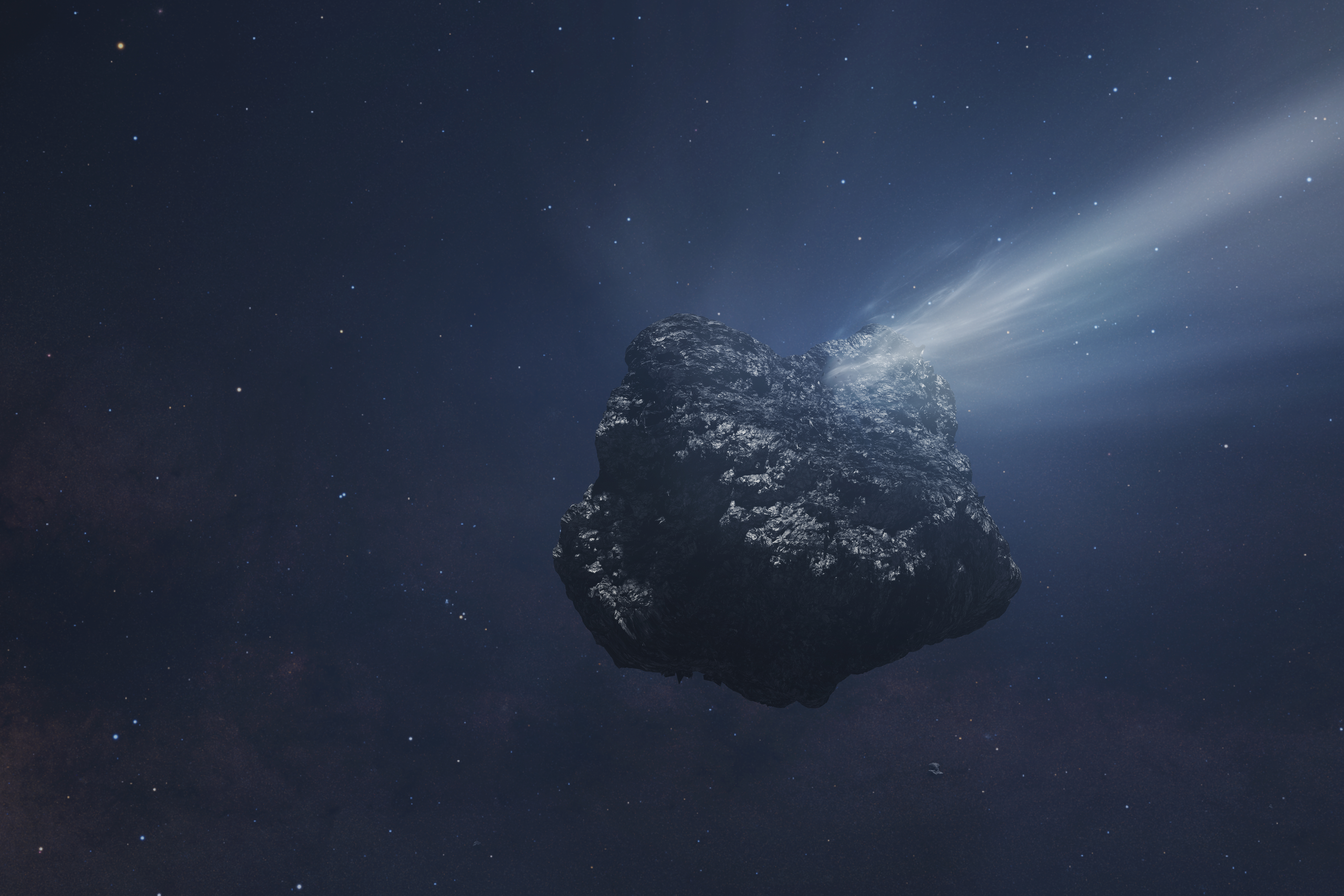
An artist rendition of comet C/2014 UN271, the largest known comet in the Oort Cloud
Credit: NSF/AUI/NSF NRAO/M.Weiss.
Hi-Res File


Giant comet’s molecular activity and chemistry detected at record distance

A team of astronomers has made a groundbreaking discovery by detecting molecular activity in comet C/2014 UN271 (Bernardinelli-Bernstein)—the largest and second most distantly active comet ever observed from the Oort Cloud. Using the powerful Atacama Large Millimeter/submillimeter Array (ALMA) in Chile, researchers observed this giant comet while it was more than halfway to Neptune, at an astonishing distance of 16.6 times the distance between the Sun and Earth.

C/2014 UN271 is a true behemoth, measuring nearly 85 miles (140 km) across—more than 10 times the size of most known comets. Until now, little was known about how such cold, distant objects behave. The new observations revealed complex and evolving jets of carbon monoxide gas erupting from the comet’s nucleus, providing the first direct evidence of what drives its activity so far from the Sun.

“These measurements give us a look at how this enormous, icy world works,” said lead author Nathan Roth of American University and NASA Goddard Space Flight Center. “We’re seeing explosive outgassing patterns that raise new questions about how this comet will evolve as it continues its journey toward the inner solar system.”

The ALMA telescope observed C/2014 UN271 by capturing light from carbon monoxide gas in its atmosphere and heat (thermal emission) when the comet was still very far from the Sun. Thanks to ALMA’s high sensitivity and resolution, scientists could focus on the extremely faint signal from such a cold, distant object. Building on previous ALMA observations (Lellouch+2022, A&A, 659, L1) which first characterized the large nucleus size of UN271, these new findings measured the thermal signal to further calculate the comet’s size and the amount of dust surrounding its nucleus. Their values for the nucleus size and dust mass are in agreement with previous ALMA observations and confirm it as the largest Oort Cloud comet ever found. ALMA’s ability to precisely measure these signals made this study possible, offering a clearer picture of this distant, icy giant.

The discovery not only marks the first detection of molecular outgassing in this record-setting comet, but also offers a rare glimpse into the chemistry and dynamics of objects originating from the farthest reaches of our solar system. As C/2014 UN271 approaches the Sun, scientists anticipate that more frozen gases will begin to vaporize, revealing even more about the comet’s primitive makeup and the early solar system. Such discoveries help answer fundamental questions about where Earth and its water came from, and how life-friendly environments might form elsewhere.


About NRAO

The National Radio Astronomy Observatory (NRAO) is a facility of the U.S. National Science Foundation, operated under cooperative agreement by Associated Universities, Inc.

About ALMA

The Atacama Large Millimeter/submillimeter Array (ALMA), an international astronomy facility, is a partnership of the European Southern Observatory (ESO), the U.S. National Science Foundation (NSF) and the National Institutes of Natural Sciences (NINS) of Japan in cooperation with the Republic of Chile. ALMA is funded by ESO on behalf of its Member States, by NSF in cooperation with the National Research Council of Canada (NRC) and the National Science and Technology Council (NSTC) in Taiwan and by NINS in cooperation with the Academia Sinica (AS) in Taiwan and the Korea Astronomy and Space Science Institute (KASI).

ALMA construction and operations are led by ESO on behalf of its Member States; by the National Radio Astronomy Observatory (NRAO), managed by Associated Universities, Inc. (AUI), on behalf of North America; and by the National Astronomical Observatory of Japan (NAOJ) on behalf of East Asia. The Joint ALMA Observatory (JAO) provides the unified leadership and management of the construction, commissioning and operation of ALMA.


Thursday, April 14, 2022

Hubble Confirms Largest Comet Nucleus Ever Seen

Comet C/2014 UN271 Nucleus
This sequence shows how the nucleus of Comet C/2014 UN271 (Bernardinelli-Bernstein) was isolated from a vast shell of dust and gas surrounding the solid icy nucleus. On the left is a photo of the comet taken by the NASA Hubble Space Telescope's Wide Field Camera 3 on January 8, 2022. A model of the coma (middle panel) was obtained by means of fitting the surface brightness profile assembled from the observed image on the left. This allowed for the coma to be subtracted, unveiling the point-like glow from the nucleus. Combined with radio telescope data, astronomers arrived at a precise measurement of the nucleus size. That's no small feat from something about 2 billion miles away. Though the nucleus is estimated to be as large as 85 miles across, it is so far away it cannot be resolved by Hubble. Its size is derived from its reflectivity as measured by Hubble. The nucleus is estimated to be as black as charcoal. The nucleus area is gleaned from radio observations. Credits: Science: NASA, ESA, Man-To Hui (Macau University of Science and Technology), David Jewitt (UCLA) Image Processing: Alyssa Pagan (STScI). Release Images


Comparison of Comet Nucleus Sizes
This diagram compares the size of the icy, solid nucleus of comet C/2014 UN271 (Bernardinelli-Bernstein) to several other comets. The majority of comet nuclei observed are smaller than Halley’s comet. They are typically a mile across or less. Comet C/2014 UN271 is currently the record-holder for big comets. And, it may be just the tip of the iceberg. There could be many more monsters out there for astronomers to identify as sky surveys improve in sensitivity. Though astronomers know this comet must be big to be detected so far out to a distance of over 2 billion miles from Earth, only the Hubble Space Telescope has the sharpness and sensitivity to make a definitive estimate of nucleus size. Credits: Illustration: NASA, ESA, Zena Levy (STScI).


NASA's Hubble Space Telescope has determined the size of the largest icy comet nucleus ever seen by astronomers. The estimated diameter is approximately 80 miles across, making it larger than the state of Rhode Island. The nucleus is about 50 times larger than found at the heart of most known comets. Its mass is estimated to be a staggering 500 trillion tons, a hundred thousand times greater than the mass of a typical comet found much closer to the Sun.

The behemoth comet, C/2014 UN271 (Bernardinelli-Bernstein) is barreling this way at 22,000 miles per hour from the edge of the solar system. But not to worry. It will never get closer than 1 billion miles away from the Sun, which is slightly farther than the distance of the planet Saturn. And that won't be until the year 2031.

The previous record holder is comet C/2002 VQ94, with a nucleus estimated to be 60 miles across. It was discovered in 2002 by the Lincoln Near-Earth Asteroid Research (LINEAR) project.

"This comet is literally the tip of the iceberg for many thousands of comets that are too faint to see in the more distant parts of the solar system," said David Jewitt, a professor of planetary science and astronomy at the University of California, Los Angeles (UCLA), and co-author of the new study in The Astrophysical Journal Letters . "We've always suspected this comet had to be big because it is so bright at such a large distance. Now we confirm it is."

Comet C/2014 UN271 was discovered by astronomers Pedro Bernardinelli and Gary Bernstein in archival images from the Dark Energy Survey at the Cerro Tololo Inter-American Observatory in Chile. It was first serendipitously observed in November 2010, when it was a whopping 3 billion miles from the Sun, which is nearly the average distance to Neptune. Since then, it has been intensively studied by ground- and space-based telescopes.

"This is an amazing object, given how active it is when it's still so far from the Sun," said the paper's lead author Man-To Hui of the Macau University of Science and Technology, Taipa, Macau. "We guessed the comet might be pretty big, but we needed the best data to confirm this." So, his team used Hubble to take five photos of the comet on January 8, 2022.

The challenge in measuring this comet was how to discriminate the solid nucleus from the huge dusty coma enveloping it. The comet is currently too far away for its nucleus to be visually resolved by Hubble. Instead, the Hubble data show a bright spike of light at the nucleus' location. Hui and his team next made a computer model of the surrounding coma and adjusted it to fit the Hubble images. Then, the glow of the coma was subtracted to leave behind the starlike nucleus.

Hui and his team compared the brightness of the nucleus to earlier radio observations from the Atacama Large Millimeter/submillimeter Array (ALMA) in Chile. This combined data constrains the diameter and the reflectivity of the nucleus. The new Hubble measurements are close to the earlier size estimates from ALMA, but convincingly suggest a darker nucleus surface than previously thought. "It's big and it's blacker than coal," said Jewitt.

The comet has been falling toward the Sun for well over 1 million years. It is coming from the hypothesized nesting ground of trillions of comets, called the Oort Cloud. The diffuse cloud is thought to have an inner edge at 2,000 to 5,000 times the distance between the Sun and the Earth. Its outer edge might extend at least a quarter of the way out to the distance of the nearest stars to our Sun, the Alpha Centauri system.

The Oort Cloud's comets didn't actually form so far from the Sun; instead, they were tossed out of the solar system billions of years ago by a gravitational "pinball game" among the massive outer planets, when the orbits of Jupiter and Saturn were still evolving. The far-flung comets only travel back toward the Sun and planets if their distant orbits are disturbed by the gravitational tug of a passing star — like shaking apples out of a tree.

Comet Bernardinelli-Bernstein follows a 3-million-year-long elliptical orbit, taking it as far from the Sun as roughly half a light-year. The comet is now less than 2 billion miles from the Sun, falling nearly perpendicular to the plane of our solar system. At that distance temperatures are only about minus 348 degrees Fahrenheit. Yet that's warm enough for carbon monoxide to sublimate off the surface to produce the dusty coma.

Comet Bernardinelli-Bernstein provides an invaluable clue to the size distribution of comets in the Oort Cloud and hence its total mass. Estimates for the Oort Cloud's mass vary widely, reaching as high as 20 times Earth's mass. First hypothesized in 1950 by Dutch astronomer Jan Oort, the Oort Cloud still remains a theory because the innumerable comets that make it up are too faint and distant to be directly observed. Ironically, this means the solar system's largest structure is all but invisible. It's estimated that NASA's pair of Voyager spacecraft won't reach the inner realm of the Oort Cloud for another 300 years and could take as long as 30,000 years to pass through it.

Circumstantial evidence come from infalling comets that can be traced back to this nesting ground. They approach the Sun from all different directions meaning the cloud must be spherical in shape. These comets are deep-freeze samples of the composition of the early solar system, preserved for billions of years. The reality of the Oort Cloud is bolstered by theoretical modeling of the formation and evolution of the solar system. The more observational evidence that can be gathered through deep sky surveys coupled with multiwavelength observations, the better astronomers will understand the Oort Cloud's role in the solar system's evolution.

The Hubble Space Telescope is a project of international cooperation between NASA and ESA (European Space Agency). NASA's Goddard Space Flight Center in Greenbelt, Maryland, manages the telescope. The Space Telescope Science Institute (STScI) in Baltimore, Maryland, conducts Hubble science operations. STScI is operated for NASA by the Association of Universities for Research in Astronomy, in Washington, D.C.


Credits:

Release: NASA, ESA, STScI

Media Contact:

Ray Villard
Space Telescope Science Institute, Baltimore, Maryland

Science Contact: Man-To Hui
State Key Laboratory of Lunar and Planetary Science, Macau University of Science and Technology, Taipa, China

David Jewitt
University of California, Los Angeles, Los Angeles, California


Permissions: Content Use Policy

Contact Us:

Direct inquiries to the News Team.

Related Links and Documents:


Monday, June 28, 2021

Giant Comet Found in Outer Solar System by Dark Energy Survey

Illustration of Comet Bernardinelli-Bernstein

Discovery image of Comet Bernardinelli-Bernstein (annotated) 
 
Discovery image of Comet Bernardinelli-Bernstein (unannotated) 
 
Discovery image of Comet Bernardinelli-Bernstein (wide field) 


Videos

Zooming on Comet Bernardinelli-Bernstein
Zooming on Comet Bernardinelli-Bernstein   Videos


Estimated to be 100–200 kilometers across, the unusual wandering body will make its closest approach to the Sun in 2031

A giant comet from the outskirts of our Solar System has been discovered in 6 years of data from the Dark Energy Survey. Comet Bernardinelli-Bernstein is estimated to be about 1000 times more massive than a typical comet, making it arguably the largest comet discovered in modern times. It has an extremely elongated orbit, journeying inward from the distant Oort Cloud over millions of years. It is the most distant comet to be discovered on its incoming path, giving us years to watch it evolve as it approaches the Sun, though it's not predicted to become a naked-eye spectacle.

A giant comet has been discovered by two astronomers following a comprehensive search of data from Dark Energy Survey (DES). The comet, which is estimated to be 100–200 kilometers across, or about 10 times the diameter of most comets, is an icy relic flung out of the Solar System by the migrating giant planets in the early history of the Solar System. This comet is quite unlike any other seen before and the huge size estimate is based on how much sunlight it reflects. 

Pedro Bernardinelli and Gary Bernstein, of the University of Pennsylvania, found the comet — named Comet Bernardinelli-Bernstein (with the designation C/2014 UN271) — hidden among data collected by the 570-megapixel Dark Energy Camera (DECam) mounted on the Víctor M. Blanco 4-meter Telescope at Cerro Tololo Inter-American Observatory (CTIO) in Chile. The analysis of data from the Dark Energy Survey is supported by the Department of Energy (DOE) and the National Science Foundation (NSF), and the DECam science archive is curated by the Community Science and Data Center (CSDC) at NSF’s NOIRLab. CTIO and CSDC are Programs of NOIRLab.

One of the highest-performance, wide-field CCD imagers in the world, DECam was designed specifically for the DES and operated by the DOE and NSF between 2013 and 2019. DECam was funded by the DOE and was built and tested at DOE's Fermilab. At present DECam is used for programs covering a huge range of science.

DES was tasked with mapping 300 million galaxies across a 5000-square-degree area of the night sky, but during its six years of observations it also observed many comets and trans-Neptunian objects passing through the surveyed field. A trans-Neptunian object, or TNO, is an icy body that resides in our Solar System beyond the orbit of Neptune.

Bernardinelli and Bernstein used 15–20 million CPU hours at the National Center for Supercomputing Applications and Fermilab, employing sophisticated identification and tracking algorithms to identify over 800 individual TNOs from among the more than 16 billion individual sources detected in 80,000 exposures taken as part of the DES. Thirty-two of those detections belonged to one object in particular — C/2014 UN271.

Comets are icy bodies that evaporate as they approach the warmth of the Sun, growing their coma and tails. The DES images of the object in 2014–2018 did not show a typical comet tail, but within a day of the announcement of its discovery via the Minor Planet Center, astronomers using the Las Cumbres Observatory network took fresh images of Comet Bernardinelli-Bernstein which revealed that it has grown a coma in the past 3 years, making it officially a comet. 

Its current inward journey began at a distance of over 40,000 astronomical units (au) from the Sun — in other words 40,000 times farther from the Sun than Earth is, or 6 trillion kilometers away (3.7 trillion miles or 0.6 light-years — 1/7 of the distance to the nearest star). For comparison, Pluto is 39 au from the Sun, on average. This means that Comet Bernardinelli-Bernstein originated in the Oort Cloud of objects, ejected during early history of the Solar System. It could be the largest member of the Oort Cloud ever detected, and it is the first comet on an incoming path to be detected so far away. 

Comet Bernardinelli-Bernstein is currently much closer to the Sun. It was first seen by DES in 2014 at a distance of 29 au (4 billion kilometers or 2.5 billion miles, roughly the distance of Neptune), and as of June 2021, it was 20 au (3 billion kilometers or 1.8 billion miles, the distance of Uranus) from the Sun and currently shines at magnitude 20. The comet's orbit is perpendicular to the plane of the Solar System and it will reach its closest point to the Sun (known as perihelion) in 2031, when it will be around 11 au away (a bit more than Saturn’s distance from the Sun) — but it will get no closer. Despite the comet’s size, it is currently predicted that skywatchers will require a large amateur telescope to see it, even at its brightest. 

"We have the privilege of having discovered perhaps the largest comet ever seen — or at least larger than any well-studied one — and caught it early enough for people to watch it evolve as it approaches and warms up," said Gary Bernstein. "It has not visited the Solar System in more than 3 million years."

Comet Bernardinelli-Bernstein will be followed intensively by the astronomical community, including with NOIRLab facilities, to understand the composition and origin of this massive relic from the birth of our own planet. Astronomers suspect that there may be many more undiscovered comets of this size waiting in the Oort Cloud far beyond Pluto and the Kuiper Belt. These giant comets are thought to have been scattered to the far reaches of the Solar System by the migration of Jupiter, Saturn, Uranus and Neptune early in their history.

“This is a much needed anchor on the unknown population of large objects in the Oort Cloud and their connection with early migration of the ice/gas giants soon after the Solar System was formed,” said NOIRLab astronomer Tod Lauer. 

“These observations demonstrate the value of long-duration survey observations on national facilities like the Blanco telescope,” says Chris Davis, National Science Foundation Program Director for NOIRLab. “Finding huge objects like Comet Bernardinelli-Bernstein is crucial to our understanding of the early history of our Solar System.”

It is not yet known how active and bright it will become when it reaches perihelion. However, Bernardinelli says that Vera C. Rubin Observatory, a future Program of NOIRLab, “will continuously measure Comet Bernardinelli-Bernstein all the way to its perihelion in 2031, and probably find many, many others like it,” allowing astronomers to characterize objects from the Oort Cloud in much greater detail.


More Information

This research was reported to the Minor Planet Center.

NSF’s NOIRLab (National Optical-Infrared Astronomy Research Laboratory), the US center for ground-based optical-infrared astronomy, operates the international Gemini Observatory (a facility of NSF, NRC–Canada, ANID–Chile, MCTIC–Brazil, MINCyT–Argentina, and KASI–Republic of Korea), Kitt Peak National Observatory (KPNO), Cerro Tololo Inter-American Observatory (CTIO), the Community Science and Data Center (CSDC), and Vera C. Rubin Observatory (operated in cooperation with the Department of Energy’s SLAC National Accelerator Laboratory). It is managed by the Association of Universities for Research in Astronomy (AURA) under a cooperative agreement with NSF and is headquartered in Tucson, Arizona. The astronomical community is honored to have the opportunity to conduct astronomical research on Iolkam Du’ag (Kitt Peak) in Arizona, on Maunakea in Hawai‘i, and on Cerro Tololo and Cerro Pachón in Chile. We recognize and acknowledge the very significant cultural role and reverence that these sites have to the Tohono O'odham Nation, to the Native Hawaiian community, and to the local communities in Chile, respectively.

The Dark Energy Survey (DES) is a collaboration of more than 400 scientists from 25 institutions in seven countries. Funding for the DES Projects has been provided by the US Department of Energy Office of Science, US National Science Foundation, Ministry of Science and Education of Spain, Science and Technology Facilities Council of the United Kingdom, Higher Education Funding Council for England, ETH Zurich for Switzerland, National Center for Supercomputing Applications at the University of Illinois at Urbana-Champaign, Kavli Institute of Cosmological Physics at the University of Chicago, Center for Cosmology and AstroParticle Physics at Ohio State University, Mitchell Institute for Fundamental Physics and Astronomy at Texas A&M University, Financiadora de Estudos e Projetos, Fundação Carlos Chagas Filho de Amparo à Pesquisa do Estado do Rio de Janeiro, Conselho Nacional de Desenvolvimento Científico e Tecnológico and Ministério da Ciência e Tecnologia, Deutsche Forschungsgemeinschaft, and the collaborating institutions in the Dark Energy Survey.

NCSA at the University of Illinois at Urbana-Champaign provides supercomputing and advanced digital resources for the nation’s science enterprise. At NCSA, University of Illinois faculty, staff, students and collaborators from around the globe use advanced digital resources to address research grand challenges for the benefit of science and society. NCSA has been advancing one third of the Fortune 50® for more than 30 years by bringing industry, researchers and students together to solve grand challenges at rapid speed and scale. For more information.

Fermilab is America’s premier national laboratory for particle physics and accelerator research. A US Department of Energy Office of Science laboratory, Fermilab is located near Chicago, Illinois, and operated under contract by the Fermi Research Alliance LLC. Follow Fermilab on Twitter at @Fermilab.

The DOE Office of Science is the single largest supporter of basic research in the physical sciences in the United States and is working to address some of the most pressing challenges of our time. 

Bernardinelli and Bernstein’s search was partially supported by a grant from the National Science Foundation.


Links


Contacts

Pedro Bernardinelli
University of Pennsylvania
Email:
pedrobe@sas.upenn.edu

Gary Bernstein
University of Pennsylvania
Email:
garyb@physics.upenn.edu

Amanda Kocz
Press and Internal Communications Officer
NSF’s NOIRLab
Cell: +1 626 524 5884
Email:
amanda.kocz@noirlab.edu

Source: NOIRLab/News