

Comparison of the TRAPPIST-1 system with the inner Solar System and the Galilean Moons of Jupiter

Comparison of the TRAPPIST-1 system with the inner Solar System and the Galilean Moons of Jupiter

Comparison of the sizes of the TRAPPIST-1 planets with Solar System bodies

Light curve of TRAPPIST-1 — showing the dimming events caused by transits of planets

The orbits of the seven planets around TRAPPIST-1

VLT observations of the light curve of TRAPPIST-1 during the triple transit of 11 December 2015

Light curves of the seven TRAPPIST-1 planets as they transit

Comparison of the TRAPPIST-1 system and the inner Solar System

The ultracool dwarf star TRAPPIST-1 in the constellation of Aquarius

Comparison between the Sun and the ultracool dwarf star TRAPPIST-1

Artist’s impression of view from planet in the TRAPPIST-1 planetary system

Artist's illustrations of planets in TRAPPIST-1 system and Solar System’s rocky planets

Artist’s impression of the TRAPPIST-1 system

Comparing the TRAPPIST-1 planets

Seven planets orbiting the ultracool dwarf star TRAPPIST-1

Artist’s impression of view from distant planet in the TRAPPIST-1 planetary system

Artist’s impression of view from one of the middle planets in the TRAPPIST-1 planetary system
Videos
ESOcast 96: Ultracool Dwarf and the Seven Planets
ESOcast 97 Light: 7 Earth-sized Worlds Found in Nearby Star System (4K UHD)
Animation of the planets orbiting TRAPPIST-1
Fly-through of the TRAPPIST-1 planetary system
A trip to TRAPPIST-1 and its seven planets
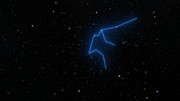
Travelling from Earth to TRAPPIST-1
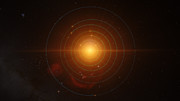
Animation of the planets in orbit around TRAPPIST-1
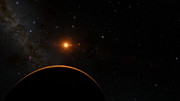
View from the planetTRAPPIST-1f
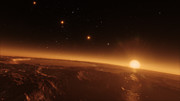
View from above the surface of TRAPPIST-1b
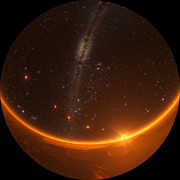
Fulldome video of the TRAPPIST-1 system

Virtual reality view of the TRAPPIST-1 planetary system
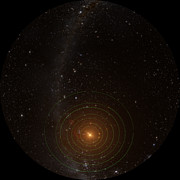
TRAPPIST-1 planetary system seen from above (fulldome)
Temperate Earth-sized Worlds Found in Extraordinarily Rich Planetary System
Astronomers have found a system of seven
Earth-sized planets just 40 light-years away. Using ground and space
telescopes, including ESO’s Very Large Telescope, the planets were all
detected as they passed in front of their parent star, the ultracool
dwarf star known as TRAPPIST-1. According to the paper appearing today
in the journal Nature, three of the planets lie in the habitable zone
and could harbour oceans of water on their surfaces, increasing the
possibility that the star system could play host to life. This system
has both the largest number of Earth-sized planets yet found and the
largest number of worlds that could support liquid water on their
surfaces.
Astronomers using the TRAPPIST–South telescope at ESO’s La Silla Observatory, the Very Large Telescope (VLT) at Paranal and the NASA Spitzer Space Telescope, as well as other telescopes around the world [1], have now confirmed the existence of at least seven small planets orbiting the cool red dwarf star TRAPPIST-1 [2].
All the planets, labelled TRAPPIST-1b, c, d, e, f, g and h in order of
increasing distance from their parent star, have sizes similar to Earth [3].
Dips in the star’s light output caused by each of the seven planets passing in front of it — events known as transits — allowed the astronomers to infer information about their sizes, compositions and orbits [4]. They found that at least the inner six planets are comparable in both size and temperature to the Earth.
Lead author Michaël Gillon of the STAR Institute at the University of Liège in Belgium is delighted by the findings: “This
is an amazing planetary system — not only because we have found so many
planets, but because they are all surprisingly similar in size to the
Earth!”
With just 8% the mass of the Sun, TRAPPIST-1 is very small in stellar
terms — only marginally bigger than the planet Jupiter — and though
nearby in the constellation Aquarius
(The Water Carrier), it appears very dim. Astronomers expected that
such dwarf stars might host many Earth-sized planets in tight orbits,
making them promising targets in the hunt for extraterrestrial life, but
TRAPPIST-1 is the first such system to be found.
Co-author Amaury Triaud expands: “The energy output from dwarf
stars like TRAPPIST-1 is much weaker than that of our Sun. Planets would
need to be in far closer orbits than we see in the Solar System if
there is to be surface water. Fortunately, it seems that this kind of
compact configuration is just what we see around TRAPPIST-1!”
The team determined that all the planets in the system are similar in
size to Earth and Venus in the Solar System, or slightly smaller. The
density measurements suggest that at least the innermost six are
probably rocky in composition.
The planetary orbits are not much larger than that of Jupiter’s Galilean moon system,
and much smaller than the orbit of Mercury in the Solar System.
However, TRAPPIST-1’s small size and low temperature mean that the
energy input to its planets is similar to that received by the inner
planets in our Solar System; TRAPPIST-1c, d and f receive similar
amounts of energy to Venus, Earth and Mars, respectively.
All seven planets discovered in the system could potentially have
liquid water on their surfaces, though their orbital distances make some
of them more likely candidates than others. Climate models suggest the
innermost planets, TRAPPIST-1b, c and d, are probably too hot to support
liquid water, except maybe on a small fraction of their surfaces. The
orbital distance of the system’s outermost planet, TRAPPIST-1h, is
unconfirmed, though it is likely to be too distant and cold to harbour
liquid water — assuming no alternative heating processes are occurring [5]. TRAPPIST-1e, f, and g, however, represent the holy grail for planet-hunting astronomers, as they orbit in the star’s habitable zone and could host oceans of surface water [6].
These new discoveries make the TRAPPIST-1 system a very important target for future study. The NASA/ESA Hubble Space Telescope
is already being used to search for atmospheres around the planets and
team member Emmanuël Jehin is excited about the future possibilities: “With the upcoming generation of telescopes, such as ESO’s European Extremely Large Telescope and the NASA/ESA/CSA James Webb Space Telescope, we will soon be able to search for water and perhaps even evidence of life on these worlds.”
Notes
[1] As well as the NASA Spitzer Space Telescope, the team used many ground-based facilities: TRAPPIST–South at ESO’s La Silla Observatory in Chile, HAWK-I on ESO’s Very Large Telescope in Chile, TRAPPIST–North in Morocco, the 3.8-metre UKIRT in Hawaii, the 2-metre Liverpool and 4-metre William Herschel telescopes at La Palma in the Canary Islands, and the 1-metre SAAO telescope in South Africa.
[2] TRAPPIST–South (the TRAnsiting Planets and PlanetesImals Small Telescope–South) is a Belgian 0.6-metre robotic telescope operated from the University of Liège and based at ESO’s La Silla Observatory
in Chile. It spends much of its time monitoring the light from around
60 of the nearest ultracool dwarf stars and brown dwarfs (“stars” which
are not quite massive enough to initiate sustained nuclear fusion in
their cores), looking for evidence of planetary transits.
TRAPPIST–South, along with its twin TRAPPIST–North, are the forerunners
to the SPECULOOS system, which is currently being installed at ESO’s Paranal Observatory.
[3] In early 2016, a team of astronomers, also led by Michaël Gillon announced the discovery
of three planets orbiting TRAPPIST-1. They intensified their follow-up
observations of the system mainly because of a remarkable triple transit
that they observed with the HAWK-I instrument on the VLT. This transit
showed clearly that at least one other unknown planet was orbiting the
star. And that historic light curve
shows for the first time three temperate Earth-sized planets, two of
them in the habitable zone, passing in front of their star at the same
time!
[4] This is one of the main methods that astronomers use to identify the presence of a planet around a star. They look at the light coming from the star to see if some of the light is blocked as the planet passes in front of its host star on the line of sight to Earth — it transits the star, as astronomers say. As the planet orbits around its star, we expect to see regular small dips in the light coming from the star as the planet moves in front of it.
[5] Such processes could include tidal heating,
whereby the gravitational pull of TRAPPIST-1 causes the planet to
repeatedly deform, leading to inner frictional forces and the generation
of heat. This process drives the active volcanism on Jupiter's moon Io.
If TRAPPIST-1h has also retained a primordial hydrogen-rich atmosphere,
the rate of heat loss could be very low.
[6] This discovery also
represents the largest known chain of exoplanets orbiting in
near-resonance with each other. The astronomers carefully measured how
long it takes for each planet in the system to complete one orbit around
TRAPPIST-1 — known as the revolution period
— and then calculated the ratio of each planet’s period and that of its
next more distant neighbour. The innermost six TRAPPIST-1 planets have
period ratios with their neighbours that are very close to simple
ratios, such as 5:3 or 3:2. This means that the planets most likely
formed together further from their star, and have since moved inwards
into their current configuration. If so, they could be low-density and
volatile-rich worlds, suggesting an icy surface and/or an atmosphere.
More Information
This research was presented in a paper entitled “Seven
temperate terrestrial planets around the nearby ultracool dwarf star
TRAPPIST-1”, by M. Gillon et al., to appear in the journal Nature.
The team is composed of M. Gillon (Université de Liège, Liège, Belgium), A. H. M. J. Triaud (Institute of Astronomy, Cambridge, UK), B.-O. Demory (University of Bern, Bern, Switzerland; Cavendish Laboratory, Cambridge, UK), E. Jehin (Université de Liège, Liège, Belgium), E. Agol (University of Washington, Seattle, USA; NASA Astrobiology Institute's Virtual Planetary Laboratory, Seattle, USA), K. M. Deck (California Institute of Technology, Pasadena, CA, USA), S. M. Lederer (NASA Johnson Space Center, Houston, USA), J. de Wit (Massachusetts Institute of Technology, Cambridge, MA, USA), A. Burdanov (Université de Liège, Liège, Belgium), J. G. Ingalls (California Institute of Technology, Pasadena, California, USA), E. Bolmont (University of Namur, Namur, Belgium; Laboratoire AIM Paris-Saclay, CEA/DRF - CNRS - Univ. Paris Diderot - IRFU/SAp, Centre de Saclay, France), J. Leconte (Univ. Bordeaux, Pessac, France), S. N. Raymond (Univ. Bordeaux, Pessac, France), F. Selsis (Univ. Bordeaux, Pessac, France), M. Turbet (Sorbonne Universités, Paris, France), K. Barkaoui (Oukaimeden Observatory, Marrakesh, Morocco), A. Burgasser (University of California, San Diego, California, USA), M. R. Burleigh (University of Leicester, Leicester, UK), S. J. Carey (California Institute of Technology, Pasadena, CA, USA), A. Chaushev (University of Leicester, UK), C. M. Copperwheat (Liverpool John Moores University, Liverpool, UK), L. Delrez (Université de Liège, Liège, Belgium; Cavendish Laboratory, Cambridge, UK), C. S. Fernandes (Université de Liège, Liège, Belgium), D. L. Holdsworth (University of Central Lancashire, Preston, UK), E. J. Kotze (South African Astronomical Observatory, Cape Town, South Africa), V. Van Grootel (Université de Liège, Liège, Belgium), Y. Almleaky (King Abdulaziz University, Jeddah, Saudi Arabia; King Abdullah Centre for Crescent Observations and Astronomy, Makkah Clock, Saudi Arabia), Z. Benkhaldoun (Oukaimeden Observatory, Marrakesh, Morocco), P. Magain (Université de Liège, Liège, Belgium), and D. Queloz (Cavendish Laboratory, Cambridge, UK; Astronomy Department, Geneva University, Switzerland).
ESO is the foremost intergovernmental astronomy organisation in
Europe and the world’s most productive ground-based astronomical
observatory by far. It is supported by 16 countries: Austria, Belgium,
Brazil, the Czech Republic, Denmark, France, Finland, Germany, Italy,
the Netherlands, Poland, Portugal, Spain, Sweden, Switzerland and the
United Kingdom, along with the host state of Chile. ESO carries out an
ambitious programme focused on the design, construction and operation of
powerful ground-based observing facilities enabling astronomers to make
important scientific discoveries. ESO also plays a leading role in
promoting and organising cooperation in astronomical research. ESO
operates three unique world-class observing sites in Chile: La Silla,
Paranal and Chajnantor. At Paranal, ESO operates the Very Large
Telescope, the world’s most advanced visible-light astronomical
observatory and two survey telescopes. VISTA works in the infrared and
is the world’s largest survey telescope and the VLT Survey Telescope is
the largest telescope designed to exclusively survey the skies in
visible light. ESO is a major partner in ALMA, the largest astronomical
project in existence. And on Cerro Armazones, close to Paranal, ESO is
building the 39-metre European Extremely Large Telescope, the E-ELT,
which will become “the world’s biggest eye on the sky”.
Links
- Research paper in Nature
- A short story about TRAPPIST-1 by Laurence Suhner
- TRAPPIST telescope website at Université de Liège
- Further information about TRAPPIST–South
- OrCA Lab at Université de Liège
- SPECULOOS Project at Université de Liège
- NASA Spitzer press release
- Photos of the VLT
Contacts
Michaël Gillon
University of Liege
Liege, Belgium
Tel: +32 43 669 743
Cell: +32 473 346 402
Email: michael.gillon@ulg.ac.be
University of Liege
Liege, Belgium
Tel: +32 43 669 743
Cell: +32 473 346 402
Email: michael.gillon@ulg.ac.be
Amaury Triaud
Kavli Exoplanet Fellow, University of Cambridge
Cambridge, United Kingdom
Tel: +44 1223 766 690
Cell: +44 747 0087 217
Email: aht34@cam.ac.uk
Kavli Exoplanet Fellow, University of Cambridge
Cambridge, United Kingdom
Tel: +44 1223 766 690
Cell: +44 747 0087 217
Email: aht34@cam.ac.uk
Emmanuël Jehin
University of Liège
Liège, Belgium
Tel: +32 495237298
Email: ejehin@ulg.ac.be
University of Liège
Liège, Belgium
Tel: +32 495237298
Email: ejehin@ulg.ac.be
Brice-Olivier Demory
University of Bern
Bern, Switzerland
Tel: +41 31 631 51 57
Cell: +44 78 66 476 486
Email: brice.demory@csh.unibe.ch
University of Bern
Bern, Switzerland
Tel: +41 31 631 51 57
Cell: +44 78 66 476 486
Email: brice.demory@csh.unibe.ch
Richard Hook
ESO Public Information Officer
Garching bei München, Germany
Tel: +49 89 3200 6655
Cell: +49 151 1537 3591
Email: rhook@eso.org
Source: ESO


