Monday, May 12, 2008

Antennae Galaxies move closer

Credit: NASA, ESA, and the Hubble Heritage Team
(STScI/AURA)-ESA/Hubble Collaboration

Merging system's interaction sets standard for galaxy evolution.
Provided by European Space Agency

The Antennae Galaxies are among the closest known merging systems. Also known as NGC 4038 and NGC 4039, the two began interacting a few hundred million years ago, creating one of the most impressive sights in the night sky. They are used by scientists as a standard against which to validate theories of galactic evolution.

An international group of scientists led by Ivo Saviane from the European Southern Observatory used Hubble's Advanced Camera for Surveys and Wide Field Planetary Camera 2 to observe individual stars spawned by the colossal cosmic collision in the Antennae Galaxies. By measuring the colors and brightnesses of red giant stars in the system, the scientists found that the Antennae are much closer than previously thought: 45 million light-years instead of the previous best estimate of 65 million light-years.

The team targeted a region in the relatively quiescent outer regions in the southern tidal tail, away from the active central regions. This tail consists of material thrown from the main galaxies as they collided. The scientists needed to observe regions with older red giant stars to derive an accurate distance. Red giants are known to reach a standard brightness, which can then be used to infer their distance.

The previous distance to the Antennae Galaxy was about 65 million light-years, although values as high as 100 million light years have been used. Our Sun is only 8 light-minutes away from us, so the Antennae Galaxies may seem rather distant. But if we consider that we already know of galaxies more than 10 billion light-years away, the two galaxies are really our neighbors.

The new, smaller distance makes the Antennae Galaxies less extreme in terms of the physics needed to explain the observed phenomena. For instance, its infrared radiation is now that expected of a standard early merging event rather than that of an ultraluminous infrared galaxy. The size of the star clusters formed as a consequence of the Antennae merger now agree with those of clusters created in other mergers instead of being 1.5 times as large.

The Antennae Galaxies are named for the two long tails of stars, gas and dust that resemble the antennae of an insect. These "antennae" are a physical result of the collision between the two galaxies. Studying their properties gives us a preview of what may happen when our Milky Way Galaxy collides with the neighboring Andromeda galaxy in several billion years.


Thursday, May 08, 2008

Saturn Does the Wave In Upper Atmosphere

 Scientists have discovered a wave pattern, or oscillation, in Saturn's atmosphere only visible from Earth every 15 years. The pattern ripples back and forth like a wave within Saturn's upper atmosphere. In this region, temperatures switch from one altitude to the next in a candy cane-like, striped, hot-cold pattern.

The temperature "snapshot" shown in these two images captures two different phases of this wave oscillation: the temperature at Saturn's equator switches from hot to cold, and temperatures on either side of the equator switch from cold to hot every Saturn half-year.

The image on the left was taken in 1997 and shows the temperature at the equator is colder than the temperature at 13 degrees south latitude. Conversely, the image on the right taken in 2006 shows the temperature at the equator is warmer.

These images were taken with NASA's Infrared Telescope Facility in Mauna Kea, Hawaii.

Credit: NASA/JPL  

Two decades of scrutinizing Saturn are finally paying off, as scientists have discovered a wave pattern, or oscillation, in Saturn's atmosphere only visible from Earth every 15 years.

The discovery of the wave pattern is the result of a 22-year campaign observing Saturn from Earth (the longest study of temperature outside Earth ever recorded), and the Cassini spacecraft's observations of temperature changes in the giant planet's atmosphere over time.

The Cassini infrared results, which appear in the same issue of Nature as the data from the 22-year ground-based observing campaign, indicate that Saturn's wave pattern is similar to a pattern found in Earth's upper atmosphere. The earthly oscillation takes about two years. A similar pattern on Jupiter takes more than four Earth years. The new Saturn findings add a common link to the three planets.

Just as scientists have been studying climate changes in Earth's atmosphere for long periods of time, NASA scientists have been studying changes in Saturn's atmosphere. Glenn Orton of NASA's Jet Propulsion Laboratory in Pasadena, Calif., says patience is the key to studying changes over the course of a Saturnian year, the equivalent of about 30 Earth years.

"You could only make this discovery by observing Saturn over a long period of time," said Orton, lead author of the ground-based study. "It's like putting together 22 years worth of puzzle pieces, collected by a hugely rewarding collaboration of students and scientists from around the world on various telescopes."

The wave pattern is called an atmospheric oscillation. It ripples back and forth within Saturn's upper atmosphere. In this region, temperatures switch from one altitude to the next in a candy cane-like, striped, hot-cold pattern. These varying temperatures force the wind in the region to keep changing direction from east to west, jumping back and forth. As a result, the entire region oscillates like a wave.

Mike Flasar, co-author of the Cassini paper, and principal investigator for Cassini's Composite Infrared Spectrometer at NASA's Goddard Space Flight Center, Greenbelt, Md., said that Cassini helped define this oscillation in combination with the ground observation campaign.

"It's this great synergy of using ground-based data over time, and then getting up close and personal with the oscillation in Saturn's atmosphere through Cassini," said Flasar. "Without Cassini, we might never have seen the structure of the oscillation in detail."

Cassini scientists hope to find out why this phenomenon on Saturn changes with the seasons, and why the temperature switchover happens when the sun is directly over Saturn's equator.

More information on the Cassini-Huygens mission can be found at:

http://saturn.jpl.nasa.gov, and http://www.nasa.gov/cassini.  

Wednesday, May 07, 2008

Black Hole Rips Apart Screaming Star

Artist's rendering of the light echo of a high-energy flash from a black hole. When a star is disrupted by a black hole in the nucleus of a galaxy, its debris is inevitably attracted and absorbed by the black hole. This sudden increase in the accretion rate causes an abrupt burst of ultraviolet and X-ray light because the gas from the disrupted star becomes very hot. As the high-energy radiation travels through the core of the galaxy it illuminates surrounding matter and so makes it possible to probe regions of the galaxy that would otherwise be unobservable. Credit: MPE/ESA

In a distant galaxy, a star orbiting a massive central black hole strays too close to the insatiable giant and is torn apart. But before it can be devoured, the star lets out one last scream in a flare of light that slowly echoes across the galaxy. Astronomers on Earth pick up this faint call and use it to map the nucleus of the galaxy from which it emanated.

This scenario is no bit of science fiction and a team of astronomers discovered one of these rare and dramatic events while combing through the Sloan Digital Sky Survey last December. Their observations are detailed in the May issue of Astrophysical Journal Letters.

The team is still monitoring the "light echo," and for the first time, one of these events can be observed in great detail, allowing astronomers "to probe different regions of the galaxy," said study leader Stefanie Komossa of the Max Planck Institute for extraterrestrial Physics.

Campfire physics

The light echo currently coursing through galaxy SDSSJ0952+2143 likely originated as in the scenario above, with the following details: One of the stars orbiting the galaxy's central black hole likely strayed off course (perhaps after being nudged into "a fatal orbit," as Komossa called it, after interacting with another star). Eventually the pull of the black hole would rip the star apart, but before the stellar material was pulled into the accretion disk, it emitted a burst of high-energy radiation.

Komossa likens the sudden emission of light to throwing tinder into the smoldering embers of a campfire.

"Imagine a campfire which is almost extinguished so there is not much light around, and so you cannot recognize your surroundings. In a sense, that is like the core of a normal galaxy," she told SPACE.com.

"If you throw some pieces of wood into the fire, it will shortly lighten up, and you can see the environment clearly. And sort of in the same way, in this galaxy, we observed a star was thrown into the black hole, like the piece of wood into the fire," Komossa added.

Just as the campfire would illuminate the people sitting around it and the trees in the background, this burst of radiation illuminates the regions of the galaxy as it hits them, only the immensity of the galaxy creates a time-delay effect.

"The dimensions of a galaxy are much bigger, so the light needs a lot of time to travel through the core of the galaxy," Komossa explained. "And whenever [the light] reaches a certain region, the gas [in that region] will temporarily shine up brightly and then will fade away again."

Time delay

Galactic nuclei are normally hard to resolve because a permanent accretion disk of dust and gas around the black hole illuminates everything simultaneously.

"But this light echo effect makes different components shine up temporarily, but ... at different times. That is an exciting way to do some mapping of the components of the nucleus," Komossa said.

Different parts of the galaxy, such as the molecular torus (a swirling structure of gas and dust that shrouds the black hole and its accretion disk), have a "fingerprint" of atoms in their gases, and by examining the strong change the light echo creates in these fingerprints, the astronomers can tell what part of the galaxy the echo is traveling through. Then by timing how long it takes the echo to traverse the region, the scientists can estimate its dimensions.

The light echo that Komossa and her team are tracking is thought to have started in 2004, when the telescope of Sloan Digital Sky Survey routinely imaged and took spectral readings of the radiation in this and thousands of other galaxies.

Tuesday, May 06, 2008

XMM-Newton discovers part of missing matter in the universe

Galaxy clusters Abell 222 and Abell 223
About this image: Composite optical and X-ray image of galaxy clusters Abell 222 and Abell 223. The cluster pair is connected by a filament permeated by hot X-ray emitting gas.
The optical image was obtained by SuprimeCam at the Subaru telescope, the X-ray image showing the distribution of the diffuse hot gas (yellow to red) was obtained by XMM-Newton.
Credits: ESA/ XMM-Newton/ EPIC/ ESO (J. Dietrich)/
SRON (N. Werner)/ MPE (A. Finoguenov)

ESA’s orbiting X-ray observatory XMM-Newton has been used by a team of international astronomers to uncover part of the missing matter in the universe.

10 years ago, scientists predicted that about half of the missing ‘ordinary’ or normal matter made of atoms exists in the form of low-density gas, filling vast spaces between galaxies.

All the matter in the universe is distributed in a web-like structure. At dense nodes of the cosmic web are clusters of galaxies, the largest objects in the universe. Astronomers suspected that the low-density gas permeates the filaments of the web.

The low density of the gas hampered many attempts to detect it in the past. With XMM-Newton’s high sensitivity, astronomers have discovered its hottest parts. The discovery will help them understand the evolution of the cosmic web.

Only about 5% of our universe is made of normal matter as we know it, consisting of protons and neutrons, or baryons, which along with electrons, form the building blocks of ordinary matter. The rest of our universe is composed of elusive dark matter (23%) and dark energy (72%).

Scientists predicted that the gas would have a high temperature and so it would primarily emit low-energy X-rays. But its very low density made observation difficult.

Astronomers using XMM-Newton were observing a pair of galaxy clusters, Abell 222 and Abell 223, situated at a distance of 2300 million light-years from Earth, when the images and spectra of the system revealed a bridge of hot gas connecting the clusters.

"The hot gas that we see in this bridge or filament is probably the hottest and densest part of the diffuse gas in the cosmic web, believed to constitute about half the baryonic matter in the universe," says Norbert Werner from SRON Netherlands Institute for Space Research, leader of the team reporting the discovery.

About this image: This is a model of the cosmic web. 
Clusters of galaxies are expectedto develop at the intersections of the web.
Credits: Springel et al., Virgo Consortium

"The discovery of the warmest of the missing baryons is important. That’s because various models exist and they all predict that the missing baryons are some form of warm gas, but the models tend to disagree about the extremes,” adds Alexis Finoguenov, a team member.

Even with XMM-Newton’s sensitivity, the discovery was only possible because the filament is along the line of sight, concentrating the emission from the entire filament in a small region of the sky. The discovery of this hot gas will help better understand the evolution of the cosmic web.

"This is only the beginning. To understand the distribution of the matter within the cosmic web, we have to see more systems like this one. And ultimately launch a dedicated space observatory to observe the cosmic web with a much higher sensitivity than possible with current missions. Our result allows to set up reliable requirements for those new missions." concludes Norbert Werner.

ESA’s XMM-Newton Project Scientist, Norbert Schartel, comments on the discovery, “This important breakthrough is great news for the mission. The gas has been detected after hard work and more importantly, we now know where to look for it. I expect many follow-up studies with XMM-Newton in the future targeting such highly promising regions in the sky.”

Monday, May 05, 2008

RAS PN 08/14 (NAM 05): Two supernova factories found in the Milky Way

Image 1

Image 2

Contributed by Anita Heward 

The discovery of two “supernova factories”, rare clusters of Red Supergiant (RSG) stars, located in the Galactic Bar of the Milky Way will be presented at the RAS National Astronomy Meeting in Belfast on Tuesday 1st April.

“RSGs represent the final brief stage in a massive star’s lifecycle before it goes supernova. They are very rare objects, so to find this many in the same place is remarkable. Together they contain 40 RSGs, which is nearly 20% of all the known RSGs in the Milky Way. These stars are all at the brink of going supernova,” said Dr Ben Davies of the Rochester Institute of Technology.

The two clusters are located next to each other on the edge of the Galactic Bar which is ploughing through the disc of the Milky Way. It is likely to be this interaction between the bar and the disc that triggered the star formation event that created the clusters.

The clusters are about 20 000 light years from Earth and separated from each other by 800 light years. Cluster 1 contains 14 RSGs and is 12 million years old; Cluster 2 contains 26 RSGs and is 17 million years old. Massive stars are rarely observed because they burn their fuel up very quickly. RSGs are doubly rare because they are only a brief period of that short life cycle.

Dr Davies said, “The next supernova could go off in one of these clusters at any time. We estimate that it’s about 5000 years between explosions for these clusters and we can see the remnants of a supernova that went off around 5000 years ago. That means that the next one could be any time between today and 7008 AD.”

The team identified the clusters initially using the mid-infrared Galactic Plane survey (GLIMPSE), a huge database of images taken by the Spitzer Space Telescope. They found two distinct groupings of bright stars very close to one another in the constellation of Scutum. Using the Keck Telescope in Mauna Kea, Hawaii, they were then able to pin-point the exact distance from Earth of each star in each group. These observations showed that, in each group, large numbers of stars were at exactly the same distance from Earth, and therefore were members of the same cluster.

Dr Davies said, “The discovery of these clusters gives us a great opportunity to answer some long-standing questions in astrophysics, such as exact mechanisms of how massive stars evolve toward supernovae, and how the Galactic Bar can trigger huge starburst events in the Milky Way.”

NOTES FOR EDITORS

RAS NATIONAL ASTRONOMY MEETING
The RAS National Astronomy Meeting (NAM 2008) is hosted by Queen’s University Belfast. It is principally sponsored by the RAS and the STFC. NAM 2008 is being held together with the UK Solar Physics (UKSP) and Magnetosphere, Ionosphere and Solar-Terrestrial (MIST) spring meetings.

RED SUPERGIANTS (RSGs)
Red Supergiants are approximately 14-18 times the mass of the Sun. Their diameters are many hundreds of times the diameter of the Sun and around a million Suns could fit inside one RSG.

Image 1: Colour composite of Cluster 1. Blue represents hot interstellar gas, stars show up as green and hot dust shows as red. The RSGs are the bright stars in the centre.

Image 2: Top-down illustration of the Milky Way, showing the Bar and the location of the clusters.

CONTACTS
Dr Ben Davies
Center for Imaging Science
Rochester Institute of Technology
54 Lomb Memorial Drive                                          
Rochester, NY 14623                    
USA
Phone: (+1) 585-475-2338           
E-mail:
 davies@cis.rit.edu

Jupiter's Rings Made in the Shade


Jupiter's rings consist of bands of widely scattered dust particles generated by the impact of space debris into the planet's small inner moons, Adrastea, Metis, Amalthea and Thebe. This dust is organized into a main ring, an inner halo, and two fainter and more distant gossamer rings. The rings largely are bounded by the orbits of these four moons. However, a faint outward protrusion of dust (not show here) extends beyond the orbit of Thebe.
Credit: NASA

An eclipse of the sun by Jupiter, as viewed from Galileo, reveals the rings. Small dust particles high in Jupiter's atmosphere, as well as the dust particles that compose the rings, can be seen by reflected sunlight.
Credit: NASA, JPL, Galileo Project, (NOAO), J. Burns (Cornell) et al.

Jupiter has a thin set of nearly imperceptible rings with features that have long puzzled scientists. A new study reveals how light and shadow are at work there, solving several mysteries at once.

Nowhere near as visible as the rings of Saturn, which are icy and bright and contain many chunks as big as houses, Jupiter's rings are made mostly of dark dust. They were discovered in 1979 by Voyager 1. Not until the Galileo spacecraft, orbiting Jupiter from 1995 to 2003, did scientists figure out the rings were made of dust kicked up by meteoroids slamming into Jupiter's inner moons.

Yet oddities remained that didn't match theoretical predictions: The rings protrude beyond the orbit of the moon Thebe, and part of the ring system is tilted compared to the main ring plane.

Alternating light and shadow cause these anomalies, the new research finds.

"As they orbit about the planet, dust grains in the rings alternately discharge and charge when they pass through the planet's shadow," explained astronomer Douglas Hamilton of the University of Maryland. "These systematic variations in dust particle electric charges interact with the planet's powerful magnetic field.

Small dust particles are pushed beyond the ring's expected outer boundary, and very small grains "even change their inclination, or orbital orientation, to the planet," Hamilton said.

The ring oddities are "made in the shade," he quipped.

The findings are detailed in the May 1 issue of the journal Nature.

Hamilton and German co-author Harald Kruger studied impact data on dust grain sizes, speeds and orbital orientations taken by Galileo as it crossed the rings in preparation for its deliberate death plunge into the planet. Kruger analyzed the new data set and Hamilton created computer models that matched dust and imaging data on Jupiter's rings and explained the observed eccentricities.

"Within our model we can explain all essential structures of the dust ring we observed," Kruger said.

The new understanding can be applied to the rings of Saturn, Uranus and Neptune, too, but the effects are more pronounced around Jupiter, the researchers say.

"The icy particles in Saturn's famous rings are too large and heavy to be significantly shaped by this process, which is why similar anomalies are not seen there," Hamilton said. "Our findings on the effects of shadow may also shed some light on aspects of planetary formation because electrically charged dust particles must somehow combine into larger bodies from which splanets and moons are ultimately formed.

By SPACE.com Staff
Space.com

Uranus


An image of the planet Uranus (located 20 Astronomical units from Earth) obtained at the Very Large Telescope Observatory using the Adaptive Optics system NAOS and the near-infrared imager CONICA to capture high-contrast images of the giant planet and its system of satellites and rings during its 2008 equinox. Every 42 years, the ring (and satellites) plane of Uranus crosses the Sun, providing us with a unique opportunity to observe the rings while they present their edge to us. Ring plane crossing also allow us to observe the rings form their dark side (i.e. while the Sun is illuminating them from the opposite side), so one can search for faint satellites, faint rings, or faint ring structures, which could not be seen otherwise. Ring Plane Crossings are also an excellent opportunity to observe mutual events between satellites such as eclipse or occultation phenomena.

The image above corresponds to a one minute exposure (maximum permitted time to prevent trailing of the moving satellites) obtained at 2.2 micron with a K band filter. The bandpass of this filter matches the absorption bands of methane, which is present in the atmosphere of Uranus, and has the effect of making the bright planet (almost) completely disappear from our images. Thanks to this observing trick, we can observe the faint rings and small satellites of Uranus, which would become invisible otherwise, lost in the glare of the planet. The bright spots on each side of Uranus are Miranda (~470km diam.) and Ariel (~1100km diam.), respectively to the right and left of the image. Two much smaller satellites can be seen just above the ring plane, to the left of the planet, the closer to Uranus being Puck (~150km diam.) and the other Portia (~100km), near the ring tip in this image.

A movie of these observations is also available here. The movie shows an animation of this system of satellites over a two hour period. You can easily see the impact of fluctuating seeing conditions on the image quality. Under good seeing, both small satellites Puck and Portia becomes clearly visible when they move along their orbital path, while the images start to blur when the seeing conditions degrade.

Credit: C. Dumas, B. Sicardy, and J.-E. Arlot
ESO Chile Image of the Month

Friday, May 02, 2008

Black Hole Expelled From Its Parent Galaxy

This image shows an artist’s conception of a black hole being ejected from a galaxy. 
Credit: MPE/HST

A gravitational rocket propelled the monster 
at a speed of thousands of kilometers per second.
Provided by the Max Planck Institute in Germany

By an enormous burst of gravitational waves that accompanies the merger of two black holes, a newly formed black hole was ejected from its galaxy. This extreme ejection event, which had been predicted by theorists, has now been observed in nature for the first time. 

The team led by Stefanie Komossa from the Max Planck Institute for Extraterrestrial Physics (MPE) thereby opened a new window into observational astrophysics. The discovery will have far-reaching consequences for our understanding of galaxy formation and evolution in the early universe, and also provides observational confirmation of a key prediction from the General Theory of Relativity (Astrophysical Journal Letters, May 10, 2008).

When two black holes merge, waves of gravitational radiation ripple outward through the galaxy at the speed of light. Because the waves are emitted mainly in one direction, the black hole itself is pushed in the opposite direction, much like the recoil that accompanies the firing of a rifle or the launching of a rocket. The black hole is booted from its normal location in the nucleus of the galaxy. If the kick velocity is high enough, the black hole can escape the galaxy completely.

The MPE team's discovery verifies, for the first time, that these extreme events actually occur; up to now they had only been simulated in supercomputers. The recoiling black hole caught the astrophysicists' attention by its high speed — 2650 kilometers per second — that was measured via the broad emission lines of gas around the black hole. At this speed, one could travel from New York to Los Angeles in just under 2 seconds. Because of the tremendous power of the recoil the black hole, which has a mass of several 100 millions solar masses, was catapulted from the core of its parent galaxy.

In addition to the emission lines from gas bound to the recoiling black hole, the astronomers were also struck by a remarkably narrow set of emission lines originating from gas left behind in the galaxy. This gas has been excited by radiation from the recoiling black hole.

Gas that moves with the black hole — the so-called accretion disk gas — continues to feed the recoiling black hole for millions of years. In the process of being accreted, this gas shines in X-rays. In fact the team around Komossa also detected this X-ray emission from the disk around the black hole at a distance of 10 billion light years: by chance the region was scanned by the satellite ROSAT, and at the extreme end of the visual field an X-ray source was discovered the position of which corresponds with the distant galaxy.

The new discovery is also important because it indirectly proves that black holes do in fact merge and that the mergers are sometimes accompanied by large kicks. This process had been postulated by theory, but never before confirmed via direct observation. Another implication of the discovery is that there must be galaxies without black holes in their nuclei — as well as black holes that float forever in space between the galaxies. This raises new questions for the scientists: Did galaxies and black holes form and evolve jointly in the early universe? Or was there a population of galaxies that had been deprived of their central black holes? And if so, how was the evolution of these galaxies different from that of galaxies that retained their black holes?

In a close interplay between theory and observation, the astrophysicists prepare to answer these questions. Various detectors on earth and in space, for example the space interferometer LISA, will be set on the track of gravitational waves. The discovery of the MPE team will provide new impetus for theorists to develop more detailed models of the superkicks and their consequences for the evolution of black holes and galaxies.

Thursday, May 01, 2008

NASA spacecraft tracks raging Saturn storm

The view at left was created by combining images taken using red, green and blue spectral filters, and shows Saturn in colors that approximate what the human eye would see. The storm stands out with greater clarity in the sharpened, enhanced color view at right.
Credit: NASA/JPL/Space Science Institute

PASADENA, Calif. -- As a powerful electrical storm rages on Saturn with lightning bolts 10,000 times more powerful than those found on Earth, the Cassini spacecraft continues its five-month watch over the dramatic events.
Scientists with NASA's Cassini-Huygens mission have been tracking the visibly bright, lightning-generating storm -- the longest continually observed electrical storm ever monitored by Cassini.

Saturn's electrical storms resemble terrestrial thunderstorms, but on a much larger scale.�Storms on Saturn have diameters of several thousand kilometers (thousands of miles), and radio signals produced by their lightning are thousands of times more powerful than those produced by terrestrial thunderstorms.

Lightning flashes within the persistent storm produce radio waves called Saturn electrostatic discharges, which the radio and plasma wave science instrument first detected on Nov. 27, 2007. Cassini's imaging cameras monitored the position and appearance of the storm, first spotting it about a week later, on Dec. 6.

"The electrostatic radio outbursts have waxed and waned in intensity for five months now," said Georg Fischer, an associate with the radio and plasma wave science team at the University of Iowa, Iowa City. "We saw similar storms in 2004 and 2006 that each lasted for nearly a month, but this storm is longer-lived by far. And it appeared after nearly two years during which we did not detect any electrical storm activity from Saturn."

The new storm is located in Saturn's southern hemisphere -- in a region nicknamed "Storm Alley" by mission scientists -- where the previous lightning storms were observed by Cassini.

"In order to see the storm, the imaging cameras have to be looking at the right place at the right time, and whenever our cameras see the storm, the radio outbursts are there," said Ulyana Dyudina, an associate of the Cassini imaging team at the California Institute of Technology in Pasadena, Calif.

Cassini's radio plasma wave instrument detects the storm every time it rotates into view, which happens every 10 hours and 40 minutes, the approximate length of a Saturn day. Every few seconds the storm gives off a radio pulse lasting for about a tenth of a second, which is typical of lightning bolts and other electrical discharges. These radio waves are detected even when the storm is over the horizon as viewed from Cassini, a result of the bending of radio waves by the planet's atmosphere.

Amateur astronomers have kept track of the storm over its five-month lifetime. "Since Cassini's camera cannot track the storm every day, the amateur data are invaluable," said Fischer.�"I am in continuous contact with astronomers from around the world."

The long-lived storm will likely provide information on the processes powering Saturn's intense lightning activity. Cassini scientists will continue to monitor Storm Alley as the seasons change, bringing the onset of autumn to the planet's southern hemisphere.

The Cassini-Huygens mission is a cooperative project of NASA, the European Space Agency and the Italian Space Agency.�JPL, a division of Caltech, manages the Cassini mission for NASA's Science Mission Directorate, Washington, D.C.�The Cassini orbiter and its two onboard cameras were designed, developed and assembled at JPL. The imaging team is based at the Space Science Institute, Boulder, Colo. The radio and plasma wave science team is based at the University of Iowa, Iowa City.

Wednesday, April 30, 2008

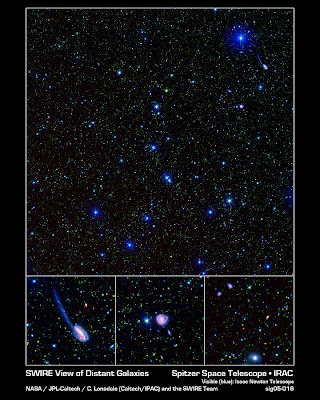
The Second Stellar Baby Boom

Credit: NASA/JPL-Caltech/C. Lonsdale (Caltech/IPAC) and the SWIRE Team
Written by Linda Vu, Spitzer Science Center

When it comes to giving birth, galaxies don't seem to have a "ticking biological clock." In fact, observations from NASA's Spitzer Space Telescope show that old galaxies were the biggest producers of new stars when our universe was half of its current age of 13.6 billion years. 

"The idea that galaxies might form their stars in different generations at different times is an old one... What our work proves is that this is the 'typical' behavior of the most luminous infrared galaxies between five and eight billion years ago," says Dr. Karina Caputi, of the Institute of Astronomy ETH Hoenggerberg, in Zurich, Switzerland. 

Infrared galaxies are extremely dusty, and most are furiously forming new stars. Astronomers suspect that the source of the galaxy's infrared glow comes from the warm dust around newborn stars. Using Spitzer data, Caputi and her colleagues identified approximately 600 of the brightest infrared galaxies within eight billion light-years of Earth. 

"The Spitzer data allowed us to estimate how luminous these galaxies were at infrared wavelengths and, how many stars were forming per unit time. The most luminous infrared galaxies were forming stars at a rate equivalent to a few tens to several hundreds of Suns per year," says Caputi.

Once team members identified the galaxies, they used data from the ground-based observations from the European Southern Observatory's Very Large Telescope (VLT), in Chile, to learn about the stellar population of these infrared galaxies.

"For most of the galaxies in our study, the VLT data revealed an older population of stars mingling with newborn stars. This indicates that the galaxies are 'old,' and undergoing a new 'burst' of star formation," says Caputi. 

Team members suspect that the older stellar population was responsible for filling the infrared galaxies with dust. This dust eventually absorbed ultraviolet light from the new generation of stars, and re-emitted the absorbed energy in infrared, giving the galaxies their infrared shine. 

In addition, the scientists found a 10 to 100 million-year lag between when the starbursts began, and when the galaxy got its brilliant infrared glow. 

"We suspect that it must take that long for the dust to absorb the ultraviolet-light that is emitted by young stars, and re-emit it in the infrared," says Caputi, who notes that this research will help astronomers better understand how galaxies develop over time. 

A paper on the topic was published in the June 2008 issue of Astrophysical Journal. It incorporated data from the Spitzer's S-COSMOS Legacy Project, led by Dr. David Sanders, of the University of Hawaii, Honolulu. And, VLT data collected by Dr. Simon Lilly, of the Institute of Astronomy ETH Hoenggerberg, in Zurich, Switzerland.

A SWIRE Picture is Worth Billions of Years

These spectacular images, taken by the Spitzer Wide-area Infrared Extragalactic (SWIRE) Legacy project, encapsulate one of the primary objectives of the Spitzer mission: to connect the evolution of galaxies from the distant, or early, universe to the nearby, or present day, universe.

The larger picture (top) depicts one-tenth of the SWIRE survey field called ELAIS-N1. In this image, the bright blue sources are hot stars in our own Milky Way, which range anywhere from 3 to 60 times the mass of our Sun. The fainter green spots are cooler stars and galaxies beyond the Milky Way whose light is dominated by older stellar populations. The red dots are dusty galaxies that are undergoing intense star formation. The faintest specks of red-orange are galaxies billions of light-years away in the distant universe.

The three lower panels highlight several regions of interest within the ELAIS-N1 field.

The Tadpole galaxy (bottom left) is the result of a recent galactic interaction in the local universe. Although these galactic mergers are rare in the universe's recent history, astronomers believe that they were much more common in the early universe. Thus, SWIRE team members will use this detailed image of the Tadpole galaxy to help understand the nature of the "faint red-orange specks" of the early universe.

The middle panel features an unusual ring-like galaxy called CGCG 275-022. The red spiral arms indicate that this galaxy is very dusty and perhaps undergoing intense star formation. The star-forming activity could have been initiated by a near head-on collision with another galaxy.

The most distant galaxies that SWIRE is able to detect are revealed in a zoom of deep space (bottom right). The colors in this feature represent the same objects as those in the larger field image of ELAIS-N1.

The observed SWIRE fields were chosen on the basis of being "empty" or as free as possible from the obscuring dust, gas, and stars of our own Milky Way. Because Earth is located within the Milky Way galaxy, there is always a screen of Milky Way objects blocking our view of the rest of the universe. In some places, our view of the larger universe is less obscured than others and for the most part is considered "empty." These are prime observing spots for astronomers interested in studying objects beyond the Milky Way. ELAIS-N1 is only one of six SWIRE survey fields. The full survey covers 49 square degrees of the sky, equivalent to the area covered by about 250 full moons.

The SWIRE image is a 3-channel false-color composite, where blue represents visible green light (light that would appear to be blue/green to the human eye), green captures 3.6 microns, and red represents emissions at 8 microns.

Interesting Note: From the Earth the SWIRE image (top image) can be seen in one square degree of sky, or a patch of sky that is approximately the size of a pea held out at arms length.

Tuesday, April 29, 2008

Compact Galaxies in Early Universe Pack a Big Punch

Credit: NASA, ESA, P. van Dokkum (Yale University), M. Franx (Leiden University, The Netherlands), and G. Illingworth (University of California, Santa Cruz, and Lick Observatory)

Imagine receiving an announcement touting the birth of a baby 20 inches long and weighing 180 pounds. After reading this puzzling message, you would immediately think the baby's weight was a misprint.

Astronomers looking at galaxies in the universe's distant past received a similar perplexing announcement when they found nine young, compact galaxies, each weighing in at 200 billion times the mass of the Sun. The galaxies, each only 5,000 light-years across, are a fraction of the size of today's grownup galaxies but contain approximately the same number of stars. Each galaxy could fit inside the central hub of our Milky Way Galaxy.

Astronomers used NASA's Hubble Space Telescope and the W.M. Keck Observatory on Mauna Kea, Hawaii, to study the galaxies as they existed 11 billion years ago, when the universe was less than 3 billion years old.

"Seeing the compact sizes of these galaxies is a puzzle," said Pieter G. van Dokkum of Yale University in New Haven, Conn., who led the study. "No massive galaxy at this distance has ever been observed to be so compact. It is not yet clear how they would build themselves up to become the large galaxies we see today. They would have to change a lot over 11 billion years, growing five times bigger. They could get larger by colliding with other galaxies, but such collisions may not be the complete answer."

To determine the sizes of the galaxies, the team used the Near Infrared Camera and Multi-Object Spectrometer on Hubble. The Keck observations were carried out with assistance of a powerful laser to correct for image blurring caused by the Earth's atmosphere. "Only Hubble and Keck can see the sizes of these galaxies because they are very small and far away," van Dokkum explained.

Van Dokkum and his colleagues studied the galaxies in 2006 with the Gemini South Telescope Near-Infrared Spectrograph, on Cerro Pachon in the Chilean Andes. Those observations provided the galaxies' distances and showed that the stars are a half a billion to a billion years old. The most massive stars had already exploded as supernovae.

"In the Hubble Deep Field, astronomers found that star-forming galaxies are small," said Marijn Franx of Leiden University, The Netherlands. "However, these galaxies were also very low in mass. They weigh much less than our Milky Way. Our study, which surveyed a much larger area than in the Hubble Deep Field, surprisingly shows that galaxies with the same weight as our Milky Way were also very small in the past. All galaxies look really different in early times, even massive ones that formed their stars early."

The ultradense galaxies might comprise half of all galaxies of that mass 11 billion years ago, van Dokkum said, forming the building blocks of today's largest galaxies.

How did these small, crowded galaxies form? One way, suggested van Dokkum, involves the interaction of dark matter and hydrogen gas in the nascent universe. Dark matter is an invisible form of matter that accounts for most of the universe's mass. Shortly after the Big Bang, the universe contained an uneven landscape of dark matter. Hydrogen gas became trapped in puddles of the invisible material and began spinning rapidly in dark matter's gravitational whirlpool, forming stars at a furious rate.

Based on the galaxies' masses, which are derived from their color, the astronomers estimated that the stars are spinning around their galactic disks at roughly 890,000 to 1 million miles an hour (400 to 500 kilometers a second). Stars in today's galaxies, by contrast, are traveling at about half that speed because they are larger and rotate more slowly than the compact galaxies.

These galaxies are ideal targets for the Wide Field Camera 3, which is scheduled to be installed aboard Hubble during Servicing Mission 4 in the fall of 2008. "We hope to use the Wide Field Camera 3 to find thousands of these galaxies. The Hubble images, together with the laser adaptive optics at Keck and similar large telescopes, should lead to a better understanding of the evolution of galaxies early in the life of the universe," said Garth Illingworth of the University of California, Santa Cruz, and Lick Observatory.

The findings appeared in the April 10 issue of The Astrophysical Journal Letters.

The authors of the science paper are Pieter van Dokkum (Yale University), Marijn Franx (Leiden University, The Netherlands), Mariska Kriek (Princeton University), Bradford Holden, Garth Illingworth, Daniel Magee, and Rychard Bouwens (University of California, Santa Cruz, and Lick Observatory), Danilo Marchesini (Yale University), Ryan Quadri (Leiden University), Greg Rudnick (National Optical Astronomical Observatory, Tucson), Edward Taylor (Leiden University), and Sune Toft (European Southern Observatory, Germany).

About this Image: This illustration shows the comparative sizes of our Milky Way Galaxy and an ultracompact galaxy, which existed in the early universe. Although the compact galaxy is only a fraction of the size of our Milky Way, it contains the same number of stars. The small, dense galaxy could fit inside the central hub of our Milky Way.
Credit: NASA, ESA, A. Feild (STScI), and P. van Dokkum (Yale University)

Monday, April 28, 2008

A Distant Galaxy Cluster - XMMU J2235.3-2557

ESO Chile Image of the Month - April 2008

A composite infrared image of the X-ray luminous galaxy cluster XMMU J2235.3-2557 at redshift 1.4, one of the most distant galaxy clusters known.

The composite is made of 4 HAWK-I pointings in both J and Ks and covers 13.5 arc minutes on a side. The cluster is right in the middle of the frame and is difficult to see, given the large field of view, so a blow-up centred on the cluster is shown in the inset. As can be seen by eye, the core of the cluster is dominated by red galaxies with very similar colours. The stars in these galaxies are already very old. On average they formed when the Universe was only one billion years old. As one moves away from the center of the cluster, cluster galaxies become slightly bluer, suggesting that galaxies in the outskirts are either younger or have recently experienced a small amount of star formation (commonly called "frosting"). As one moves even further out, the authors hope to find small groups of galaxies that will, one day, merge with the core.

In the standard flat, lambda-dominated cosmology, the universe is 4.6 billion years old at redshift 1.4 and 1.1 billion years old at redshift 5. The universe at redshift 0 (today) is 13.7 billion years old.

At a redshift of 1.4, 10 arc minutes on the sky corresponds to a linear distance of 5 Mpc (15,000,000,000,000,000,000 km).

Authors: Chris Lidman, Piero Rosati,
Masyuki Tanaka and the HAWK-I science verification team.

ESO
- European Organisation
for Astronomical
Research in theSouthern Hemisphere

Friday, April 25, 2008

Inside blazars

A blazar is a very compact and highly variable energy source associated with a supermassive black hole. It is also characterized by a relativistic jet that is pointing in the general direction of the Earth. Blazars are among the most violent phenomena in the universe and are an important topic in extragalactic astronomy.
Credit:Boston University - Cosmovision

Michigan telescopes help give astronomers insights into blazars

Provided by the University of Michigan

For the first time, astronomers have observed a blazar in action, substantiating a prevailing theory about how these luminous and energetic galactic cores work.

Two University of Michigan astronomers contributed to the research, which was led by Alan Marscher of the Institute for Astrophysical Research at Boston University. A paper on the observations is published in the April 24 issue of Nature.

Blazars, among the most energetic objects in the universe, are fueled by supermassive black holes at the core of certain giant elliptical galaxies. Periodically, they emit jets of high-energy plasma at almost the speed of light. Competing theoretical models sought to explain how this phenomenon occurs.

One model predicted that the jets were propelled by magnetic fields that were twisted by the gravity of the black hole and the materials falling into it. This is the behavior the astronomers detected.

"What we've observed is the mechanism by which the acceleration of relativistic particles in the emanating jets occurs. Knowing that mechanism enhances our understand of the physics that goes into the acceleration process," says Hugh Aller, a professor in the U-M Department of Astronomy.

Relativistic particles are particles traveling close to the speed of light.

"Often, we'd observe blazars, but they didn't do anything. It's been difficult to catch these outbursts when they occur," he adds.

Scientists from across the globe aimed a variety of telescopes at the blazar BL Lacertae, about 950 million light-years away from Earth. Optical, X-ray and radio telescopes monitored the galaxy at different electromagnetic wavelengths periodically for several years. U-M recorded radio light curves at the Radio Astronomy Observatory at Peach Mountain in Dexter.

"This is the first observational evidence that really fits with the picture that the theoreticians have had," says Margo Aller, a research scientist and lecturer in the U-M Department of Astronomy. "The reason we have this evidence is a very fine sampling of a large number of instruments, including the Michigan radio telescopes."

Scientists hope to get a closer look at blazar jets when NASA launches its Gamma-ray Large Area Space Telescope (GLAST) satellite observatory in May.

Thursday, April 24, 2008

Galaxies Gone Wild!

Credit: NASA, ESA,
the Hubble Heritage (STScI/AURA)-ESA/Hubble Collaboration,
and A. Evans (University of Virginia,
Charlottesville/NRAO/Stony Brook University)

Astronomy textbooks typically present galaxies as staid, solitary, and majestic island worlds of glittering stars.

But galaxies have a wild side. They have flirtatious close encounters that sometimes end in grand mergers and overflowing "maternity wards" of new star birth as the colliding galaxies morph into wondrous new shapes.

Today, in celebration of the Hubble Space Telescope's 18th launch anniversary, 59 views of colliding galaxies constitute the largest collection of Hubble images ever released to the public. This new Hubble atlas dramatically illustrates how galaxy collisions produce a remarkable variety of intricate structures in never-before-seen detail.

Astronomers observe only one out of a million galaxies in the nearby universe in the act of colliding. However, galaxy mergers were much more common long ago when they were closer together, because the expanding universe was smaller. Astronomers study how gravity choreographs their motions in the game of celestial bumper cars and try to observe them in action.

For all their violence, galactic smash-ups take place at a glacial rate by human standards - timescales on the order of several hundred million years. The images in the Hubble atlas capture snapshots of the various merging galaxies at various stages in their collision.

Most of the 59 new Hubble images are part of a large investigation of luminous and ultra- luminous infrared galaxies called the GOALS project (Great Observatories All-sky LIRG Survey). This survey combines observations from Hubble, NASA's Spitzer Space Telescope, NASA's Chandra X-ray Observatory, and NASA's Galaxy Evolution Explorer. The majority of the Hubble observations are led by Aaron S. Evans of the University of Virginia, Charlottesville, the National Radio Astronomy Observatory, and Stony Brook University.

For more information, contact:

Ray Villard
Space Telescope Science Institute, Baltimore, Md.
410-338-4514
villard@stsci.edu

Lars Lindberg Christensen
Hubble/ESA, Garching, Germany
011-49-89-3200-6306
lars@eso.org

Aaron Evans
University of Virginia, Charlottesville, Va.
ae3f@mail.astro.virginia.edu

Tuesday, April 22, 2008

Astrophotography: NGC 3718 by Dietmar Hagar


If southern skies stargazers thought there was nothing to the north to be interested in, then think again. There's a surprising number of galaxies both close to home and towards the farthest reaches of our Universe in the constellation of Ursa Major. It you think the larger of this 42 million light year distant galactic pair is a little warped, you'd be right. But there's more than two cosmic cannibals in this astronomy picture.

Originally discovered by Sir William Herschel during this very same month 211 years ago, NGC 3718 became the future study of an astronomer named Halton Arp. For 28 years Dr. Arp was staff astronomer at the Mt. Palomar and Mt. Wilson observatories and while there, he produced his well known catalog of Peculiar Galaxies that are disturbed or irregular in appearance. Needless to say, NGC 3718 became Arp 214: ""Barred spiral, (with a) sharp nucleus, narrow absorption lanes through center".

But it's not quiet and it's alone in the field. Joining warped NGC 3718 around 150,000 light years away is NGC 3729 - another massive galaxy which may be causing its neighbor's peculiarities. While the warping of galactic discs is common, the process is not quite yet understood. It's highly possible that tidal forces exerted by neighboring galaxies could be at work and in the case of this pair, it seems to carry through.

NGC 3718 contains an active galactic nucleus (AGN) and is known as a Seyfert Galaxy type 1.9 - one which may contain a massive black hole and is known for violent stars. Through HI mapping, NGC 3718 displays a tidal "tail" which begins on its eastern frontier and extends north towards its companion, NGC 3729. Is this just a case gravitational relationship? One galaxy consuming another? Let's find out…

It is commonly accepted that when galaxies pass each other that tidal forces draw out the companion galaxy's stars, gas, and dust in the formation of a spectacular tail. Just as it is commonly accepted that a merger of two spiral galaxies results in a remnant with an elliptical-like surface-brightness profile. In the case of NGC 3718, it would appear (according to interferometer data), the disk warp is evolving into a polar ring. No doubt, its molecular gas content is consistent with elliptical galaxy structure, but the distribution is warping the inner disk. At the same time, 2MASS data shows Arp 214's main support against gravitational collapse comes from pressure due to random motion of stars as seen in an elliptical galaxy rather than from rotation. The origin of the unusual combination of properties makes the whole scene not only beautiful to look at, but most unique.

But don't stop there… A closer examination of this picture will also show another another compact set of interacting galaxies as well - Hickson 56. Instead of two, there are five which share similarities with the closer cousins. Located some 400 million light years distant, this Hickson compact group has several catalogue designations including UGC 6527, VV 150, Markarian 176 and Arp 322 and were originally observed by Lord Rosse. According to Halton Arp, "Much print has been dedicated to explaining discordant redshifts in compact groups as unrelated background galaxies. But no one has analyzed the accordant galaxies. It is shown here that when there is a brightest galaxy in the group, the remainder with differences of less than 1000 km s−1 are systematically redshifted. This is the same result as obtained in all other well-defined groups and demonstrates again an increasing intrinsic redshift with fainter luminosity."

So what's Paul Hickson take? "Group 56 consists of five galaxies, three of which appear to be in contract and interacting. Two of these three galaxies (B and D) are stream of "galaxy stuff" linking its B and C components. An examination of the C galaxy reveals an asymmetric halo but D has a less complex outer luminosity profile. Last, but not least, both the A and D galaxies are Seyfert. More galaxies that have - or are - interacting in the past, present and future.

What's the chances of seeing some these galaxies yourself? Not bad at all. For the average-to-large telescope, NGC 3718 (RA 11 32 56 Dec +53 01 55) is roughly magnitude 10 to 11 (depending on whose scale you're looking at) and is noted as a soft, even haze with a dark dustlane seen upon aversion. NGC 3729 (RA 11 34 Dec +53 08), despite its magnitude billing is low surface brightness and requires a large telescope and aversion to detect. As for Hickson 56 (RA 11 32 46 Dec +52 56 28), you're going to need major aperture and excellent skies to even see a hint of this quintuplet.

Thanks to the photographic magic of Dietmar Hagar of Austria, we're able to enjoy this cosmic portrait. Using a 9" TMB refractor, the image was captured with a SXV H16 CCD camera and processed with AstroArt Software, Maxim DL and Registax. When Dietmar isn't busy being a trauma surgeon, he certainly takes outstanding astrophotos and is a member of the MRO imaging team. We thank him for sharing!

Written by Tammy Plotner

Universe Today


Wednesday, April 16, 2008

Hubble Finds that "Blue Blobs" in Space Are Orphaned Clusters of Stars

About this image: [Left] A GALEX ultraviolet image of the interacting galaxies M81 and M82, which lie 12 million light-years away in the constellation Ursa Major. The gravity from each galaxy dramatically affected the other during their last close encounter, 200 million years ago. Gas density waves rippling around M81 make it a grand design spiral. M82 is undergoing a starburst at its core, creating glowing fingers of hydrogen.

[Right] A Hubble Space Telescope visible light image of bright blue star clusters found along a wispy bridge of gas that was tidally stretched between the two galaxies, and a third companion galaxy not seen in this picture. This is not the place astronomers expect to find star clusters because the density of gas is so low. Turbulence in the gas may have enhanced the density locally to trigger starbirth. The so-called "blue blobs" are clumped together in a structure called Arp's Loop. Hubble reveals the clusters contain the equivalent of five Orion Nebulae. A Hubble plot of the stellar population in the clusters yields an age of approximately 200 million years, which coincides with the epoch of the collision.
Image Type: Astronomical/Illustration
Credit: NASA, ESA, and D. de Mello (Catholic University of America/GSFC)

Finding blue blobs in space sounds like an encounter with an alien out of a science fiction movie. But the Hubble Space Telescope's powerful vision has resolved strange objects nicknamed "blobs" and found them to be brilliant blue clusters of stars born in the swirls and eddies of a galactic smashup 200 million years ago.

The findings are being reported by Duilia de Mello of the Catholic University of America, Washington, D.C. and NASA's Goddard Space Flight Center, Greenbelt, Md. and her colleagues at the 211th meeting of the American Astronomical Society in Austin, Texas.

Such "blue blobs"-weighing tens of thousands of solar masses-have never been seen in detail before in such sparse locations, say researchers. They are more massive than most open clusters found inside galaxies but a fraction of the mass of globular star clusters that orbit a galaxy.

Because the orphan stars don't belong to any particular galaxy, the heavier elements produced in their fusion furnaces may easily be expelled back into intergalactic space. This may offer clues as to how the early universe was "polluted" with heavier elements early in its history, say researchers.

The mystery is that the "blue blobs" are found along a wispy bridge of gas strung among three colliding galaxies, M81, M82, and NGC 3077, residing approximately 12 million light-years from Earth. This is not the place astronomers expect to find star clusters: in the "abyssal plain" of intergalactic space. "We could not believe it, the stars were in the middle of nowhere," says de Mello.

The "blue blobs" are clumped together in a structure called Arp's Loop, along the tenuous gas bridge. The gas filaments were considered too thin to accumulate enough material to actually build these many stars, says de Mello. But Hubble reveals the "blue blobs" contain the equivalent of five Orion Nebulae.

After finding that these "blobs" were resolved into stars, the team used the Hubble image to measure an age for the clusters of less than 200 million years with many stars as young and even younger than 10 million years. Not coincidentally, 200 million years is the estimated age of the galactic collision that created the tidal gas streamers, pulled between the galaxies like taffy.

De Mello and her team propose that the star clusters in this diffuse structure might have formed from gas collisions and subsequent turbulence, which enhanced locally the density of the gas streams. Galaxy collisions were much more frequent in the early universe, so "blue blobs" should have been common. After the stars burned out or exploded, the heavier elements forged in their nuclear furnaces would have been ejected to enrich intergalactic space.

Radio observations with the Very Large Array of radio telescopes in Socorro, New Mexico, gave a detailed map of the intergalactic bridge that revealed knots of denser gas. Studies with the 3.5-meter WIYN telescope on Kitt Peak in Arizona mapped the optical light glow of hydrogen along the bridge. Observations with NASA's Galaxy Evolution Explorer (GALEX) ultraviolet space telescope revealed an ultraviolet glow at the knots, and that earned them the nickname "blue blobs." But GALEX did not have the resolution to see individual stars or clusters. Only Hubble's Advanced Camera for Surveys at last revealed the point sources of the ultraviolet radiation.

CONTACT

Ray Villard
Space Telescope Science Institute, Baltimore,
Md.
410-338-4514 villard@stsci.edu

Robert Naeye

Goddard Space Flight Center,
Greenbelt, Md.
301-286-4453 robert.p.naeye@nasa.gov

Duilia de Mello

The Catholic University of America, Washington,
D.C.
and Goddard Space Flight Center, Greenbelt, Md.
301-286-7497 duilia.f.demello@nasa.gov