Showing posts with label hydrogen Lyman-alpha (Lyα). Show all posts

Monday, February 09, 2026

'Red Potato' galaxy discovered by astronomers

Galaxy MQN01 J004131.9-493704 "Red Potato" at z=3.25 and its surrounding cool Lyα-emitting gas reservoir.
Credit: arXiv (2026). DOI: 10.48550/arxiv.2601.20473


Using the James Webb Space Telescope (JWST), an international team of astronomers has discovered a new massive and quiescent red galaxy, which they dubbed "Red Potato." The discovery was reported in a research paper published January 28 on the arXiv pre-print server.

A potato in the cosmic web

A team of astronomers led by Weichen Wang of the University of Milan, Italy, has recently observed a gas-rich cosmic web node at a redshift of approximately 3.25, designated MQN01. In general, such cosmic web nodes and protoclusters at high redshifts are known to host rich reservoirs of cool and molecular gas. Therefore, these structures are expected to be sites of exceptionally efficient formation of massive galaxies via gas accretion.

By investigating MQN01 with JWST's Near Infrared Camera (NIRCam) and Near Infrared Spectrograph (NIRSpec), Wang's team has serendipitously discovered a new massive red galaxy. Due to its morphology and color, they named it "Red Potato."

"In this work, we present the discovery of a massive quiescent galaxy in a gas-rich environment of a cosmic web node or protocluster at z ∼ 3.2, identified and spectroscopically confirmed from a JWST program," the researchers write in the paper.

Massive and quiescent

The Red Potato, or MQN01 J004131.9-493704, has a half-light radius of about 3,260 light years and stellar mass of 110 billion solar masses. The molecular gas mass of the galaxy was calculated to be less than 7 billion solar masses, which yields a molecular gas fraction smaller than 0.06.

The non-detection of carbon monoxide and sodium D-lines indicate that the Red Potato is poor in molecular and neutral gas. Moreover, no gas outflows have been detected from the galaxy. In general, the Red Potato galaxy appears to be a dispersion-dominated system according to the kinematics of ionized gas.

The study found that Red Potato has a star-formation rate (SFR) at a level of 4.0 solar masses per year, which is at least one dex below the star-forming main sequence (SFMS). This is a relatively low SFR given that the galaxy is located at the center of a large reservoir of cool circumgalactic medium (CGM).

X-ray jet causing gas turbulence

The stellar velocity dispersion of Red Potato was found to be 268 km/s, suggesting elevated levels of gas turbulence in the CGM. Furthermore, deep X-ray data point to the presence of an extended X-ray jet which most likely emanates from a neighboring luminous X-ray active galactic nucleus (AGN), indicating a certain form of jet-mode feedback acting on the Red Potato's CGM.

"We argue that the jet feedback may have led to increased CGM turbulence around the Red Potato and thus have reduced the gas accretion onto the galaxy, which is indicated by the high gas velocity dispersion measured from the Lyα and Hα line profiles," the authors of the paper conclude.


Written for you by our author Tomasz Nowakowski, edited by Sadie Harley, and fact-checked and reviewed by Robert Egan—this article is the result of careful human work. We rely on readers like you to keep independent science journalism alive.If this reporting matters to you, please consider a donation (especially monthly). You'll get an ad-free account as a thank-you.


Publication details

Weichen Wang et al, A Quiescent Galaxy in a Gas-Rich Cosmic Web Node at z~3, arXiv (2026).
DOI: 10.48550/arxiv.2601.20473

Journal information: arXiv


Explore further

SXDF-NB1006-2 is a young starburst galaxy experiencing ionized gas outflows, observations find


Sunday, April 14, 2024

Probing Cold Gas with the Resonance Doublet of Singly Ionized Magnesium

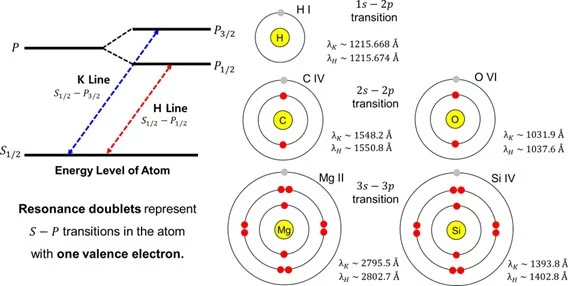
Figure 1: Schematic illustration of resonance doublets: the energy levels of resonance doublets are shown on the left, some example atoms and ions with one valence electron on the right. © MPA

Traditional studies of the gas around galaxies rely in particular on absorption and emission features of neutral hydrogen, the simplest and most abundant element in the universe. MPA researchers have now investigated alternative tracers, in particular the resonance doublet of singly ionized magnesium and found that analyzing this emission can lead to significant advances in studying the circum-galactic medium. They showed the potential of the magnesium doublet as an alternative to Lyman-alpha emission through a new radiative transfer code and suggest that the magnesium doublet ratio could even be used as a tracer of the Lyman-continuum escape.

Light, and in particular how it interacts with the atoms of various elements, plays a pivotal role in unveiling the secrets of the universe. At the heart of this interaction lies the resonance line, the transition between the ground state and the first excited state in an atom. This transition is significant and interesting for atoms and ions with just one electron in their outermost shell. Considering the fine structure of these atoms, the resonance line manifests as a doublet, the K and H lines. The most renowned example of such a resonance doublet is the hydrogen Lyman-alpha (Lyα) line at 1216 Å. Although the two lines of Lyman-alpha are not distinguishable due to a too small energy gap, other metal doublets are observed as separated doublets.

In astrophysical spectra, the resonance doublets stand out as prominent absorption lines since the abundant electrons in the ground state easily interact with photons near the line center. In addition to absorption features in astrophysical spectra, the doublets also appear as emission lines, acting as one of the main coolants of shock and ionized gas. The atomic physics of the resonance doublet dictates that the scattering cross-section of the K line is always two times higher than that of the H line. This also translates into the ratio of K and H emission from collisional excitation and recombination, which is generally two. Furthermore, due to their resonant nature, photons of the doublet emission suffer scattering with the electrons in the ground state, by which the physical properties of the gas are imprinted on their emission features. The study of resonance doublets, therefore, opens a window into the complexities of astrophysical environments, making it a cornerstone of astrophysical spectroscopy.

Figure 2: These diagrams show the magnesium (left) and Lyman-alpha (right) spectra for various column densities (different color hues). The black dashed line represents the intrinsic Gaussian profile. For magnesium, the doublet is clearly separated, while the energy gap is too small for hydrogen. With larger densities, the asymmetry of the lines becomes more pronounced. © MPA

Studying CGM with Resonance Doublets

The circumgalactic medium (CGM), the diffuse halo of multiphase gas that envelopes galaxies, is a key to understanding the mysteries of galaxy formation, evolution, and the flow of matter around galaxies. While traditional studies of the CGM have relied on analyzing the absorption features of the resonance lines observed in quasar spectra, this approach offers a view constrained by singular lines of sight. The evolution of observational technology, with instruments like MUSE on the VLT, KCWI on Keck, and HETDEX, has opened new windows into the CGM through the direct observation of spatially extended emissions such as Lyman-alpha and resonance doublets of heavier elements.

The Lyman-alpha emission is central to these advances and a powerful tool for probing the cold CGM (with temperatures up to 10000K) and studying the early universe (at redshift z from 2 to 5). However, observing Lyman-alpha faces significant challenges: it is obscured by Earth’s atmosphere at z < 2 and becomes difficult to detect beyond z > 6 due to the optically thick universe in the epoch of reionization. These limitations highlight the necessity for alternative tracers of cold gas within the CGM across different cosmic epochs.

Figure 3: The projected images of surface brightness in Mg II (top left) and Lyman-alpha (top right), the Mg II doublet ratio (bottom left), and the degree of polarization of Mg II (bottom right). All quantities are given for optically thin (left) and thick (right) environments in magnesium. © MPA

Resonance Doublet of Singly Ionized Magnesium as a New Tracer of Cold Gas

The resonance doublet of singly ionized magnesium (Mg II) at 2796 Å and 2803 Å presents such an alternative. Due to its resonance nature and with a similar ionization energy to atomic hydrogen, the Mg II emission can trace cold gas properties through scattering processes like Lyman-alpha. In this work, we developed a new 3D Monte Carlo radiative transfer code to investigate the escape of both emission lines through homogeneous and clumpy multiphase media. Our new code allows for exploring gas in arbitrary 3D geometries via both Lyman-alpha and metal resonance doublets, significantly enhancing our understanding of the cold gas environment surrounding galaxies.

One of the key findings of this research is the distinct behavior of Mg II emissions compared to Lyman-alpha, despite similarities in atomic physics. Lyman-alpha emission is more spatially extended via scattering than Mg II due to a small fraction of magnesium in the gas. Furthermore, the Mg II escape fraction generally exceeds that of Lyman-alpha, offering a clearer view through the cosmic dust that often obscures Lyman-alpha emissions. This makes Mg II an invaluable alternative for tracing cold gas, particularly in environments where Lyman-alpha emission is weak or unobservable.

Figure 4: The Mg II doublet ratio for various outflow/inflow velocities. While the doublet ratio is insensitive to velocities blow the separation velocity of the two lines (700 km/s), a clear distinction can be sees for larger velocities. © MPA

Magnesium Doublet Ratio

The escape of the Lyman continuum (LyC) or its leakage is particularly significant for understanding the mechanisms behind galaxy evolution and the reionization of the universe. The Mg II doublet ratio, which is the flux ratio of the two doublet lines, is one of the new promising indicators of the LyC leakage.

Our study investigates the Mg II doublet ratio in various environments. We found that the doublet ratio indicates a strong outflow/inflow. The double ratio of Mg II from stellar continuum becomes ~ 1 for high column densities of Mg II. In addition, we tested the doublet ratio as a leakage indicator of LyC and tracer of the LyC escape fraction.

The Mg II spectrum in the halo is composed of only scattered photons, and the physical properties of cold gas are clearly imprinted on it. We explored this and derived the analytic solution of LyC escape using the halo doublet ratio. These insights not only expand our methodologies in studying the CGM but also pave new pathways for future observation and theory.

Figure 5: Left: Schematic illustration for the relation between the Mg II doublet ratio and the Lyman-continuum (LyC) escape. Right: the Mg II doublet ratio in the halo, which is the flux ratio of Mg II K and H lines, as a function of Mg II column density. Both LyC escape fraction and the doublet ratio decrease with increasing Mg II column density. When the gas is optically thick for LyC, the Mg II doublet ratio in the halo, which is the flux ratio of Mg II K and H lines, is less than 2. On the other hand, the doublet ratio is higher than 2. Hence, the halo doublet ratio can be a tracer of LyC escape. © MPA

Potential of Metal Resonance Doublets

Moreover, our research opens the door to exploring the emission features of other metal resonance doublets as tracers of the CGM. The success of the Mg II doublet in providing new insights into cold gas properties and the escape of ionizing photons suggests the potential for similar analyses for other elements. For example, the C IV doublet can be a good indicator of the galactic wind. Other metal doublets, such as O VI, N V, and Si IV, share similar atomic physics and could trace the CGM at different temperatures. This avenue of research holds promise for broadening our understanding of the multiphase CGM, offering a richer, more nuanced view of the processes that govern galaxy evolution and the cosmic web.


Author:

Seok-Jun Chang
Postdoc
tel:2009

sjchang@mpa-garching.mpg.de

Original publication

Seok-Jun Chang & Max Gronke

Probing cold gas with Mg II and Lyα radiative transfer
submitted to MNRAS


Source