Showing posts with label IC 63. Show all posts

Friday, October 26, 2018

The ghost of Cassiopeia

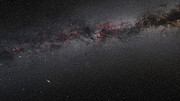
Ground-based view of the sky around IC 63


Videos
Zoom-in on the Ghost Nebula
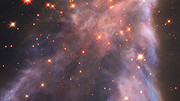

Pan across a cosmic ghost


About 550 light-years away in the constellation of Cassiopeia lies IC 63, a stunning and slightly eerie nebula. Also known as the ghost of Cassiopeia, IC 63 is being shaped by radiation from a nearby unpredictably variable star, Gamma Cassiopeiae, which is slowly eroding away the ghostly cloud of dust and gas. This celestial ghost makes the perfect backdrop for the upcoming feast of All Hallow's Eve — better known as Halloween.

The constellation of Cassiopeia, named after a vain queen in Greek mythology, forms the easily recognisable “W” shape in the night sky. The central point of the W is marked by a dramatic star named Gamma Cassiopeiae.

The remarkable Gamma Cassiopeiae is a blue-white subgiant variable star that is surrounded by a gaseous disc. This star is 19 times more massive and 65 000 times brighter than our Sun. It also rotates at the incredible speed of 1.6 million kilometres per hour — more than 200 times faster than our parent star. This frenzied rotation gives it a squashed appearance. The fast rotation causes eruptions of mass from the star into a surrounding disk. This mass loss is related to the observed brightness variations.

The radiation of Gamma Cassiopeiae is so powerful that it even affects IC 63, sometimes nicknamed the Ghost Nebula, that lies several light years away from the star. IC 63 is visible in this image taken by the NASA/ESA Hubble Space Telescope.

The colours in the eerie nebula showcase how the nebula is affected by the powerful radiation from the distant star. The hydrogen within IC 63 is being bombarded with ultraviolet radiation from Gamma Cassiopeiae, causing its electrons to gain energy which they later release as hydrogen-alpha radiation — visible in red in this image.

This hydrogen-alpha radiation makes IC 63 an emission nebula, but we also see blue light in this image. This is light from Gamma Cassiopeiae that has been reflected by dust particles in the nebula, meaning that IC 63 is also a reflection nebula.

This colourful and ghostly nebula is slowly dissipating under the influence of ultraviolet radiation from Gamma Cassiopeiae. However, IC 63 is not the only object under the influence of the mighty star. It is part of a much larger nebulous region surrounding Gamma Cassiopeiae that measures approximately two degrees on the sky — roughly four times as wide as  the full Moon.

This region is best seen from the Northern Hemisphere during autumn and winter. Though it is high in the sky and visible all year round from Europe, it is very dim, so observing it requires a fairly large telescope and dark skies.

From above Earth’s atmosphere, Hubble gives us a view that we cannot hope to see with our eyes. This photo is possibly the most detailed image that has ever been taken of IC 63, and it beautifully showcases Hubble’s capabilities.


More Information

The Hubble Space Telescope is a project of international cooperation between ESA and NASA.

Image credit: NASA, ESA


Links


Contact

Mathias Jäger
ESA/Hubble, Public Information Officer
Garching, Germany
Tel: +49 176 62397500
Email:
mjaeger@partner.eso.org


Monday, September 30, 2013

Observations reveal critical interplay of interstellar dust, hydrogen

Intense molecular hydrogen formation shown in near infrared image of the reflection nebula IC 63 in the constellation Cassiopeia. The white bars represent polarization seen toward stars in the background of the nebula. The largest polarization shows the most intense emission, demonstrating that hydrogen formation influences alignment of the dust grain with a magnetic field.  Image: B-G Andersson, USRA

For astrophysicists, the interplay of hydrogen — the most common molecule in the universe — and the vast clouds of dust that fill the voids of interstellar space has been an intractable puzzle of stellar evolution.

The dust, astronomers believe, is a key phase in the life cycle of stars, which are formed in dusty nurseries throughout the cosmos. But how the dust interacts with hydrogen and is oriented by the magnetic fields in deep space has proved a six-decade-long theoretical challenge.

Now, an international team of astronomers reports key observations that confirm a theory devised by University of Wisconsin-Madison astrophysicist Alexandre Lazarian and Wisconsin graduate student Thiem Hoang. The theory describes how dust grains in interstellar space, like soldiers in lock-drill formation, spin and organize themselves in the presence of magnetic fields to precisely align in key astrophysical environments.

 Alexandre Lazarian

The effort promises to untangle a theoretical logjam about key elements of the interstellar medium and underpin novel observational tactics to probe magnetic fields in space.

The new observations, conducted by a team led by B-G Andersson of the Universities Space Research Association (USRA), and their theoretical implications are to be reported in the Oct. 1, 2013 edition of the Astrophysical Journal. The observations were conducted using a variety of techniques — optical and near infrared polarimetry, high-accuracy optical spectroscopy and photometry, and sensitive imaging in the near infrared — at observatories in Spain, Hawaii, Arizona and New Mexico.

"We need to understand grain alignment if we want to make use of polarimetry as a means of investigating interstellar magnetic fields," says Lazarian, who was encouraged to attack the problem by the renowned astrophysicist Lyman Spitzer. "Spitzer himself worked on the problem extensively."

Scientists have long known that starlight becomes polarized as it shines through clouds of neatly aligned, rapidly spinning grains of interstellar dust. And the parsing of polarized light is a key observational technique. But how the grains of dust interact with hydrogen, become aligned so that starlight shining through becomes polarized, and are set spinning has been a mystery.

"While interstellar polarization has been known since 1949, the physical mechanisms behind grain alignment have been poorly understood until recently," explains Andersson. "These observations form part of a coordinated effort to — after more than 60 years — place interstellar grain alignment on a solid theoretical and observational footing."

The observations made by Andersson and his colleagues support an analytical theory posed by Lazarian and Hoang known as Radiative Alignment Torque, which describes how irregular grains can be aligned by their interaction with magnetic fields and stellar radiation. Under the theory, grains are spun, propeller-like, by photons. Their alignment is modified by magnetic fields, which orients them with respect to the field, telling an observer its direction. Impurities and defects on the dust grains produce catalytic sites for the formation of hydrogen molecules, which are subsequently ejected, creating miniature "rocket engines," also called "Purcell thrusters" after Nobel laureate Edwin Purcell, who studied grain alignment.

The theory devised by Lazarian and Hoang predicts how the molecular hydrogen thrust changes grain alignment, and was put to the test by Andersson's team of observers.

Confirming the theory, Lazarian notes, not only helps explain how interstellar dust grains align, but promises a new ability for astronomers to use polarized visible and near infrared light to reliably probe the strength and structure of magnetic fields in interstellar space, a notoriously difficult phenomenon to measure quantitatively.
Interstellar magnetic fields are ubiquitous in spiral galaxies like our Milky Way and are believed to be essential regulators of star formation and the evolution of proto-planetary disks. They also control the regulation and propagation of cosmic rays.

The murky piece of the astrophysical puzzle, says Lazarian, was how the irregular grains of interstellar dust were set in spinning motion. The observations conducted by Andersson demonstrate that intense molecular hydrogen formation on the surface of the interstellar dust grains is an important contributor to the dust grains spinning.

Hydrogen does not exist in the element's gas phase in space since the two atoms of the molecule cannot rid themselves of the formation reaction energy without a third body. The two hydrogen atoms therefore use the surfaces of dust grains as a substrate, and the force of the reaction energy is enough to set the dust grains in motion.

The new work, which was supported by the National Science Foundation, is especially timely, Lazarian says, as two new observatories — the ground-based ALMA, the Atacama Large Millimeter Array, and the space-based Planck Telescope — are poised to build on the new results.