Tuesday, May 05, 2009

Galactic X-ray emissions originate from stars

Astronomers identify the origin of the diffuse radiation
in the plane of the Milky Way

A 25-year old astronomical mystery has been solved: Most of the diffuse X-ray emissions in the Milky Way do not originate from one single source but from so-called white dwarfs and from stars with active outer gas layers. Mikhail Revnivtsev from the Excellence Cluster Universe at the TU Munich and his colleagues at the Max Planck Institute for Astrophysics in Garching, the Space Research Institute in Moscow and the Harvard-Smithsonian Center for Astrophysics in Cambridge have now succeeded in proving this. (Nature, April 30, 2009).

Fig.: The plane of the Milky Way, recorded with the Chandra satellite in three colours: Photons with energies between 0.5 and 1keV appear red, those between 1 and 3keV green, and those between 3 and 7keV blue. Discrete sources are indicated by circles. Image credit: Mikhail Revnivtsev

It is now 25 years since scientists discovered diffuse X-ray emissions from the vicinity of the Milky Way plane. Since then, a whole generation of astronomers has been racking its brains as to their origin. Energetic X-ray emissions usually originate from very hot gases in a temperature range between 10 and 100 million degrees Celsius. And this "Galactic Ridge X-ray Emission" (GRXE) is also typical for very hot, optically thin plasma.

A gas with these thermal properties would, however, immediately escape from our galaxy - the Milky Way would continuously lose colossal amounts of energy and finally collapse as the existing energy sources, such as stars and supernovae, would not be sufficient to replenish such a loss. Cosmic particles colliding with the interstellar medium could also be ruled out as an explanation for the GRXE.

It is only recently that observations with the RXTE and Integral satellites have shown that the X-ray emissions of the Milky Way exhibit the same distribution pattern as the stars. Since then, it has been assumed that a large portion of the GRXE originates from individual stars. These findings motivated the international team to carry out more precise measurements with the Chandra X-ray telescope. The test area chosen was a small celestial region near the centre of the Milky Way.

The region chosen, about half as big as a full moon, lent itself to the observations for two reasons: On the one hand because of the high GRXE intensity, which minimized the "interfering radiation" from extra-galactic X-ray sources; and on the other hand because the interstellar matter at this position absorbs only small amounts of radiation so that it was even possible to detect weak discrete sources with Chandra.

Chandra actually managed to identify 473 point sources of X-rays in a sector of the search field covering only 2.6 arcminutes. In a further step, the group used measurements from the Spitzer satellite observatory to prove that the results of the sector observed could be applied to the whole galaxy.

Most of the 473 X-ray sources are probably white dwarfs, which accrete matter from their surroundings, as well as stars with high activity in their outermost gas layer, the corona. White dwarfs are the remnants of extinct, low-mass suns. These cooling dead stars frequently orbit a partner, and in such a binary star system the white dwarf extracts matter from its larger partner until it becomes a Type Ia supernova.

The resolution of the diffuse X-ray emissions in our galaxy into discrete sources has far-reaching consequences for our understanding of a number of astrophysical phenomena. Astronomers can use the GRX emission as a calibration for the spatial distribution of star populations within the Milky Way, for example. The results were also relevant for research into other galaxies: It now seems clear that the diffuse X-ray radiation from these objects originates from white dwarfs and active stars.

Original work:

Mikhail Revnivtsev, Sergey Sazonov, Eugene Churazov, William Forman, Alexey Vikhlinin and Rashid Sunyaev
Discrete sources as the origin of the Galactic X-ray ridge emission
Nature, Vol. 458, No. 7242, April 30, 2009

PDF (244 KB)

Contact:

Dr. Mona Clerico, Press Officer Max Planck Institute for Astrophysics and
Max-Planck-Institute for Extraterrestrial Physics, Garching
Tel.: +49 89 30000-3980
E-mail: clerico@mpe.mpg.de

Dr. Eugene Churazov
Max Planck Institute for Astrophysics, Garching
Tel.: +49 89 30000-2219
E-mail: echurazov@mpa-garching.mpg

Prof. Dr. Rashid Sunyaev
Max Planck Institute for Astrophysics, Garching
Tel.: +49 89 30000-2244

Touching the Edge of the Universe world premiere

Touching the Edge of the Universe - ESA's IYA2009 planetarium show
Videos (1)

ESA will present the world premiere of Touching the Edge of the Universe, a stunning new planetarium show, starting 7 May 2009 at 30 planetaria in Germany, Austria and Switzerland. The premiere comes just days before the launch of Herschel & Planck, two of the show's starring missions, scheduled for 14 May.

Both missions will make fundamental contributions to astronomy and cosmology and serve as Europe’s cornerstone contribution to the 2009 Year of Astronomy.
In 1609, Galileo Galilei pointed his telescope at the sky, discovering worlds unknown and proving that Aristotle's long-held theories on the cosmos were in fact wrong. His findings marked the beginning of an intellectual revolution that continues today, underpinning much of modern science.

Touching the Edge of the Universe tells the story of astronomy from the time of Galileo and his simple optical telescope to today’s sophisticated space astronomy missions. Viewers will experience an entirely new view of the cosmos conveyed through stunning 3D graphics and a professionally acted script, much of which was shot on location at various ESA Establishments.

Planck scans the sky during Touching the Edge of the Universe - ESA's IYA2009 planetarium show. Videos (2)

Content based on latest knowledge


The show includes the most current knowledge based on the research of scientists working on present and future ESA missions.

Providing a 360° 'full dome' projection, the show takes the audience on a breathtaking voyage of discovery, from Galileo's 16th Century Tuscan villa to the tense countdown, launch and orbiting of the next generation of space telescopes - and out into the Universe.

"The ESA planetarium show provides a lively and compelling picture of space exploration today and what it means for people in everyday life," says Jocelyne Landeau-Constantin, ESA's Project Manager for the show.

"It also reminds us that scientific exploration remains a grand project, just as during the time of Galileo and Kepler, 400 hundred years ago," she adds.

ESA partnership with European planetaria

More than 30 German-language planetaria located in Germany, Austria and Switzerland are partners in Touching the Edge of the Universe. These planetaria offer some of the best connections between formal academic learning and the power of infotainment.

Herschel separation - a dramatic moment during Touching the Edge of the Universe - ESA's YA2009 planetarium show. Videos (3)

"While books, TV and many other media present the topic of space to the general public, nowhere else can we experience the fascination of space as impressively as in a planetarium," says Fernando Doblas, Head of ESA’s Communication and Knowledge Department.

Digital projection systems using full dome video technology are fast displacing traditional analogue projection systems and planetaria can now provide audiences with a full-surround, cinematic experience.

But digital production techniques are far more demanding and with Touching the Edge of the Universe, the Agency relied on the expertise of the creative team at the Media Faculty of the Kiel University of Applied Sciences, Kiel, Germany.

Show poster - with German-language title 'Augen im All'

In addition to complex digital imagery recorded using 'green screen' substitution techniques, the show includes detailed and accurate 3D renderings of Herschel, Planck and ESA’s future Mars Rover, as well as of Europe’s Ariane 5 launcher.

Professional actors from the Kiel theatre were employed to ensure a truly authentic educational experience.

ESA will also release the English-language version in June this year.

These premieres will be followed by further releases throughout 2009. ESA scientists and managers will be on hand at several of the premieres for an introductory talk.

Further information at http://www.planetariumshow.eu

Contact

Jocelyne Landeau-Constantin
Head of Corporate Communication Office,
ESA/ESOC, Darmstadt, Germany

Tel: +49-6151-902696
jlc @ esa.int

Show premieres

World premiere in Berlin, Vienna and Lucern, 7 May 2009
  • Vienna - Zeiss Planetarium Wien
  • Berlin - Zeiss Großplanetarium Berlin
  • Lucern - Planetarium Luzern
Grand openings in Germany, Austria and Switzerland, May 2009

8 May 2009
Planetarium Hamburg
Nicolaus Copernicus Planetarium, Nürnberg
Planetarium Klagenfurt
Planetarium Sigmund Jähn Rodewisch, Rodewisch

9 May 2009
Planetarium Herzberg
Planetarium Drebach
LWL Planetarium Münster
Planetarium Laupheim

11 May 2009
Planetarium Cottbus

12 May 2009
Zeiss Planetarium Bochum
Planetarium Osnabrück

13 May 2009
Mediendom der Fachhochschule Kiel

14 May 2009
Planetarium Jena
Wilhelm Foerster Sternwarte Berlin

Top Five Breakthroughs From Hubble's Workhorse Camera

Several hundred never before seen galaxies are visible in this "deepest-ever" view of the universe, called the Hubble Deep Field (HDF), made with the Wide Field and Planetary Camera 2 aboard NASA's Hubble Space Telescope. Image credit: NASA/STScI

Deepest photograph of the universe. Hubble's famous "Deep Field" picture (above), taken by the Wide Field and Planetary Camera 2, left the world with its mouth agape when it was first revealed in 1996. In just a small patch of sky, more than 1,000 galaxies located billions of light-years away could be seen floating in space like sea creatures at the bottom of an endless ocean. Our world and our galaxy suddenly seemed very small.

Observations of comet collision with Jupiter. The Wide Field and Planetary Camera 2 gave the world a rare, stunning view of Comet Shoemaker-Levy 9 plunging into the gas giant Jupiter in 1994. The images revealed the event in great detail, including ripples expanding outward from the impact.

The birth and death of stars. The Wide Field and Planetary Camera 2 brought the cosmos down to Earth with its exquisite pictures of stars in all stages of development. Its famed picture of the "Pillars of Creation" and other images of colorful dying stars offered the first, glorious views of a star's life. The camera also took the first pictures of the dusty disks around stars where planets are born, demonstrating that planet-forming environments are common in the universe.

The age and rate of expansion of our universe. Our universe formed from a colossal explosion known as the Big Bang, and has been stretching apart ever since. Hubble's Wide Field and Planetary Camera 2, by observing stars that vary periodically in brightness, was able to calculate the pace of this expansion to an unprecedented degree of error of 10 percent. The camera also played a leading role in discovering that the expansion of the universe is accelerating, driven by a mysterious force called "dark energy." Together, these findings led to the calculation that our universe is approximately 13.7 billion years old.

Most galaxies harbor huge black holes. Before Hubble, astronomers suspected, but had no proof, that supermassive black holes lurk deep in the bellies of galaxies. The Wide Field and Planetary Camera 2, together with spectroscopy data from Hubble, showed that most galaxies in the universe do indeed harbor monstrous black holes up to billions of times the mass of our sun.

Media contact: DC Agle/JPL
(818) 393-9011

Friday, May 01, 2009

Friends of the RAS

Interested in Astronomy?
Enjoy popular lectures?
Know someone who does?

Why not become a Friend of the RAS and attend the next Friends meeting on Naming Pluto? This will be at 1800 on TUESDAY 19 MAY,in the RAS at Burlington House, consisting of the screening of a new film about Pluto followed by a talk by Oxford historian Allan Chapman.

The film tells the story of how an 11-year-old Oxford schoolgirl, Venetia Burney Phair, named the planet over breakfast on March 14, 1930, after her grandfather read about its discovery in 'The Times'. In this new documentary she recalls how she suggested 'Pluto' to her grandfather. He liked the name and mentioned it to his friend Herbert Hall Turner, a former President of the Royal Astronomical Society. The suggestion was then sent by telegram to the Lowell Observatory in Arizona, which had the planet’s naming rights, and the title was made official on May 1, 1930. However, until 2007 Mrs Burney Phair had never seen her planet through a telescope. The film records the quest for her to see it. During the film’s production, the International Astronomical Union, controversially, demoted Pluto to a ‘dwarf planet’ following a reclassification of the solar system, and the British weather caused a year-long hold up as it did its best to deny Mrs Burney Phair a clear view!

Dr Allan Chapman FRAS will explore the history of Pluto, possibly our most mysterious neighbour. Following the screening, introduced by the film maker Ginita Jimenez, ( which we hope Venetia Burney Phair may be well enough to attend) and talk there will be a drinks reception.

There is no charge for attending this event - however it is restricted to 'Friends of the RAS'.'Friends' will not meet the requirements to become , nor have the same concerns as, a Fellow of the RAS. Rather, membership of the RAS as a 'Friend' recognises the appeal of astronomy to the general public.

To become a 'Friend' (see below * for a fuller description of activities and benefits) for the remainder of 2009, send your name, address, email address and telephone number with a cheque (made out to ‘The Royal Astronomical Society’) for £15.00 to the Membership Secretary, Royal Astronomical Society, Burlington House, Piccadilly, London W1J 0BQ.

  • Become a Friend of the RAS and enjoy:
  • Use of the Society's historic library in Burlington House
In addition every Friend will receive the RAS 2009 Diary and a colour guide to Astronomy in the UK.

For further information see http://friends.ras.org.uk

Thursday, April 30, 2009

Streams of Stars Provide "Missing Link" in the Evolution of Galaxy Disks

"Missing Link" Found
NASA/JPL-Caltech/University of the Witwatersrand

About this image: Here we see two different views of the spiral galaxy, Messier 81. On the left is an image taken in blue light, while on the right is a specially-processed version of an image taken with the Spitzer Space Telescope's infrared array camera (IRAC) at 4.5 microns. The processed image reveals myriads of tiny arclets, a representative sample of which are arrowed. Each of these arclets represents a young star stream in the disk of the galaxy.

Observing the galaxy in the infrared is the only way to directly see the youngest stars, since the shroud of dust and gas that surrounds them is opaque to visible light, but transparent in the IR. Even so, the unprocessed infrared image was still dominated by the light from the smooth, older disk of the galaxy rather than the faint tracks of young stars. Further processing using a mathematical technique called Fourier filtering allowed the team to pick out structures on the physical scale on which star formation occurs, revealing these streams of young stars flowing away from their stellar nurseries.

M81 is one of several galaxies that were observed in this way. Taken together, this sample is the first time that young star streams have been discovered in the disks of galaxies millions of light years distant, filling in the "missing link" in the evolution of galaxy disks.

Why Are Galaxies So Smooth?
NASA/JPL-Caltech

About this image: This latest image from NASA's Spitzer Space Telescope is of the spiral galaxy, NGC 2841. Located about 46 million light-years from Earth in the constellation Ursa Major, this spectacular galaxy is helping astronomers solve one of the oldest puzzles in astronomy: Why do galaxies look so smooth, with stars sprinkled evenly throughout? An international team of astronomers has discovered that rivers of young stars flow from their hot, dense stellar nurseries, dispersing out to form the large, smooth distribution that we see in spiral galaxies like this one.

This image is a composite of three different wavelengths from Spitzer's infrared array camera . The shortest wavelengths are displayed in blue, and mostly show the older stars in NGC 2841, as well as foreground stars in our own Milky Way galaxy. The cooler areas are highlighted in red, and show the dusty, gaseous regions of the galaxy. Blue shows infrared light of 3.6 microns, green represents 4.5-micron light and red, 8.0-micron light. The contribution from starlight measured at 3.6 microns has been subtracted from the 8.0-micron image to enhance the visibility of the dust features.

Using NASA's Spitzer Space Telescope, an international team of astronomers has discovered streams of young stars flowing from their natal cocoons in distant galaxies. These distant rivers of stars provide an answer to one of astronomy's most fundamental puzzles: how do young stars that form clustered together in dense clouds of dust and gas disperse to form the large, smooth distribution seen in the disks of spiral galaxies like the Milky Way?

"When you look at the disks of galaxies in the infrared they are remarkably smooth. All of the older stars are evenly distributed. But stars aren't born that way; they're born in clusters and associations like the Pleiades cluster, or the association of young stars in the Orion constellation of our own Milky Way galaxy. So the question is - why are the disks of galaxies so smooth?" said team leader David Block of the University of the Witwatersrand in South Africa.

Astronomers know that the clusters where stars form begin to disappear when their ages reach several hundred million years. A few mechanisms are thought to explain this: some clusters evaporate when random internal motions kick out stars one by one, and other clusters disperse as a result of collisions among the clouds where they were born. Zooming out to mechanisms operating on larger scales still, shearing motions caused by the galaxy's rotation around its center disperses the clusters of clusters of young stars.

"Our analysis now answers the grand puzzle. By finding a myriad of streams of young stars all over the disks of galaxies we studied, we see that the mechanism for pulling the clusters of young stars apart is shearing motions of the parent galaxy. These streams are the 'missing link' we needed to understand how the disks of galaxies evolve to look the way they do," said Block.

Crucial to this discovery was finding a way to image previously hidden young stellar streams in galaxies millions of light-years away. To do this the team used high-resolution infrared observations from the Spitzer.

Using infrared rather than visible light to look at the galaxies allowed the group to pick out stars at just the right age when the stars are just starting to spread out from their clusters.

"Spitzer observes in the infrared where 100-million-year-old populations of stars dominate the light," noted co-author Bruce Elmegreen, from IBM's Research Division in New York. "Younger regions shine more in the visible and ultraviolet parts of the spectrum, and older regions get too faint to see. So we can filter out all the stars we don't want by taking pictures with an infrared camera."

Infrared is also important because light in this part of the spectrum can penetrate the dense dust clouds surrounding the clusters where stars form.

"Dust blocks optical starlight very effectively," said Robert Gehrz of the University of Minnesota, "but infrared light with its longer wavelength goes right around the dust particles blocking our view. This allows the infrared light from young stars to be seen more clearly."

But even when the images are taken in the infrared, they are still dominated by the light from the smooth older disks of galaxies, not the faint tracks of young dispersing clusters. Special mathematical manipulations were needed to pick out the clusters, whose faint tracks can still be seen precisely because they are not smooth.

Team member Ivanio Puerari of the Instituto Nacional de Astrofisica in Puebla, Mexico used a technique invented by mathematician Jean Baptiste Fourier in the early 1800's. The technique is effectively a spatial filter that picks out structure on the physical scale where star formation occurs. "The structures cannot be seen on the original Spitzer images with the human eye," noted Puerari.

"The combination of the Fourier filtering and infrared images highlighted regions of just the right size and the right age. To then unveil so many star streams in the disks of galaxies was unimaginable a year ago. This discovery continues to highlight the enormous potential of the Spitzer Space Telescope to make contributions none of us could have dreamed possible," commented Giovanni Fazio from the Harvard-Smithsonian Center for Astrophysics, project leader for the Spitzer Infrared Array Camera team used to take the pictures, and co-author of the discovery.

"Galileo, as both astronomer and mathematician, would have been proud. It is a wonderful interplay between the use of astronomical observations and mathematics and computers, exactly 400 years since Galileo used his telescope to examine our Milky Way galaxy in 1609," Fazio concluded.

Debra Elmegreen, Maria Mitchell Professor at Vassar College and President elect of the American Astronomical Society was also a member of the team. The results appeared in the March 20, 2009 issue of the Astrophysical Journal.

Starbursts in Dwarf Galaxies are a Global Affair

Credit: NASA, ESA, K. McQuinn (University of Minnesota, Minneapolis),
and I. Karachentsev (Special Astrophysical Observatory of
the Russian Academy of Sciences, Russia)

These images, taken by NASA's Hubble Space Telescope, show myriad stars residing in the central regions of the three dwarf galaxies NGC 4163, NGC 4068, and IC 4662.

The bluish dots are younger stars; the reddish dots, older stars. The irregularly shaped red blobs in the images of NGC 4163 and IC 4662 are regions of current starburst activity. Starbursts are areas of intense star formation.

The three galaxies are part of a Hubble study of starbursts in nearby, small, or dwarf, galaxies. Based on this study, astronomers have found that starbursts continue 100 times longer than first thought, lasting 200 million to 400 million years. These galaxies show that starbursts are not isolated events, but sweep across a galaxy.

Each of the three starburst galaxies has a different shape. The collection of stars in NGC 4163 is more spherical, with a higher concentration of stars forming in the center.

By contrast, the grouping of stars in NGC 4068 is more elongated and has fewer new stars than the other two galaxies. Astronomers think the starburst in this galaxy is ending. In the image of IC 4662 the clumpy red blobs peppered throughout the galaxy indicate active regions of star birth. One such region extends off the image's top, right edge.

This galaxy exhibits the strongest star formation of the three galaxies in the study.

The distances of the galaxies range from 8 million to 14 million light-years away.
The images were taken in 2004 by the Advanced Camera for Surveys.


Bursts of star making in a galaxy have been compared to a Fourth of July fireworks display: They occur at a fast and furious pace, lighting up a region for a short time before winking out.

But these fleeting starbursts are only pieces of the story, astronomers say. An analysis of archival images of small, or dwarf, galaxies taken by NASA's Hubble Space Telescope suggests that starbursts, intense regions of star formation, sweep across the whole galaxy and last 100 times longer than astronomers thought. The longer duration may affect how dwarf galaxies change over time, and therefore may shed light on galaxy evolution.

"Our analysis shows that starburst activity in a dwarf galaxy happens on a global scale," explains Kristen McQuinn of the University of Minnesota in Minneapolis and leader of the study. "There are pockets of intense star formation that propagate throughout the galaxy, like a string of firecrackers going off." According to McQuinn, the duration of all the starburst events in a single dwarf galaxy would total 200 million to 400 million years.

These longer timescales are vastly more than the 5 million to 10 million years proposed by astronomers who have studied star formation in dwarf galaxies. "They were only looking at individual clusters and not the whole galaxy, so they assumed starbursts in galaxies lasted for a short time," McQuinn says.

Dwarf galaxies are considered by many astronomers to be the building blocks of the large galaxies seen today, so the length of starbursts is important for understanding how galaxies evolve.

"Astronomers are really interested to find out the steps of galaxy evolution," McQuinn says. "Exploring these smaller galaxies is important because, according to popular theory, large galaxies are created from the merger of smaller, dwarf galaxies. So understanding these smaller pieces is an important part of filling in that scenario."

McQuinn's team analyzed archival Advanced Camera for Surveys data of three dwarf galaxies, NGC 4163, NGC 4068, and IC 4662. Their distances range from 8 million to 14 million light-years away. The trio is part of a survey of starbursts in 18 nearby dwarf galaxies.

Hubble's superb resolution allowed McQuinn's team to pick out individual stars in the galaxies and measure their brightness and color, two important characteristics astronomers use to determine stellar ages. By determining the ages of the stars, the astronomers could reconstruct the starburst history in each galaxy.

Two of the galaxies, NGC 4068 and IC 4662, show active, brilliant starburst regions in the Hubble images. The most recent starburst in the third galaxy, NGC 4163, occurred 200 million years ago and has faded from view.

The team looked at regions of high and low densities of stars, piecing together a picture of the starbursts. The galaxies were making a few stars, when something, perhaps an encounter with another galaxy, pushed them into high star-making mode. Instead of forming eight stars every thousand years, the galaxies started making 40 stars every thousand years, which is a lot for a small galaxy, McQuinn says. The typical dwarf is 10,000 to 30,000 light-years wide. By comparison, a normal-sized galaxy such as our Milky Way is about 100,000 light-years wide.

About 300 million to 400 million years ago star formation occurred in the outer areas of the galaxies. Then it began migrating inward as explosions of massive stars triggered new star formation in adjoining regions. Starbursts are still occurring in the inner parts of NGC 4068 and IC 4662.

The total duration of starburst activity depends on many factors, including the amount of gas in a galaxy, the distribution and density of the gas, and the event that triggered the starburst. A merger or an interaction with a large galaxy, for example, could create a longer starburst event than an interaction with a smaller system.

McQuinn plans to expand her study to a larger sample of more than 20 galaxies. "Studying nearby dwarf galaxies, where we can see the stars in great detail, will help us interpret observations of galaxies in the distant universe, where starbursts were much more common because galaxies had more gas with which to make stars," McQuinn explains.

McQuinn's results appeared in the April 10 issue of The Astrophysical Journal.

CONTACT
Donna Weaver / Ray Villard
Space Telescope Science Institute, Baltimore, Md.
410-338-4493 / 410-338-4514
dweaver@stsci.edu / villard@stsci.edu

Kristen McQuinn
University of Minnesota, Minneapolis, Minn.
612-626-1819
kmcquinn@astro.umn.edu

Rogue Black Holes May Roam the Milky Way

This artist's conception shows a rogue black hole floating near a globular star cluster on the outskirts of the Milky Way. New calculations by Ryan O'Leary and Avi Loeb suggest that hundreds of massive black holes, left over from the galaxy-building days of the early universe, may wander the Milky Way. Fortunately, the closest rogue black hole should reside thousands of light-years from Earth.Credit: David A. Aguilar (CfA)

It sounds like the plot of a sci-fi movie: rogue black holes roaming our galaxy, threatening to swallow anything that gets too close. In fact, new calculations by Ryan O'Leary and Avi Loeb (Harvard-Smithsonian Center for Astrophysics) suggest that hundreds of massive black holes, left over from the galaxy-building days of the early universe, may wander the Milky Way.

Good news, however: Earth is safe. The closest rogue black hole should reside thousands of light-years away. Astronomers are eager to locate them, though, for the clues they will provide to the formation of the Milky Way.

"These black holes are relics of the Milky Way's past," said Loeb. "You could say that we are archaeologists studying those relics to learn about our galaxy's history and the formation history of black holes in the early universe."

According to theory, rogue black holes originally lurked at the centers of tiny, low-mass galaxies. Over billions of years, those dwarf galaxies smashed together to form full-sized galaxies like the Milky Way.

Each time two proto-galaxies with central black holes collided, their black holes merged to form a single, "relic" black hole. During the merger, directional emission of gravitational radiation would cause the black hole to recoil. A typical kick would send the black hole speeding outward fast enough to escape its host dwarf galaxy, but not fast enough to leave the galactic neighborhood completely. As a result, such black holes would still be around today in the outer reaches of the Milky Way halo.

Hundreds of rogue black holes should be traveling the Milky Way's outskirts, each containing the mass of 1,000 to 100,000 suns. They would be difficult to spot on their own because a black hole is visible only when it is swallowing, or accreting, matter.

One telltale sign could mark a rogue black hole: a surrounding cluster of stars yanked from the dwarf galaxy when the black hole escaped. Only the stars closest to the black hole would be tugged along, so the cluster would be very compact.

Due to the cluster's small size on the sky, appearing to be a single star, astronomers would have to look for more subtle clues to its existence and origin. For example, its spectrum would show that multiple stars were present, together producing broad spectral lines. The stars in the cluster would be moving rapidly, their paths influenced by the gravity of the black hole.

"The surrounding star cluster acts much like a lighthouse that pinpoints a dangerous reef," explained O'Leary. "Without the shining stars to guide our way, the black holes would be all but impossible to find."

The number of rogue black holes in our galaxy depends on how many of the proto-galactic building blocks contained black holes at their cores, and how those proto-galaxies merged to form the Milky Way. Finding and studying them will provide new clues about the history of our galaxy.

Locating the star cluster signposts may turn out to be relatively straightforward.

"Until now, astronomers were not searching for such a population of highly compact star clusters in the Milky Way's halo," said Loeb. "Now that we know what to expect, we can examine existing sky surveys for this new class of objects."

Loeb and O'Leary's journal paper will be published in the Monthly Notices of the Royal Astronomical Society and is available online at http://arxiv.org/abs/0809.4262.

Headquartered in Cambridge, Mass., the Harvard-Smithsonian Center for Astrophysics (CfA) is a joint collaboration between the Smithsonian Astrophysical Observatory and the Harvard College Observatory. CfA scientists, organized into six research divisions, study the origin, evolution and ultimate fate of the universe.

For more information, contact:

David A. Aguilar
Director of Public Affairs
Harvard-Smithsonian Center for Astrophysics
617-495-7462
daguilar@cfa.harvard.edu

Christine Pulliam
Public Affairs Specialist
Harvard-Smithsonian Center for Astrophysics
617-495-7463
cpulliam@cfa.harvard.edu

Galactic X-ray Ridge: Resolving a Galactic Mystery

Credit: X-ray (NASA/CXC/TUM/M.Revnivtsev et al.);
IR (NASA/JPL-Caltech/GLIMPSE Team)
JPEG (726.2 kb)
Tiff (24.1 MB)
PS (26.7 MB)
Powerpoint and PDF
Zoom-In (flash)

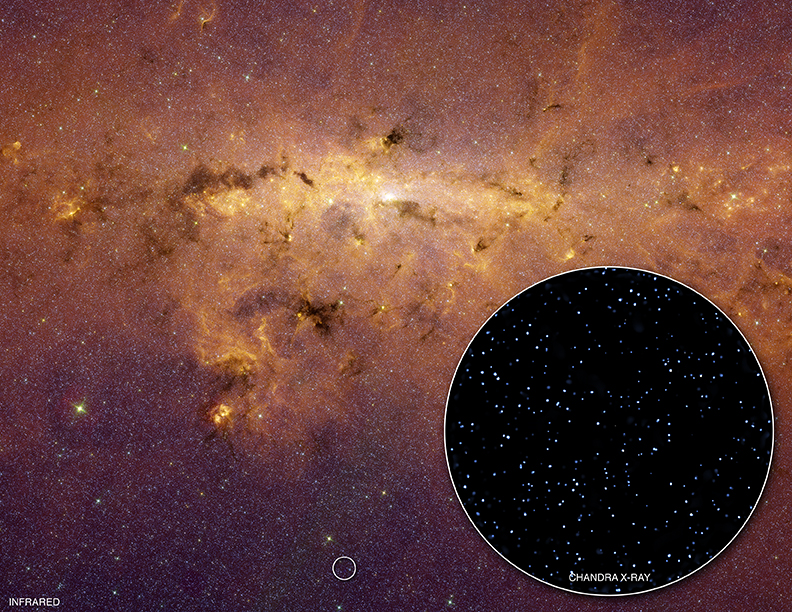
An extremely deep Chandra X-ray Observatory image of a region near the center of our Galaxy has resolved a long-standing mystery about an X-ray glow along the plane of the Galaxy. The glow in the region covered by the Chandra image was discovered to be caused by hundreds of point-like X- ray sources, implying that the glow along the plane of the Galaxy is due to millions of such sources.

This image shows an infrared view from the Spitzer Space Telescope of the central region of the Milky Way, with a pullout showing a Chandra image of a region located only 1.4 degrees away from the center of the Galaxy.

The so-called Galactic ridge X-ray emission was first detected more than two decades ago using early X-ray observatories such as v. The ridge was observed to extend about two degrees above and below the plane of the Galaxy and about 40 degrees along the plane of the galaxy on either side of the galactic center. It appeared to be diffuse.

One interpretation of the Galactic X-ray ridge is that it is emission from 100-million-degree gas. This interpretation is problematic because the disk of the Galaxy is not massive enough to confine such hot gas, which should flow away in a wind. Replenishing the gas would then be a problem, since plausible sources of energy such as supernovas are not nearly powerful enough.

A very deep Chandra observation, lasting for about 12 days, was used to study the nature of this ridge emission. The field was chosen to be close enough to the Galactic plane so that the ridge emission was strong, but in a region with relatively little absorption from dust and gas to maximize the number of sources that might be detected. A total of 473 sources were detected in an area on the sky only about 3% of the size of the full Moon, one of the highest densities of X-ray sources ever seen in our Galaxy.

It was found that more than 80% of the seemingly diffuse ridge of X-ray emission was resolved into individual sources. These are believed to be mostly white dwarfs pulling matter from companion stars and double stars with strong magnetic activity that are producing X-ray outbursts or flares that are similar to, but more powerful than the flares seen on the Sun. These stars are unrelated to the large-scale structures seen towards the center of the Spitzer image, which are probably caused by young massive stars.

The paper reporting these results appears in the April 30th issue of Nature. This work was led by Mikhail Revnivtsev from the Excellence Cluster Universe, Technical University Munich, in Garching, Germany and from the Space Research Institute, in Moscow, Russia. The co-authors were Sergey Sasanov of the Space Research Institute in Moscow, Russia; Eugene Churazov of the Max Planck Institute for Astrophysics (MPA) in Garching, Germany; William Forman and Alexey Vikhlinin from the Harvard- Smithsonian Center for Astrophysics and Rashid Sunyaev from MPA.

Fast Facts for Galactic X-ray Ridge:
Scale: Inset Image is 5.1 arcmin across
Category: Normal Galaxies & Starburst Galaxies, Milky Way Galaxy
Coordinates: (J2000) RA 17h 51m 29s | Dec -29° 34’ 26''
Constellation: Sagittarius
Observation Date: 2009: May 7; Jul 17, 20, 23, 27, 31; Aug 1
Observation Time: 250 hours
Obs. ID: 9500-9505, 9854-9855, 9892-9893
Color Code: X-ray (Blue); IR (Yellow, Orange & Violet)
Instrument: ACIS
Distance Estimate: About 26,000 light years

Wednesday, April 29, 2009

Watching solar activity muddle Earth’s magnetic field

Credits: ESA

Scientists have found that extreme solar activity drastically compresses the magnetosphere and modifies the composition of ions in near-Earth space. They are now looking to model how these changes affect orbiting satellites, including the GPS system.

The results were obtained from coordinated in-situ measurements performed by ESA’s four Cluster satellites along with the two Chinese/ESA Double Star satellites.

Under normal solar conditions, GPS satellites orbit within the magnetosphere—the protective magnetic bubble carved out by Earth’s magnetic field. But when solar activity increases, the picture changes significantly: compressed and particles become energized, exposing satellites to higher doses of radiation that can perturb signal reception.

Such increased solar activity affects all satellites, not only the GPS system. This is why monitoring and forecasting its impact on near-Earth space is becoming increasingly critical to safeguarding daily life on Earth. One way to do this is by studying the physics of near-Earth space and observing the impact of such activity in time.

During two extreme solar explosions, or solar flares, on 21 January 2005 and 13 December 2006, the Cluster constellation and the two Double Star satellites were favourably positioned to observe the events at a large scale. The satellites carried out coordinated measurements of the response of the magnetosphere to these events.

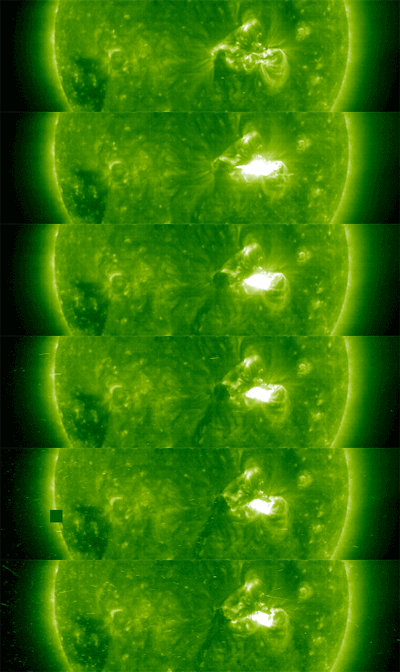
High-energy (X-3) solar flare on 13 December 2006. Credits: ESA/NASA/SOHO

During both events, the velocity of positively charged particles in the solar wind was found to be higher than 900 km/s, more than twice their normal speed. In addition, the density of charged particles around Earth was recorded as five times higher than normal. The measurements taken in January 2005 also showed a drastic change in ion composition.

These factors together caused the magnetosphere to be compressed. Data show that the ‘nose’ of the dayside magnetopause (the outer boundary of the magnetosphere), usually located about 60 000 km from Earth, was only 25 000 km away.

Artist's impression of the Cluster constellation.
ESA's mission Cluster consists of four identical spacecraft flying in formation between 19 000 and 119 000 km above the Earth. They study the interaction between the solar wind and Earth’s magnetosphere, or the Sun-Earth connection in 3D. Credits: ESA

The second explosion in December 2006 released extremely powerful high-energy X-rays followed by a huge amount of mass from the solar atmosphere (called a coronal mass ejection). During the event, GPS signal reception on ground was lost.

Typical nose-like ion structures in near-Earth space were washed out as energetic particles were injected into the magnetosphere. These nose-like structures, that had formed earlier in the ‘ring current’ in the equatorial region near Earth, were detected simultaneously on opposite sides of Earth. Measurements of the ring current showed that its strength had increased.

About five hours after the coronal mass ejection hit Earth’s magnetosphere, a Double Star satellite observed penetrating solar energetic particles on the night side. These particles are hazardous to astronauts as well as satellites.

An artist's impression of the Double Star mission in orbit.
Credits: ESA

“With these detailed observations, we’ll be able to plug in data and better estimate what happens to the inner magnetosphere and near-Earth space during such explosions on the Sun”, said Iannis Dandouras, lead author of the results published recently, and Principal Investigator of the Cluster Ion Spectrometer.

“Looking at such a large-scale physical phenomena with a single satellite is akin to predicting the impact of a tsunami with a single buoy,” added Matt Taylor, ESA’s Project Scientist for Cluster and Double Star. “With Cluster and Double Star we have monitored both sides of Earth simultaneously, and obtained valuable in-situ data.”

Notes for editors: These results appear in Dandouras, I.S., Rème, H., Cao, J. & Escoubet, P. (2009). Magnetosphere response to the 2005 and 2006 extreme solar events as observed by the Cluster and Double Star spacecraft. Advances in Space Research. Vol.43,618–623.

For more information:

Iannis Dandouras
CESR, Université de Toulouse/CNRS, Toulouse, France
Email: iannis.dandouras@cesr.fr

Arnaud Masson, ESA Deputy Cluster Project Scientist
Email: Arnaud.Masson@esa.int

Matt Taylor, ESA Cluster Project Scientist
Email: Matthew.Taylor@esa.int

Philippe Escoubet, ESA Cluster Mission Manager
Email: Philippe.Escoubet@esa.int

IYA0910: The Portal to the Universe opens its doors


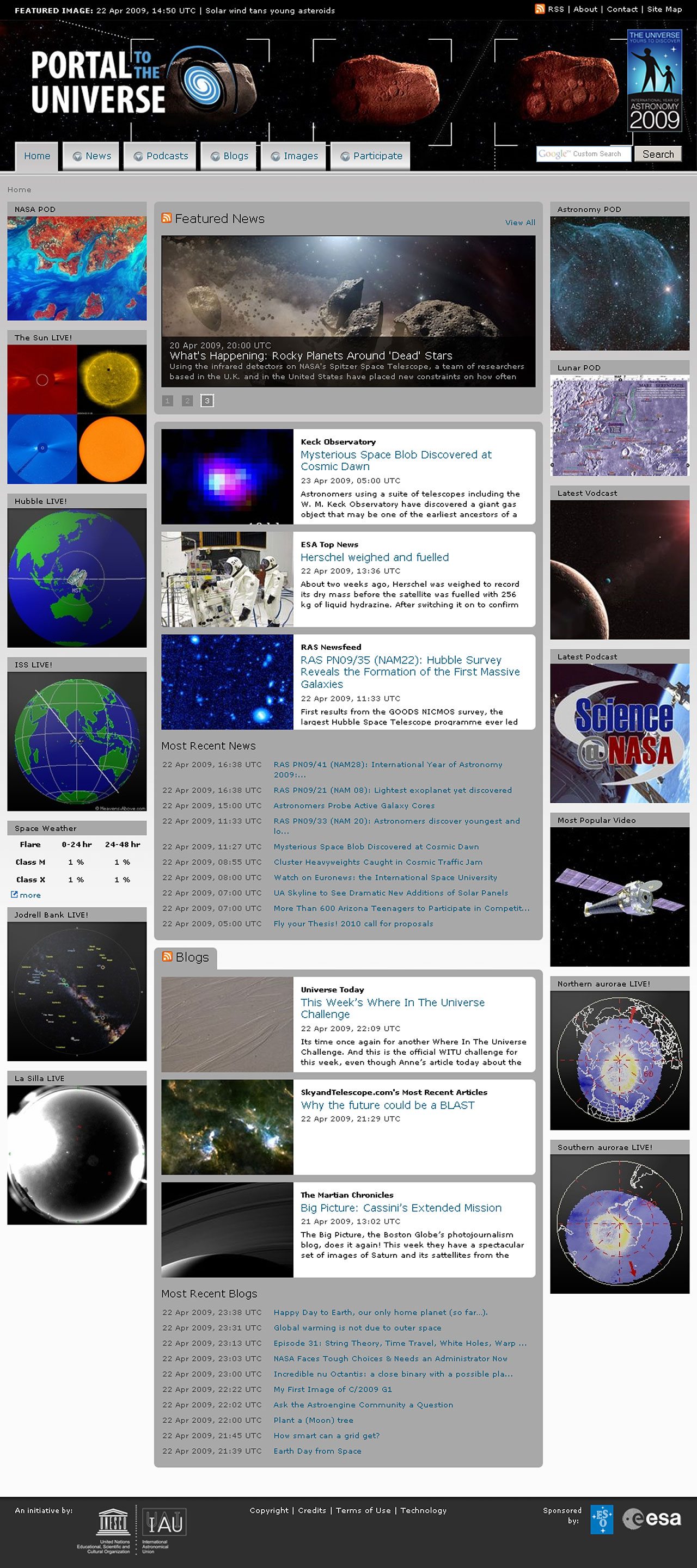
Keeping up-to-date with cutting-edge astronomy and space science breakthroughs has just become that much easier, thanks to the Portal To The Universe, the latest Cornerstone project of the International Year of Astronomy 2009 (IYA2009). As a high-tech website embracing Web 2.0 technologies, the Portal to the Universe aims to become a one-stop-shop for astronomy news.

Released during the European Week of Astronomy and Space Science (JENAM 2009), taking place this week at the University of Hertfordshire, UK, the Portal to the Universe website has been eagerly anticipated by journalists, science communicators, scientists, educators and members of the general public alike. The Portal to the Universe provides a global portal for online astronomy content, serving as an index and aggregator.

The site itself features news, blogs, video podcasts, audio podcasts, images, videos and more. Web 2.0 collaborative tools, such as the ranking of different services according to popularity, help the user to sift constructively through the wealth of information available and will promote interactions within the astronomy multimedia community. A range of "widgets" (small applications) have also been developed to tap into all sorts of existing "live data", such as near-live pictures of the Sun, live positions of spacecraft or live observations from telescopes.

Project Manager Lars Lindberg Christensen says: "It is clear that even in such a well-defined field as astronomy, there is much more ‘information confusion' than you might think. There is a real need in the community for this kind of site, where astronomy content is gathered in one place and is easily accessible. The International Year of Astronomy 2009 seeks to bring the Universe down to Earth, and this Portal is an excellent way of achieving this. This website will provide a single entry point to stars and galaxies".

The vision for the Portal is to enable real-time access to content by aggregating (pulling) from providers of dynamic content like blogs, images, news, etc. and distributing (pushing) to users, as well as indexing and archiving, collecting and maintaining a central repository of useful information.

Modern technology such as RSS feeds and standardised metadata make it possible to tie all the suppliers of astronomy information together with a single, semi-automatically updating portal. The result is a technologically advanced site that brings together strands of astronomy content from across the worldwide web.

Lead developer, Lars Holm Nielsen, says, "It has been a bit of a stretch to ensure that everything goes online just minutes after it has been released. We encourage everyone to participate and to submit RSS feeds for relevant news, images, videos, podcasts etc. to help make the Portal more complete."

Lars Lindberg Christensen says: "Today's release is just the beginning. The project will develop with, and around, the community's needs and lots of new features are planned, including adding resources such as educational materials, addresses for all astronomy stakeholders such as amateur clubs, planetariums and observatories."

The Portal to the Universe can be accessed at
http://www.portaltotheuniverse.org/

Links
Portal to the Universe website: http://www.portaltotheuniverse.org/
IYA2009 website: http://www.astronomy2009.org/

Notes

The vision of the IYA2009 is to help the citizens of the world rediscover their place in the Universe through the day and night-time skies, appreciate the impact of astronomy and basic sciences on our daily lives, and understand better how scientific knowledge can contribute to a more equitable and peaceful society. The aim of the IYA2009 is to stimulate worldwide interest, especially among young people, in astronomy and science under the central theme‚"The Universe, Yours to Discover". IYA2009 events and activities will promote a greater appreciation of the inspirational aspects of astronomy that embody an invaluable shared resource for all countries.
The IYA2009 activities are taking place at the global and regional levels, and especially at the national and local levels. National Nodes in each state have been formed to prepare activities for 2009. These Nodes establish collaborations between professional and amateur astronomers, science centres, educators and science communicators in preparing activities for 2009. The International Year of Astronomy was proclaimed by the United Nations on 20 December 2007. The IAU is the international astronomical organisation that brings together almost 10 000 distinguished astronomers from all nations of the world. Its mission is to promote and safeguard the science of astronomy in all its aspects through international cooperation. The IAU also serves as the internationally recognised authority for assigning designations to celestial bodies and the surface features on them. Founded in 1919, the IAU is the world's largest professional body for astronomers.

For more information

Lars Lindberg Christensen
Portal to the Universe Project Manager and IAU Press Officer
ESO ePOD, Garching, Germany
Tel: +49 89 3200 6761
Cellular: +49 173 3872 621
E-mail: lars@eso.org

Lars Holm Nielsen
Portal to the Universe Development Lead
ESO ePOD, Garching, Germany
Tel: +49 89 3200 6615
E-mail: lnielsen@eso.org

Further contacts

Pedro Russo
IAU IYA2009 Coordinator
ESO ePOD, Garching, Germany
Tel: +49 89 320 06 195
Cellular: +49 176 6110 0211
Fax: +49 89 320 23 62
E-mail: prusso@eso.org

Yolanda Berenguer
UNESCO Focal Point for the International Year of Astronomy 2009
UNESCO HQ, Paris
Tel: +33 1 45684171
E-mail: y.berenguer@unesco.org

Dr. Karel A. van der Hucht
General Secretary, International Astronomical Union
IAU Secretariat, Paris, France
Tel: +33 1 43 25 83 58
E-mail: K.A.van.der.Hucht@sron.nl

Tuesday, April 28, 2009

NASA's Galaxy-Exploring Mission Celebrates Sixth Anniversary

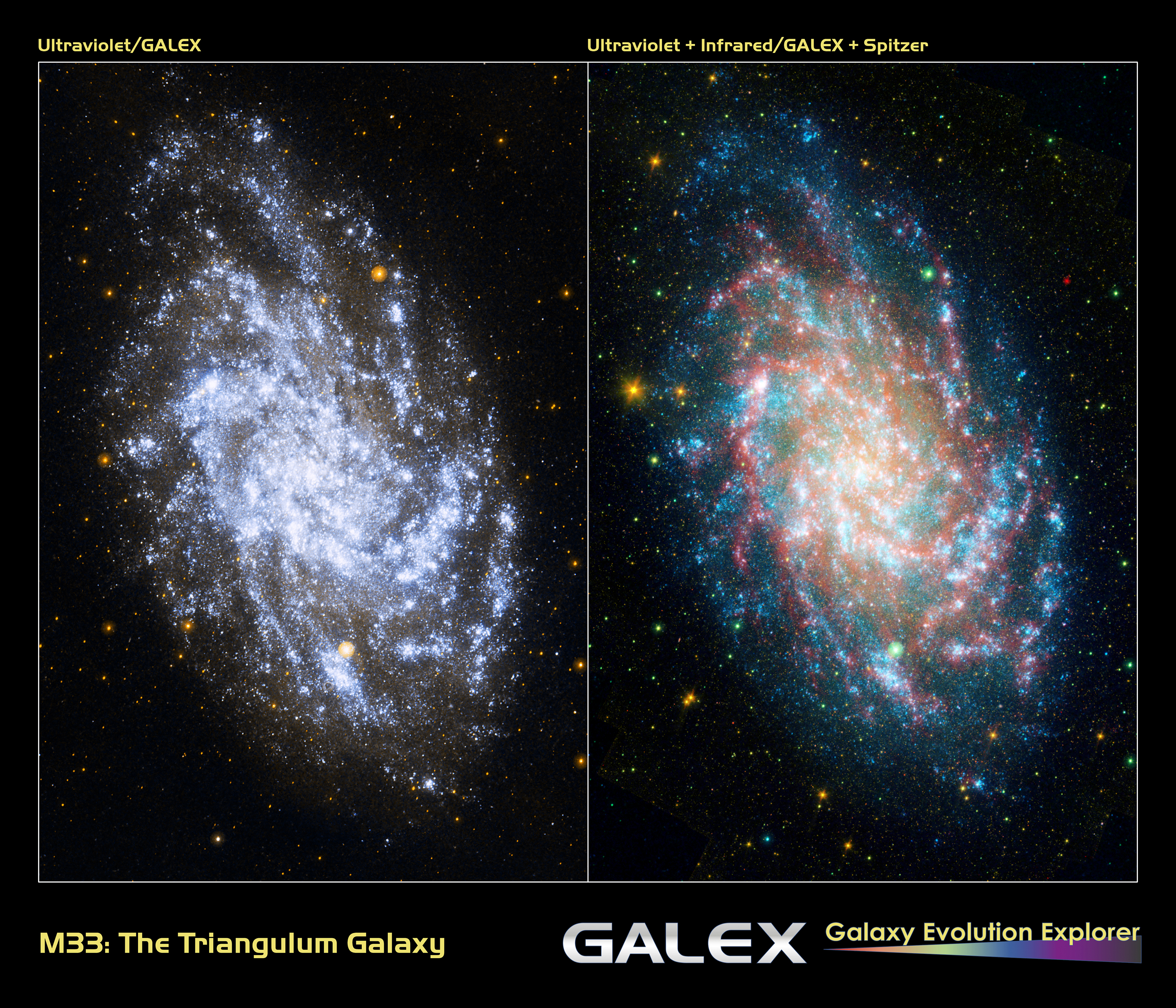
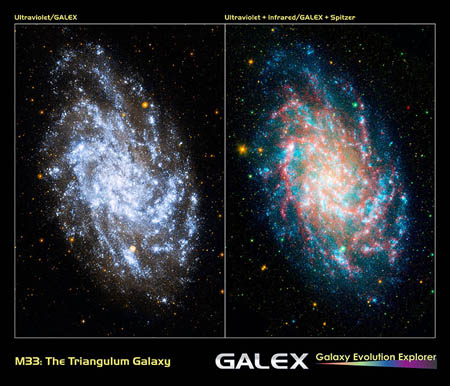
In these side-by-side images of M33, the ultraviolet image on the left was taken by the Galaxy Evolution Explorer, while the ultraviolet and infrared image on the right is a blend of the mission's M33 image and another taken by NASA's Spitzer Space Telescope. M33, one of our closest galactic neighbors, is about 2.9 million light-years away in the constellation Triangulum, part of what's known as our Local Group of galaxies. Credit: NASA/JPL-Caltech

Full Resolution TIFF [3000x2517, 13.9 MB]
Full Resolution JPEG [3000x2571, 7.4 MB]
Screen Resolution JPEG [450x386, 148 KB]

NASA's Galaxy Evolution Explorer Mission marks its sixth anniversary studying galaxies beyond our Milky Way through its sensitive ultraviolet telescope, the only such far-ultraviolet detector in space.

The mission studies the shape, brightness, size and distance of galaxies across 10 billion years of cosmic history, giving scientists a wealth of data to help us better understand the origins of the universe. One such object is pictured here, the galaxy NGC598, more commonly known as M33.

In these side-by-side images of M33, the ultraviolet image on the left was taken by the Galaxy Evolution Explorer, while the ultraviolet and infrared image on the right is a blend of the mission's M33 image and another taken by NASA's Spitzer Space Telescope. M33, one of our closest galactic neighbors, is about 2.9 million light-years away in the constellation Triangulum, part of what's known as our Local Group of galaxies.

The Galaxy Evolution Explorer has two detectors: one in far-ultraviolet, which reveals stars younger than about 10 million years old, and another in near-ultraviolet, which detects stars younger than about 100 million years old. The left ultraviolet image shows a map of the recent star formation history of M33. The bright blue and white areas are where star formation has been extremely active over the past few million years. The patches of yellow and gold are regions where star formation was more active around 100 million years ago. The ultraviolet image highlights the most massive young stars in M33. These stars burn their large supply of hydrogen fuel quickly, burning hot and bright while emitting most of their energy at ultraviolet wavelengths. Compared with low-mass stars like our sun, which live for billions of years, these massive stars never reach old age, having a lifespan as short as a few million years.

Together, the Galaxy Evolution Explorer and Spitzer can see a larger range of the full spectrum of the sky. Spitzer, for example, can detect mid-infrared radiation from dust that has absorbed young stars' ultraviolet light. That's something the Galaxy Evolution Explorer cannot see. The combined image on the right shows in amazing detail the beautiful and complicated interlacing of hot dust and young stars. In some regions of M33, dust gathers where there is very little far-ultraviolet light, suggesting that the young stars are obscured or that stars farther away are heating the dust. In some of the outer regions of the galaxy, just the opposite is true: There are plenty of young stars and very little dust.

In the combined image, far-ultraviolet light from young stars glimmers blue, near-ultraviolet light from intermediate age stars glows green, near-infrared light from old stars burns yellow and orange, and dust rich in organic molecules burns red. The small blue flecks outside the spiral disk of M33 are most likely distant background galaxies. This image is a four-band composite that, in addition to the two ultraviolet bands, includes near infrared as yellow/orange and far infrared as red.

Since its launch from a Pegasus rocket on April 28, 2003, the Galaxy Evolution Explorer has imaged more than a half-billion objects across two-thirds of the sky. Highlights over the past six years include detecting star formation in unexpected regions of the universe and spotting Mira, a fast-moving older star called a red giant. Astronomers say that studying Mira's gargantuan cosmic tail is helping us learn how stars like our sun die and ultimately seed new solar systems.

Written by Rhea Borja

Mysterious Space Blob Discovered at Cosmic Dawn

This image of the Himiko object is a composite and in false color. The thick horizontal bar at the lower right corner presents a size of 10 thousand light year. This image is created by M. Ouchi et al., which is the reproduction of Figure 2 in the article of The Astrophysical Journal May 2009 - 10 v696 issue.

Using information from a suite of telescopes, astronomers have discovered a mysterious, giant object that existed at a time when the universe was only about 800 million years old. Objects such as this one are dubbed extended Lyman-Alpha blobs; they are huge bodies of gas that may be precursors to galaxies. This blob was named Himiko for a legendary, mysterious Japanese queen. It stretches for 55 thousand light years, a record for that early point in time. That length is comparable to the radius of the Milky Way’s disk.

The researchers are puzzled by the object. Even with superb data from the world’s best telescopes, they are not sure what it is. Because it is one of the most distant objects ever found, its faintness does not allow the researchers to understand its physical origins. It could be ionized gas powered by a super-massive black hole; a primordial galaxy with large gas accretion; a collision of two large young galaxies; super wind from intensive star formation; or a single giant galaxy with a large mass of about 40 billion Suns. Because this mysterious and remarkable object was discovered early in the history of the universe in a Japanese Subaru field, the researchers named the object after the legendary mysterious queen in ancient Japan.

“The farther out we look into space, the farther we go back in time, “ explained lead author Masami Ouchi, a fellow at the Observatories of the Carnegie Institution who led an international team of astronomers from the U.S., Japan, and the United Kingdom. “I am very surprised by this discovery. I have never imagined that such a large object could exist at this early stage of the universe’s history. According to the concordance model of Big Bang cosmology, small objects form first and then merge to produce larger systems. This blob had a size of typical present-day galaxies when the age of the universe was about 800 million years old, only 6% of the age of today’s universe!”

Extended blobs discovered thus far have mostly been seen at a distance when the universe was 2 to 3 billion years old. No extended blobs have previously been found when the universe was younger. Himiko is located at a transition point in the evolution of the universe called the reionization epoch—it’s as far back as we can see to date. And at 55 thousand light years, Himiko is a big blob for that time.

This reionizing chapter in the universe was at the cosmic dawn, the epoch between about 200 million and one billion years after the Big Bang. During this period, neutral hydrogen began to form quasars, stars, and the first galaxies. Astronomers probe this era by searching for characteristic hydrogen signatures from the scattering of photons created by ionized gas clouds.

The team initially identified Himiko among 207 distant galaxy candidates seen at optical wavelengths using the Subaru telescope from the Subaru/XMM-Newton Deep Survey Field located in the constellation of Cetus. They then made spectroscopic observations to measure the distance with the Keck/DEIMOS and Carnegie’s Magellan/IMACS instrumentation. Himiko was an extraordinarily bright and large candidate for a distant galaxy. “We hesitated to spend our precious telescope time by taking spectra of this weird candidate. We never believed that this bright and large source was a real distant object. We thought it was a foreground interloper contaminating our galaxy sample,” continued Ouchi. “But we tried anyway. Then, the spectra exhibited a characteristic hydrogen signature clearly indicating a remarkably large distance—12.9 billion light years!”

“Using infrared data from NASA’s Spitzer Space Telescope and the United Kingdom Infrared Telescope, radio data from the VLA, and X-ray imaging from the XMM-Newton satellite, we were able to estimate the star-formation rate and stellar mass of this galaxy and to investigate whether it contains an active nucleus powered by a super-massive black hole,” remarked James Dunlop a team member at Edinburgh. “We found that the stellar mass of Himiko is an order of magnitude larger than other objects known at a similar epoch, but we cannot as yet tell if the center houses an active and growing black hole.”

“One of the puzzling things about Himiko is that it is so exceptional,” said Carnegie’s Alan Dressler, a member of the team. “If this was the discovery of a class of objects that are ancestors of today’s galaxies, there should be many more smaller ones already found—a continuous distribution. Because this object is, to this point, one-of-a-kind, it makes it very hard to fit it into the prevailing model of how normal galaxies were assembled. On the other hand, that’s what makes it interesting!”

The research is published in the May 10, 2009, issue of The Astrophysical Journal. The work was funded by the NASA through an award issued by JPL/Caltech, the Department of Energy, and the Carnegie Institution. The research is based in part on data collected at Subaru Telescope, which is operated by the National Astronomical Observatory of Japan; the W.M. Keck Observatory, which is operated as a scientific partnership among the California Institute of Technology, the University of California, and the National Aeronautics and Space Administration (NASA); the Spitzer Telescope, managed by JPL for NASA; the Magellan telescopes operated by a consortium consisting of the Carnegie Institution, Harvard University, MIT, the University of Michigan, and the University of Arizona; and the United Kingdom Infrared Telescope, which is operated by the Joint Astronomy Centre on behalf of the Science and Technology Facilities Council of the UK.

An image of Himiko is at:
http://www.ciw.eduhttp_www_ciw_edu_prouchihimikoimage4_6_09_jpg

For podcast see: http://videos.ciw.edu/achilles_movies_download/space_blob.mov

To access spectra see: http://www.ciw.edu/prouchielargeobjectspectrapic4_8_09

The Most Distant Object Yet Discovered in the Universe

ESO PR Photo 17a/09
Artist's impression of a gamma-ray burst

Gamma-ray bursts (GRBs) are powerful flashes of energetic gamma-rays lasting from less than a second to several minutes. They release a tremendous amount of energy in this short time making them the most powerful events in the Universe. They are thought to be mostly associated with the explosion of stars that collapse into black holes. In the explosion, two jets of very fast-moving material are ejected, as depicted in this artist’s illustration. If a jet happens to be aimed at Earth, we see a brief but powerful gamma-ray burst.

ESO's Very Large Telescope has shown that a faint gamma-ray burst detected last Thursday is the signature of the explosion of the earliest, most distant known object in the Universe (a redshift of 8.2). The explosion apparently took place more than 13 billion years ago, only about 600 million years after the Big Bang.

Gamma-ray bursts (GRBs) are powerful flashes of energetic gamma-rays lasting from less than a second to several minutes. They release a tremendous amount of energy in this short time making them the most powerful events in the Universe. They are thought to be mostly associated with the explosion of stars that collapse into black holes.

The gamma-ray burst GRB 090423 was detected by the NASA/STFC/ASI Swift satellite during the morning (CEST) of Thursday 23 April 2009. The 10 second burst was located in the constellation of Leo (the Lion). It was soon being followed by a whole range of telescopes on the ground, including the 2.2-metre ESO/MPG telescope at La Silla and ESO’s Very Large Telescope (VLT) at Paranal, both in Chile.

VLT infrared observations, made 17 hours after the burst detection, allowed astronomers to establish the distance to the explosion. “We find that the light coming from the explosion has been stretched, or redshifted, considerably by the expansion of the Universe”, says Nial Tanvir, the leader of the team who made the VLT observations. “With a redshift of 8.2 this is the most remote gamma-ray burst ever detected, and also the most distant object ever discovered — by some way.”

Because light moves at a finite speed, looking farther into the Universe means looking back in time. The explosion occurred when the Universe was about 600 million years old, less than 5 percent of its current age. It is believed that the very first stars only formed when the Universe was between 200 and 400 million years old.

“This discovery proves the importance of gamma-ray bursts in probing the most distant parts of the Universe”, says Tanvir. “We can now be confident that even more remote bursts will be found in the future, which will open a window to studying the very first stars and the ultimate end of the Dark Age of the Universe.”

The previous record holder for the most distant GRB — first detected by Swift last year and then also studied with the VLT — had a redshift of 6.7 [1]. The blast, designated GRB 080913, arose from a star exploding about 200 million years after GRB090423. The previous most distant object known in the Universe confirmed spectroscopically is a galaxy with a redshift of 6.96 [2].

More information:
The ISAAC observations at the VLT were done on behalf of an international collaboration by N. Tanvir (U. Leicester, UK), A. Levan (U. Warwick, UK), K. Wiersema (U. Leicester, UK), J. Fynbo and J. Hjorth (Dark Cosmology Centre, Copenhagen, Denmark), and P. Jakobsson (Reykjavik, Iceland).

The GROND observations with the 2.2-metre ESO/MPG telescope at La Silla were made by F. Olivares, T. Krühler, J. Greiner and R. Filgas (Max Planck Institute for Extraterrestrial Physics, Garching, Germany).

Gamma-ray bursts are discovered by telescopes in space. After releasing their intense burst of high-energy radiation, they become detectable for a short while in the optical and in the near-infrared. This ‘afterglow’ fades very rapidly, making detailed analysis possible for only a few hours after the gamma-ray detection. This analysis is important in particular in order to determine the GRB's distance and, hence, intrinsic brightness.

Gamma-ray bursts are the universe's most luminous explosions. Most occur when massive stars run out of nuclear fuel. As their cores collapse into a black hole or neutron star, gas jets — driven by processes not fully understood — punch through the star and blast into space. There, they strike gas previously shed by the star and heat it, which generates short-lived afterglows in many wavelengths.

Notes:

ESO, the European Southern Observatory, is the foremost intergovernmental astronomy organisation in Europe. It is supported by 14 countries: Austria, Belgium, the Czech Republic, Denmark, France, Finland, Germany, Italy, the Netherlands, Portugal, Spain, Sweden, Switzerland and the United Kingdom. ESO carries out an ambitious programme focused on the design, construction and operation of powerful ground-based observing facilities enabling astronomers to make important scientific discoveries. ESO also plays a leading role in promoting and organising cooperation in astronomical research. ESO operates three unique world-class observing sites in the Atacama Desert region of Chile: La Silla, Paranal and Chajnantor.

Contacts:
Nial Tanvir
University of Leicester, UK
E-mail: nrt3@star.le.ac.uk
Phone: +44 116 2231217
Mobile: +44 7980 136499

Henri Boffin
ESO La Silla - Paranal - ELT Press Officer
E-mail: hboffin@eso.org
Phone: +49 89 3200 6222

Valeria Foncea
ESO Press Officer in Chile
E-mail: vfoncea@eso.org
Phone: +56 2 463 3123

National contacts for the media: http://www.eso.org/public/outreach/eson/

Thursday, April 23, 2009

Did 'Dark Gulping' Generate Black Holes in Early Universe?

The HST WFPC2 image of gravitational lensing in the galaxy cluster Abell 2218, indicating the presence of large amount of dark matter.  Credit Andrew Fruchter at STScI

A process called ‘dark gulping’ may solve the mystery of the how supermassive black holes were able to form when the Universe was less than a billion years old. Dr Curtis Saxton will be presenting the study at the European Week of Astronomy and Space Science at the University of Hertfordshire in Hatfield. Dr Saxton and Professor Kinwah Wu, both of UCL’s Mullard Space Science Laboratory, developed a model to study the gravitational interactions between the invisible halo of dark matter in a cluster of galaxies and the gas embedded in the dark matter halo. They found that the interactions cause the dark matter to form a compact central mass, which can be gravitationally unstable, depending on the thermal properties of the dark matter. If the cluster is disturbed, the dark matter central mass would undergo a very rapid collapse, without a trace of electro-magnetic radiation being emitted. This fast dynamical collapse of the unstable dark-matter is called dark gulping.

The affected dark mass in the compact core is compatible with the scale of supermassive black holes in galaxies today. There are several theories for how supermassive black holes form: one possibility is that a single large gas cloud collapses, another is that a black hole formed by the collapse of a giant star swallows up enormous amounts of matter; another possibility is that a cluster of small black holes merge together. However, all these options take many millions of years and are at odds with recent observations that suggest that black holes were present when the Universe was less than a billion years old. Dark gulping may provide a solution to how the slowness of gas accretion was circumvented, enabling the rapid emergence of giant black holes.

“Dark matter appears to gravitationally dominate the dynamics of galaxies and galaxy clusters. However, there is still a great deal of conjecture about origin, properties and distribution of dark particles. We can only be certain that dark matter is non-interactive with light, but it interacts with ordinary matter via gravity. Previous studies have ignored the interaction between gas and the dark matter but, by factoring it into our model, we’ve achieved a much more realistic picture that fits better with observations and may also have gained some insight into the presence of early supermassive black holes,” said Dr Saxton.

According to the model, the development of a compact mass at the core is inevitable. Cooling by the gas causes it to flow gently in towards the centre. The gas can be up to 10 million degrees at the outskirts of the halos, which are few million light years in diameter, with a cooler zone towards the core, which surrounds a warmer interior a few thousand light years across. The gas doesn't cool indefinitely, but reaches a minimum temperature, which fits well with X-ray observations of galaxy clusters. 

The model also investigates how many dimensions the dark particles move in, as these determine the rate at which the dark halo expands and absorbs and emits heat, and ultimately affect the distribution of dark mass the system. 

“In the context of our model, the observed core sizes of galaxy cluster halos and the observed range of giant black hole masses imply that dark matter particles have between seven and ten degrees of freedom,” said Dr Saxton. “With more than six, the inner region of the dark matter approaches the threshold of gravitational instability, opening up the possibility of dark gulping taking place.”

The findings have been published in the Monthly Notices of the Royal Astronomical Society.

Written by Anita Heward 

FURTHER INFORMATION

“Radial structure, inflow and central mass of stationary radiative galaxy clusters”, Curtis Saxton & Kinwah Wu, Monthly Notices of the Royal Astronomical Society, Volume 391 Issue 3, Pages 1403 – 1436.

CONTACTS

Dr Curtis Saxton
Mullard Space Science Laboratory
University College London
Holmbury St. Mary
Dorking
Surrey RH5 6NT
United Kingdom
E-mail:
cjs2@mssl.ucl.ac.uk