
Explanation: What is that green thing? A volunteer sky enthusiast surfing through online Galaxy Zoo images has discovered something really strange. The mystery object is unusually green, not of any clear galaxy type, and situated below relatively normal looking spiral galaxy IC 2497. Dutch schoolteacher Hanny van Arkel, discovered the strange green "voorwerp" (Dutch for "object") last year. The Galaxy Zoo project encourages sky enthusiasts to browse through SDSS images and classify galaxy types. Now known popularly as Hanny's Voorwerp, subsequent observations have shown that the mysterious green blob has the same distance as neighboring galaxy IC 2497. Research is ongoing, but one leading hypothesis holds that Hanny's Voorwerp is a small galaxy that acts like a large reflection nebula, showing the reflected light of a bright quasar event that happened in the center of IC 2497 about 100,000 years ago. Pictured above, Hanny's Voorwerp was imaged recently by the 4.2-meter William Hershel Telescope in the Canary Islands by Matt Jarvis, Kevin Schawinski, and William Keel.
Wednesday, June 25, 2008
Tuesday, June 24, 2008
Radio Telescopes Reveal Unseen Galactic Cannibalism
 Artist's Conception of Interacting Galaxies
CREDIT: Kuo et al.
 CREDIT: Kuo et al., NRAO/AUI/NSF
Radio-telescope images have revealed previously-unseen galactic cannibalism -- a triggering event that leads to feeding frenzies by gigantic black holes at the cores of galaxies. Astronomers have long suspected that the extra-bright cores of spiral galaxies called Seyfert galaxies are powered by supermassive black holes consuming material. However, they could not see how the material is started on its journey toward the black hole.
One leading theory said that Seyfert galaxies have been disturbed by close encounters with neighboring galaxies, thus stirring up their gas and bringing more of it within the gravitational reach of the black hole. However, when astronomers looked at Seyferts with visible-light telescopes, only a small fraction showed any evidence of such an encounter. Now, new images of hydrogen gas in Seyferts made using the National Science Foundation's Very Large Array (VLA) radio telescope show the majority of them are, in fact, disturbed by ongoing encounters with neighbor galaxies.
"The VLA lifted the veil on what's really happening with these galaxies," said Cheng-Yu Kuo, a graduate student at the University of Virginia. "Looking at the gas in these galaxies clearly showed that they are snacking on their neighbors. This is a dramatic contrast with their appearance in visible starlight," he added.
The effect of the galactic encounters is to send gas and dust toward the black hole and produce energy as the material ultimately is consumed. Black holes, concentrations of matter so dense that not even light can escape their gravitational pull, reside at the cores of many galaxies. Depending on how rapidly the black hole is eating, the galaxy can show a wide range of energetic activity. Seyfert galaxies have the mildest version of this activity, while quasars and blazars are hundreds of times more powerful.
The astronomers picked a number of relatively nearby Seyfert galaxies that had previously been observed with visible-light telescopes. They then carefully studied the Seyferts with the VLA, specifically looking for radio waves emitted by hydrogen atoms. The VLA images showed the vast majority of the Seyferts were disturbed by encounters with neighbor galaxies.
By comparison, similar VLA images of inactive galaxies showed that very few were disturbed. "This comparison clearly shows a connection between close galactic encounters and the black-hole-powered activity in the cores," said Ya-Wen Tang, who began this work at the Institute of Astronomy & Astrophysics, Academia Sinica (ASIAA), in Taiwan and now is a graduate student at the National Taiwan University.
"This is the best evidence yet for the fueling of Seyfert galaxies. Other mechanisms have been proposed, but they have shown little if any difference between Seyferts and inactive galaxies," Tang added.
"Our results show that images of the hydrogen gas are a powerful tool for revealing otherwise-invisible gravitational interactions among galaxies," said Jeremy Lim, also of ASIAA. "This is a welcome advance in our understanding of these objects, made possible by the best and most extensive survey ever made of hydrogen in Seyferts," Lim said.
Kuo, Tang and Lim worked with Paul Ho, of ASIAA and the Harvard-Smithsonian Center for Astrophysics. The scientists reported their findings in the Astrophysical Journal.
The National Radio Astronomy Observatory is a facility of the National Science Foundation, operated under cooperative agreement by Associated Universities, Inc.
Contact:
Dave Finley, Public Information Officer
Socorro, NM
(575) 835-7302
dfinley@nrao.edu


Thursday, June 19, 2008
Ultraviolet gives view inside real ‘death star’
 Images courtesy: NASA/HST/COSMOS/GALEX
 An international team, including nine scientists from Oxford University, combined data from ground-bound telescopes observing visible light from supernovae with data from a space telescope looking for an earlier peak in ultraviolet light from an associated dying star. They were able to spot telltale signs of the shockwave that forms within a star before it explodes into a supernova. A report of the work appears in this week’s Science.
‘Supernovae are huge stellar explosions that light up galaxies but often we have no idea which star has exploded,’ said Dr Kevin Schawinski of Oxford University’s Department of Physics. ‘The nature of such an explosion is that we can’t look inside it and it destroys almost all evidence of the original star – scientists have been trying to catch such an event happening for decades.’
Previously, scientists have observed stars nearing the end of their lives and supernova explosions and their afterglow, but have had little firm evidence of what happens in between. The new observations give a first glimpse of what happens inside a star during its final hours of life.
‘Out of all the supernovae we looked at we found one that was preceded by a dramatic ‘flash’ of ultraviolet light given off by a red super-giant star in a galaxy around a billion light years away. This flash occurred about two weeks before it was detected as a normal supernova,’ said Dr Stephen Justham of Oxford University’s Department of Physics.
‘We believe that this light, emanating from deep within the star, was generated after its core collapsed and compressed the gas surrounding it to around one million degrees Kelvin.’ Around four hours after this light was observed a shockwave from the collapsed core, travelling at 50 million kilometres an hour, would have hit the surface of the star and blown it apart. However, it was almost two weeks before the resulting fireball was spotted by supernova hunters using telescopes in Hawaii.
‘With this observation we have managed to peer inside one of the hundred billion stars in a galaxy and see what it is like at the very moment that it dies,’ said Dr Christian Wolf of Oxford University’s Department of Physics. ‘We’ve been extremely fortunate to capture this moment but this is just one event and, of course, we’d love to capture other similar events with different stars which could deliver many more surprises.’
The team conducting the research included Dr Kevin Schawinski, Dr Stephen Justham, Dr Christian Wolf, Professor Philipp Podsiadlowski, Dr Mark Sullivan, Tony Bell, Emma Walker, Dr Isobel Hook from Oxford University’s Department of Physics and Dr Katrien Steenbrugge from St John’s College Research Centre, University of Oxford, as well as scientists from Germany, France, Canada and Korea.
A report of the research, entitled ‘Supernova shock breakout from a red supergiant’ was published in Science Express on 12 June 2008.
Feeding Your Black Hole is Easy
 Spiral galaxy M81. Image Credit: X-ray: NASA/CXC/Wisconsin/D.Pooley and CfA/A.Zezas; Optical: NASA/ESA/CfA/A.Zezas; UV: NASA/JPL-Caltech/CfA/J.Huchra et al.;
IR: NASA/JPL-Caltech/CfA
M81 is about 12 million light years from Earth. In the center of M81 is a black hole that is about 70 million times more massive than the Sun, and generates energy and radiation as it pulls gas in the central region of the galaxy inwards at high speed.
In contrast, so-called stellar mass black holes, which have about 10 times more mass than the Sun, have a different source of food. These smaller black holes acquire new material by pulling gas from an orbiting companion star. Because the bigger and smaller black holes are found in different environments with different sources of material to feed from, a question has remained about whether they feed in the same way.
"When we look at the data, it turns out that our model works just as well for the giant black hole in M81 as it does for the smaller guys," said Michael Nowak, from the Massachusetts Institute of Technology. "Everything around this huge black hole looks just the same except it's almost 10 million times bigger."
One of the implications of Einstein's theory of General Relativity is that black holes are simple objects and only their masses and spins determine their effect on space-time. The latest research indicates that this simplicity manifests itself in spite of complicated environmental effects.
The model that Markoff and her colleagues used to study the black holes includes a faint disk of material spinning around the black hole. This structure would mainly produce X-rays and optical light. A region of hot gas around the black hole would be seen largely in ultraviolet and X-ray light. A large contribution to both the radio and X-ray light comes from jets generated by the black hole. Multi-wavelength data is needed to disentangle these overlapping sources of light.
Among actively feeding black holes the one in M81 is one of the dimmest, presumably because it is "underfed". It is, however, one of the brightest as seen from Earth because of its relative proximity, allowing high quality observations to be made.
"It seems like the underfed black holes are the simplest in practice, perhaps because we can see closer to the black hole," said Andrew Young of the University of Bristol in England. "They don't seem to care too much where they get their food from."
This work should be useful for predicting the properties of a third, unconfirmed class called intermediate mass black holes, with masses lying between those of stellar and supermassive black holes. Some possible members of this class have been identified, but the evidence is controversial, so specific predictions for the properties of these black holes should be very helpful.
In addition to Chandra, three radio arrays (the Giant Meterwave Radio Telescope, the Very Large Array and the Very Long Baseline Array), two millimeter telescopes (the Plateau de Bure Interferometer and the Submillimeter Array), and Lick Observatory in the optical were used to monitor M81.
The results of this study will appear in an upcoming issue of The Astrophysical Journal.
Identical Twin Stars Not So Identical

I used to think that waitress was a real ditz, but after seeing a press release today from Vanderbilt University, I'm wondering if the waitress was on to something, and maybe she was even an astronomer.
Astronomers recently found a very young pair of identical binary stars that have surprising differences in brightness, surface temperature and size. They also believe one of the stars formed significantly earlier than its twin. Astrophysicists have assumed that binary stars form simultaneously, and so this discovery forces theorists back to the drawing board to determine if their models can produce binaries with stars that form at different times.
The identical twins were discovered in the Orion Nebula, a well-known stellar nursery, 1,500 light years from Earth. The newly formed stars are about 1 million years old. With a full lifespan of about 50 billion years, that makes them equivalent to one-day-old human babies.
"Very young eclipsing binaries like this are the Rosetta stones that tell us about the life history of newly formed stars," says Keivan Stassun, associate professor of astronomy at Vanderbilt University. He and Robert D. Mathieu from the University of Wisconsin-Madison headed up the project.
The astronomers calculated that these twin stars have nearly identical masses, about 41 percent that of the sun. According to current theories, mass and composition are the two factors that determine a star's physical characteristics and dictate its entire life cycle. Because the two stars condensed from the same cloud of gas and dust they should have the same composition. And with identical mass and composition, they should be identical in every way. So the astronomers were surprised when they discovered that the twins exhibited significant differences in brightness, surface temperature and possibly size.
"The easiest way to explain these differences is if one star was formed about 500,000 years before its twin," says Stassun. "That is equivalent to a human birth-order difference of about half of a day."
Now, I have heard stories of twins being born several hours apart and even in different years (one late on Dec. 31, and the other early on Jan. 1) so, maybe this difference in star formation isn't such a big deal, and it happens all the time. However, further study is needed.
But this new discovery may cause astronomers to readjust their estimates of the masses and ages of thousands of young stars less than a few million years old, as current estimates are based on models that presumed binary stars formed simultaneously.
Just like having twins causes you to readjust your entire life. But it’s a good readjustment.
Original News Source: Vanderbilt University (this link includes a nice multimedia presentation about the discovery)
Sunday, June 15, 2008
The Little Man and the Cosmic Cauldron


A New Type of Comet Dust Mineral

Saturday, June 14, 2008
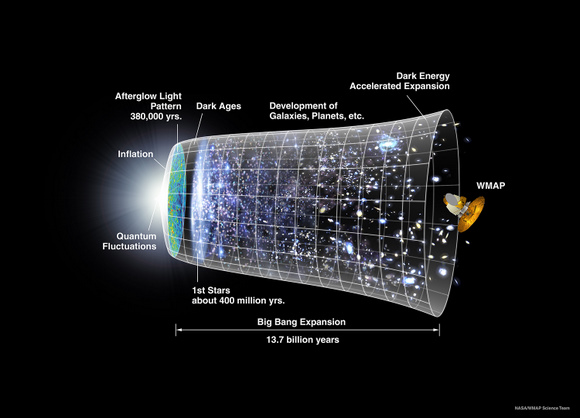
Thinking About Time Before the Big Bang

Tuesday, June 10, 2008
Hubble's Sweeping View of the Coma Cluster of Galaxies

For additional information, contact:
Ray Villard
Space Telescope Science Institute, Baltimore, Md.
410-338-4514
villard@stsci.edu
Lars Lindberg Christensen
Hubble/ESA, Garching Germany
011-49-89-3200-6306
lars@eso.org
Detective astronomers unearth hidden celestial gem

Monday, June 09, 2008
Cassini sees collisions of moonlets on Saturn's ring

Friday, June 06, 2008
W28 - A Mixed Bag

Super-luminous Supernovae

Thursday, June 05, 2008
Two of the Milky Way's spiral arms may be 'demoted
 Two major and two minor arms wind outwards from the centre of our galaxy in this artist's impression llustration: NASA/JPL-Caltech
Astronomers have long believed that our galaxy possesses four spiral arms, since radio observations show concentrations of gas that trace such a spiral structure.
But now, two of the Milky Way's arms have failed to turn up in a sensitive new survey that used the Spitzer Space Telescope to map the distribution of millions of stars. Spitzer is well-suited to mapping the galaxy's stars because its infrared vision can pierce through the dust that obscures stars at optical wavelengths of light.
Astronomer Robert Benjamin of the University of Wisconsin in Whitewater, US, says these two arms, called Sagittarius and Norma, may be mostly concentrations of gas, perhaps sprinkled with pockets of young stars.
By contrast, the other two arms, called Scutum-Centaurus and Perseus, appear rich not only in gas, but in stars both young and old. "These major arms . . . could be the things that would really stand out if you were looking at the Milky Way galaxy from Andromeda [a nearby galaxy]," Benjamin says.
Small stub
Thomas Dame of the Harvard-Smithsonian Centre for Astrophysics in Cambridge, Masssachusetts, US, who is not a member of Benjamin's team, says the major-minor arm idea is interesting. "I think it could be right, but I think we have a lot of work to do to shore this up," he told New Scientist.
Benjamin admits that much is still unclear about the structure of our galaxy. "Trying to create a picture of the Milky Way is about 40% hard science and 60% imagination," he says.
In addition to the four large arms, the Milky Way has some smaller, partial arms. The Sun is located in one such stub called the Orion Spur, which is wedged between the Sagittarius and Perseus arms.
The findings were presented on Tuesday at a meeting of the American Astronomical Society in St Louis, Missouri, US.
Another team of astronomers unveiled a vast mosaic image of the Milky Way - the most sensitive ever made in infrared light - created from Spitzer Space Telescope observations. The team, led by Sean Carey of Caltech in Pasadena, California, US, displayed a 55-metre-long poster version of the image at the meeting.
David Shiga
Tuesday, June 03, 2008
Spitzer Captures Stellar Coming of Age in Our Galaxy


White Dwarf Lost in Planetary Nebula
 Credit: NASA, NOAO, H. Bond and K. Exter (STScI/AURA)
 Evolution of Triple Star System Planetary Nebula SuWt 2
2. More massive star evolves quickly and expands into a red giant.
3. The tight binary pair is engulfed by the red giant.
4. The binary pair "stirs" the red giant's shell, forming a thick disk.
5. Bipolar lobes form above and below the disk to make a planetary nebula. The star's core shrinks down to a white dwarf.
A team of stellar astronomers is engaged in an interstellar CSI (crime scene investigation). They have two suspects, traces of assault and battery, but no corpse.
The southern planetary nebula SuWt 2 is the scene of the crime, some 6,500 light-years from Earth in the direction of the constellation Centaurus.
SuWt 2 consists of a bright, nearly edge-on glowing ring of gas. Faint lobes extend perpendicularly to the ring, giving the faintest parts of the nebula an hourglass shape.
These glowing ejecta are suspected to have been energized by a star that has now burned out and collapsed to a white dwarf. But the white dwarf is nowhere to be found.
The mystery deepened when researchers obtained ultraviolet observations in the early 1990's with NASA's International Ultraviolet Explorer satellite, expecting to see signs of a faint but very hot star. But no ultraviolet radiation was detected.
Instead, at the center of the nebular ring are two suspicious characters: a pair of tightly bound stars that whirl around each other every five days, neither one of which is a white dwarf. These stars are hotter than our Sun (their spectral class is A) but they are still not hot enough to make the nebula glow. Only a flood of ultraviolet radiation, such as that from the missing white dwarf, could do that.
The study is being conducted by Katrina Exter and Howard Bond of the Space Telescope Science Institute in Baltimore, Md. and a team of British and American colleagues. Their extensive photometry and spectroscopy of the binary show that both stars are larger than main-sequence stars of their masses. This may imply that they have started to evolve toward becoming red giants. Both stars also appear to be rotating more slowly than expected; they would be expected to always be facing the same sides toward each other, but they do not.
The astronomers suggest a simple explanation for the facts at the scene: the stars at the center of SuWt 2 were born as a family of three, with the A stars circling each other tightly and a more massive star orbiting further out. This allowed room for the massive star to evolve to become a red giant, which only then engulfed the pair of A stars. Trapped inside the red giant in what astronomers call a "common envelope," the pair spiraled down toward the core, causing the envelope to spin faster. Eventually, the outer layers of the red giant were ejected in the plane of the orbit, producing the ring-shaped nebula seen today. The unusually slow spins of the two A stars may have been another consequence of their victimization by their massive sibling.
The ground-based observations were obtained with telescopes at the Cerro Tololo Inter- American Observatory, Chile; the New Technology Telescope at the European Southern Observatory, Chile; the Anglo-Australian Telescope, Australia; and the South African Astronomical Observatory.
Ultraviolet radiation from the exposed hot core of the red giant would have caused the nebula to glow. If the giant's core were of high enough mass, it would then shrink and cool off rapidly to a faint white dwarf, which might explain its current invisibility.
Their results are being presented today at the 212th meeting of the American Astronomical Society in St. Louis, Mo. Other members of the team are Keivan Stassun (Vanderbilt University, Tenn.), Pierre Maxted and Barry Smalley (Keele University, UK), and Don Pollacco (Queen's University, UK).
CONTACT
Ray Villard
Space Telescope Science Institute, Baltimore, Md.
410-338-4514
villard@stsci.edu
Howard Bond/Katrina Exter
Space Telescope Science Institute, Baltimore, Md.
410-338-4718/4993
bond@stsci.edu/kexter@stsci.edu
Monday, June 02, 2008
Starburst Galaxies Found with Active Quasars
